
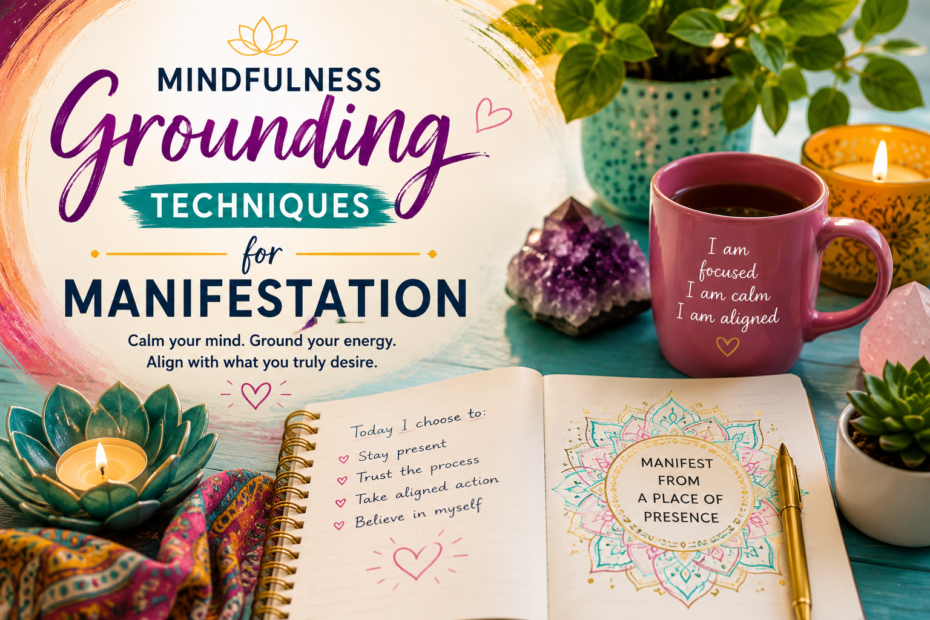
Mindfulness grounding techniques can make manifestation more useful by bringing your attention to the present before you visualise, script or set an intention. Pause, notice your breath or senses, name what you want, and choose one action within your control.
This approach does not guarantee a particular outcome or make thoughts control external events. Instead, it connects manifestation practices with clearer decisions, realistic action and your current circumstances. If manifestation is part of your spiritual beliefs, grounding can serve as preparation; if it is not, the same exercises can support reflection and goal-setting.
Start with the state behind your intention
A desire can be sincere while also carrying fear, comparison or urgency. Before deciding what to manifest, ask:
- What do I want, in plain language?
- What happened just before this desire felt urgent?
- Am I trying to move towards something meaningful or escape a difficult feeling?
- Which part of this situation is within my control?
- What would a values-based next step look like?
For example, “I need money immediately or I have failed” combines a practical concern with a judgement about worth. A steadier intention would be: “I want greater financial stability, and today I will review one expense, invoice or work opportunity.”
In this context, alignment does not mean receiving a supernatural confirmation. It means choosing an intention that fits your values, responsibilities and available evidence.
Use the 5-4-3-2-1 sensory practice

The 5-4-3-2-1 method shifts attention from an imagined future to details you can observe now. Before journalling, meditation or visualisation, identify:
- 5 things you can see
- 4 things you can physically feel
- 3 things you can hear
- 2 things you can smell
- 1 thing you can taste
If a sense is unavailable or difficult to use, substitute another observation. You could notice five colours, four points of contact with the chair or three changes in temperature.
Finish with: “I am noticing this moment. I can choose my next step.” Then write one sentence using this template:
“I am moving towards ______, and the action I can take today is ______.”
Anchor your intention with comfortable breathing
Breath counting gives the mind one simple task before intention-setting. Some people find a slightly longer exhale settling, but the breath should remain comfortable rather than forced.
- Sit or stand in a position that feels supported.
- Place a hand on your chest or stomach if touch helps you focus.
- Inhale gently for four counts.
- Exhale for up to six counts.
- Repeat for five rounds, or fewer if that is enough.
- Ask: “What do I want when I am not rushing myself?”
If counting feels uncomfortable or makes you light-headed, return to your natural breathing rhythm. The aim is attention, not completing a perfect pattern.
A practical intention might be: “I intend to improve my financial stability by making one clear decision this week.” It acknowledges the desire while pointing towards something you can do.
Pair a touch anchor with physical action
Touch is useful when manifestation feels abstract. Choose one sensation and examine its temperature, texture, pressure or weight:
- Press both feet into the floor.
- Hold a warm mug.
- Rub your hands together slowly.
- Wrap a blanket around your shoulders.
- Touch the surface of your desk or journal.
- Hold a stone or crystal.
While noticing the sensation, ask: “What can I physically do today that supports this intention?”
For a goal-to-action comparison:
| Intention | Grounded Action |
|---|---|
| I want more peace | Decline one unnecessary commitment |
| I want more abundance | Review one financial habit honestly |
| I want love | Communicate one need clearly |
| I want confidence | Take one small visible step |
| I want healing | Book support, rest, or create quiet time |
If you use a crystal, it can carry personal or spiritual symbolism. Its practical role in this exercise is to provide a specific object for mindful attention; it is not required to produce an external result.
Practise gratitude without denying difficulty
Gratitude does not require you to call a painful situation positive. A more honest version notices what is helping, names what you want and ends with an action.
- What is supporting me today? Write three concrete details, such as a quiet room, a useful conversation or a task you completed.
- What am I willing to receive? Name one form of support, rest, love, opportunity or practical help.
- What will I do next? Choose one step, such as sending an email, updating a budget or spending ten minutes on a creative project.
This format leaves room for mixed emotions. You can appreciate genuine support while still recognising disappointment, uncertainty or work that remains unfinished.
Separate your intention from outside pressure
People who identify as empaths or highly sensitive may be especially responsive to tone, conflict, visible emotion and other people’s expectations. That experience does not mean you have literally absorbed someone else’s energy. It may mean an interaction has influenced your mood or made another person’s priorities feel urgent.
Instead of asking whether a feeling was psychically transferred, try these questions:
- What did I observe, and what did I infer?
- Did I want this before the conversation or comparison?
- Whose approval am I seeking?
- Which expectation can I decline or reconsider?
- What choice still feels appropriate after a pause?
For example, if a relative presses you to make a career decision, you could say: “I hear that you are concerned. I am not ready to decide today, so I will review my options and reply tomorrow.”
If symbolic visualisation supports your spiritual practice, these energy shielding techniques for empaths can be used as prompts for attention and boundaries rather than proof that another person’s energy has entered your body.
Use nature as a sensory and symbolic pause

You do not need a remote natural setting. A tree, patch of sky, houseplant, breeze or view from a window can provide enough detail for this exercise.
- Choose one natural object or view.
- Notice one colour, one texture and one sound.
- Take three comfortable breaths.
- Ask: “What am I trying to rush?”
- Write one patient but practical response.
Seasonal growth can be a helpful spiritual metaphor: progress may be gradual and partly hidden. Use that metaphor to soften unnecessary pressure, not to ignore deadlines, financial realities or conversations that need attention.
Make a new moon reset optional and practical
In contemporary lunar spirituality, the new moon is often treated as a symbol of beginnings. The lunar phase does not determine whether an intention succeeds, but a recurring ritual can provide a memorable time to review priorities.
- Soften the room or light a candle if it is safe to do so.
- Use one sensory or breathing exercise.
- Write what you are ready to stop repeating.
- Name one intention for the coming period.
- Choose one small action and a realistic time to do it.
- Close by acknowledging one source of support.
For a longer optional sequence, use this New Moon Ritual for Beginners as a reflective ritual rather than a promise of a particular outcome.
Keep scripting connected to evidence
Scripting involves writing as though a desired change is unfolding. To prevent it from becoming fantasy without follow-through, include three parts:
- The feeling: describe how you hope to feel, such as prepared, supported or confident.
- The observable evidence: name what would show progress, such as updating a portfolio, keeping a boundary or completing an application.
- The action: state what you will practise today.
For example: “I feel increasingly prepared for meaningful work. I am improving my portfolio and applying for roles that fit my values. Today I will revise the opening paragraph of one application.”
A useful prompt is: “The version of me who is ready for this change practises ______ today.” Treat the answer as a planning prompt, not a prediction.
Train attention with one ordinary object
Choose a nearby object such as a pen, leaf, mug, ring or candle. Study it for about a minute, noticing its shape, colour, shadow, texture and small imperfections. Each time your attention drifts, return to one visible detail without criticising yourself.
At the end, write one intention and one related action. The purpose is not to empty your mind; it is to practise redirecting attention when it wanders.
Reset your space before reflective work
A busy environment can compete for your attention. Before journalling or visualising, make one small physical change rather than waiting for the whole room to be perfect:
- Clear one section of the desk.
- Put your phone out of reach.
- Wipe down one surface.
- Place your journal and pen where you will use them.
- Open a window where appropriate or adjust the lighting.
- Use calming music if it helps you concentrate.
Readers who prefer spiritual language may use these energy clearing home remedies as optional rituals. Their practical value can come from cleaning, organising and deliberately marking a transition into quiet reflection; they are not evidence that an unseen harmful force was present.
Use a body scan to explore receiving
In manifestation language, receiving can sound abstract. In daily life, it may mean accepting a compliment, allowing someone to help, considering an opportunity or resting without first earning it.
- Sit comfortably and soften your gaze or close your eyes.
- Notice your forehead and jaw without demanding that they relax.
- Observe your shoulders, hands and stomach.
- Feel where your body contacts the chair or floor.
- Take a comfortable breath towards an area of tension.
- Ask: “What form of support would I be willing to accept today?”
You might also journal about where receiving feels awkward and what boundary would make it easier. Tension does not prove that a desire is wrong, blocked or destined to arrive; it is simply information about your present experience.
Reduce a large desire to one next step

Trying to map an entire new career, relationship or routine at once can make a goal feel unmanageable. Ask: “What is the next honest step?”
A useful next step is usually:
- within your control;
- small enough to begin soon;
- consistent with your responsibilities and boundaries; and
- specific enough that you will know when it is complete.
Depending on the intention, that might mean writing the first paragraph, reviewing one account, asking one direct question, clearing one drawer or resting before making a significant decision. Once the step is complete, use what you learnt to choose the next one.
Combine a release ritual with review
Some lunar practitioners associate the full moon with illumination, gratitude or release. If that symbolism is meaningful to you, pair it with an honest review instead of treating the phase as a force that will remove a problem for you.
- Orient yourself with your senses or breath.
- Review what you actually did since setting the intention.
- Notice what helped and what interfered.
- Name one behaviour, expectation or commitment you want to release.
- Choose one adjustment for the next period.
This full moon ceremony for manifestation can provide a longer symbolic structure for that process.
Build a routine you can realistically repeat
You do not need every technique each day. Choose one short practice and connect it to an existing point in your routine.
Morning: orient and choose
Notice three sensory details, then write one intention and its smallest supporting action.
Midday: check the direction
Pause for a minute and ask whether your current activity supports the intention, needs adjusting or should be postponed.
Evening: review the evidence
Write three brief lines: what you noticed, what you did and what you will change tomorrow. This keeps the practice connected to experience rather than wishful certainty.
Judge the practice by observable usefulness

Signs that it is helping
- You can name what you are sensing in the present.
- Your intention becomes more specific.
- You pause before making an urgent decision.
- You distinguish facts from assumptions more easily.
- You complete a practical action.
- You spend less time compulsively looking for signs.
These changes indicate that the exercise is useful for attention and decision-making. They do not prove that the desired external outcome is on its way.
Common pitfalls
- Using calm as avoidance: finish the ritual by deciding whether a conversation, deadline or task needs action.
- Forcing positivity: name disappointment or fear without making it the only basis for your decision.
- Interpreting every sensation as a sign: a tight chest, wandering thought or coincidence can have ordinary explanations.
- Trying too many methods: repeat one simple technique long enough to learn whether it suits you.
- Waiting for a crisis: practising during an ordinary moment can make the sequence easier to remember when you are distressed.
Recover from emotional and sensory overload
If you are highly responsive to noise, social tension or other people’s moods, use a short check after demanding interactions:
- Name the observable facts: “The room was loud and the conversation became tense.”
- Name your interpretation: “I started assuming everyone was disappointed with me.”
- Name your immediate need: quiet, food, rest, information or distance from the conversation.
- Restate your own intention: choose what matters after the immediate stimulation has eased.
This approach respects empathic sensitivity without requiring the belief that emotions are physically transferred between people. If emotional overload is a recurring pattern, this guide to empath burnout offers further reflection on boundaries, rest and demanding environments.
Questions about grounding and manifestation
What are mindfulness grounding techniques?
They are exercises that direct attention to present sensory information, breathing, body sensations or the immediate environment. They can be used before spiritual rituals, journalling or practical planning.
Do these techniques make manifestation work?
They may make intention-setting clearer and help connect a desire with action. They cannot guarantee an outcome, control another person or establish that a spiritual interpretation is factually true.
What is the fastest technique?
There is no universal fastest method. The 5-4-3-2-1 sequence is easy to remember, while some people prefer pressing their feet into the floor or studying one object for a few breaths.
Should I use grounding before scripting?
It can help if scripting makes you feel pressured, distracted or detached from practical action. After writing, identify one piece of observable evidence and one next step.
Can it help when I feel anxious?
Grounding may help redirect attention to the present when anxious thoughts arise, but it will not resolve every cause of anxiety. If anxiety is persistent or affects daily functioning, seek support from a qualified mental health professional.
How often should I practise?
There is no required schedule. Start with one brief practice at a repeatable time, then adjust according to whether it is useful. More time is not automatically better.
Can I use a crystal?
Yes, if it is personally meaningful. Use its shape, temperature and weight as a focus for attention, with any spiritual meaning understood as belief or symbolism.
Do I need to believe in manifestation?
No. The exercises can also be used for mindfulness, reflective journalling and practical goal-setting without manifestation language.
Keep the intention connected to your life
A useful manifestation session ends with more than a desired feeling. It leaves you able to state what you want, recognise what is and is not within your control, and choose an action that fits your real circumstances.
Return to the senses when urgency takes over, revise the intention when new information appears, and let spiritual ritual support rather than replace practical judgement.
Optional lunar tracking resource
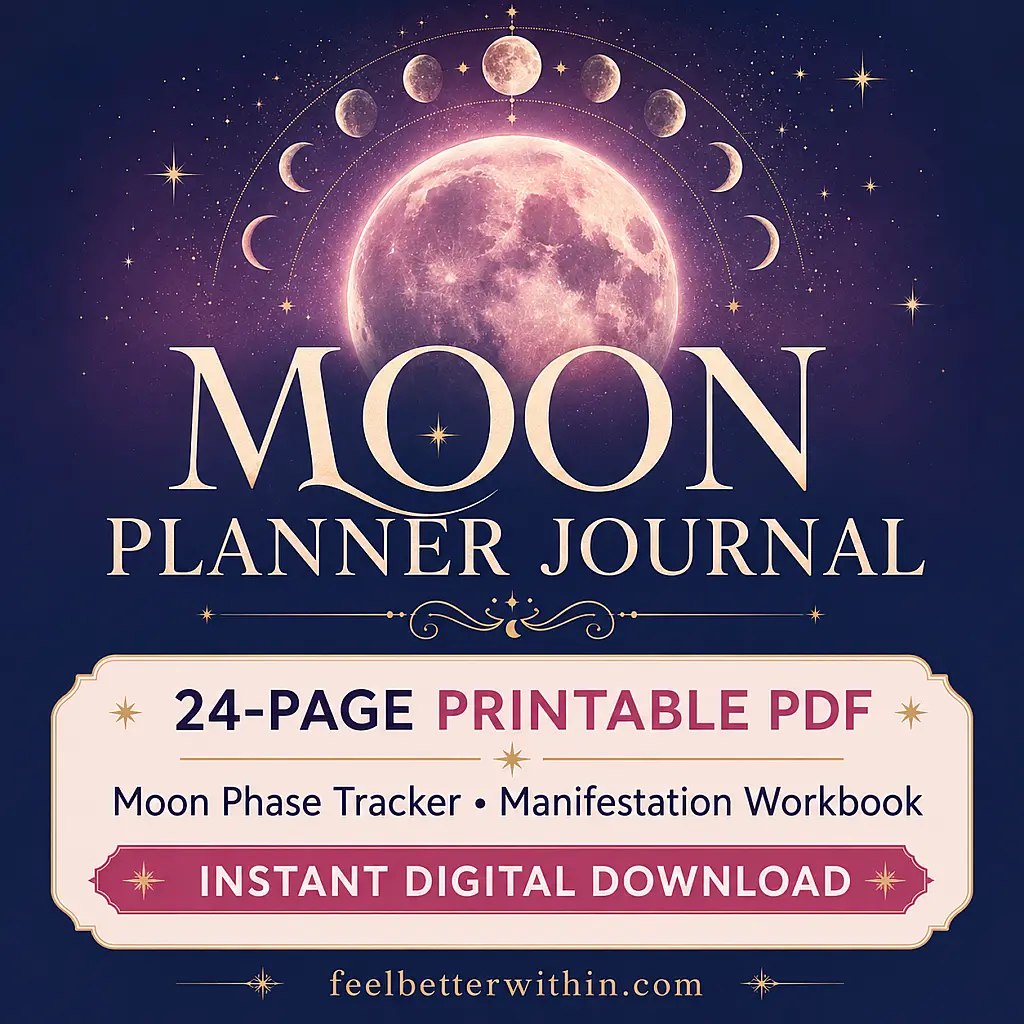
The Moon Planner Journal can be used to record lunar cycles alongside emotions, habits, intentions and self-care practices. Tracking is most useful when it helps you notice personal patterns without assuming the Moon caused every change.
If you want a structured place for those observations, explore the Moon Planner Journal.
Please note: Some resources may be paid products. Choose only tools that suit your needs, beliefs and budget.

Cite or share this page
Want to reference this guide? Please link to the canonical page rather than copying the article.