
The after-school emotional dump is a period of emotional release that happens when children return home after holding together their emotions, energy, and behaviour throughout the school day. It often shows up as tears, irritability, whining, frustration, or emotional overwhelm and is usually a sign of nervous system fatigue rather than bad behaviour.
For many parents, this can feel confusing.
Teachers may describe your child as polite, cooperative, and well-behaved. Then they walk through the front door and suddenly seem irritable, emotional, argumentative, or completely overwhelmed.
The good news is that this is often a normal nervous system response rather than a sign that something is wrong.
Children spend hours managing expectations, navigating friendships, following rules, processing sensory information, and regulating their emotions. Home is often the first place where they feel safe enough to let all of that go.
For empath parents, the experience can feel even more intense.
You don’t just hear the emotional release.
You feel it.
You absorb the frustration, mirror the energy, and sometimes carry the emotional weight of their day long after they have moved on.
The goal isn’t to stop the after-school emotional dump.
The goal is to create a healthy way for your child to release the day without it becoming an evening-long emotional storm for the entire family.
Why Children Hold Their Feelings In All Day
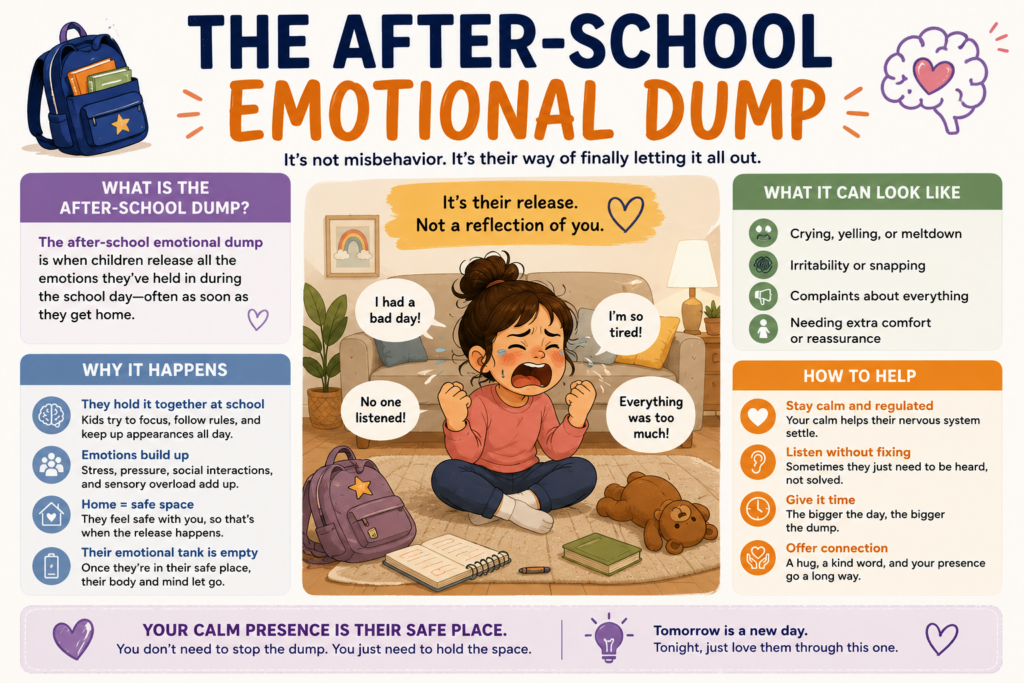
School requires children to manage far more than academics.
Throughout a typical day they are constantly navigating:
- Social expectations
- Friendships and peer relationships
- Group dynamics
- Noise and sensory stimulation
- Classroom rules
- Academic pressure
- Disappointment
- Frustration
- Transitions between activities
Even children who appear calm and confident may be working hard internally to regulate themselves.
Many children simply do not have the emotional capacity to process everything in real time.
Instead, they focus on getting through the day.
The emotional processing happens later.
For most children, home is where they finally feel safe enough to let their guard down.
This is why the after-school emotional dump can be so confusing for parents.
A child may appear completely fine at school, receive positive feedback from teachers, and then burst into tears because the wrong snack was offered at home.
The reaction is rarely about the snack.
It is often the release of everything that happened before they walked through the door.
The Nervous System Side of the After-School Emotional Dump
When children are at school, their nervous systems are constantly working.
They are:
- Listening and learning
- Following instructions
- Managing friendships
- Processing sensory input
- Adapting to different situations
- Regulating emotions
- Navigating social dynamics
Even positive experiences require energy.
By the end of the day, many children have very little emotional bandwidth left.
The after-school emotional dump is often less about what happened and more about accumulated nervous system fatigue.
This is why a child can seem completely fine all day and then become upset over something that appears small or unrelated once they get home.
Their emotional tank is already empty.
Understanding this can help parents stop viewing the behaviour as intentional misbehaviour and start viewing it as a sign that the child needs regulation, recovery, and connection.
For empath parents, this shift in perspective can be incredibly helpful.
Instead of asking:
“Why are they acting like this?”
You begin asking:
“What might their nervous system need right now?”
That question often leads to much more effective responses.
Why Kids Often Save Their Biggest Emotions for Home
Many parents secretly wonder:
“Why does my child behave better at school than at home?”
The answer is surprisingly simple.
Children tend to release their biggest emotions around the people they trust most.
Throughout the school day, children are constantly adapting to expectations, social situations, routines, and sensory input. This requires a significant amount of self-control and emotional regulation.
When they return home, that effort is no longer needed in the same way.
The emotions they have been managing throughout the day often rise to the surface.
That release may show up as:
- Tears
- Irritability
- Complaining
- Hyperactivity
- Clinginess
- Anger
- Emotional overwhelm
As frustrating as it can be, the after-school emotional dump is often a sign of trust rather than rejection.
Why the After-School Emotional Dump Can Change With Age
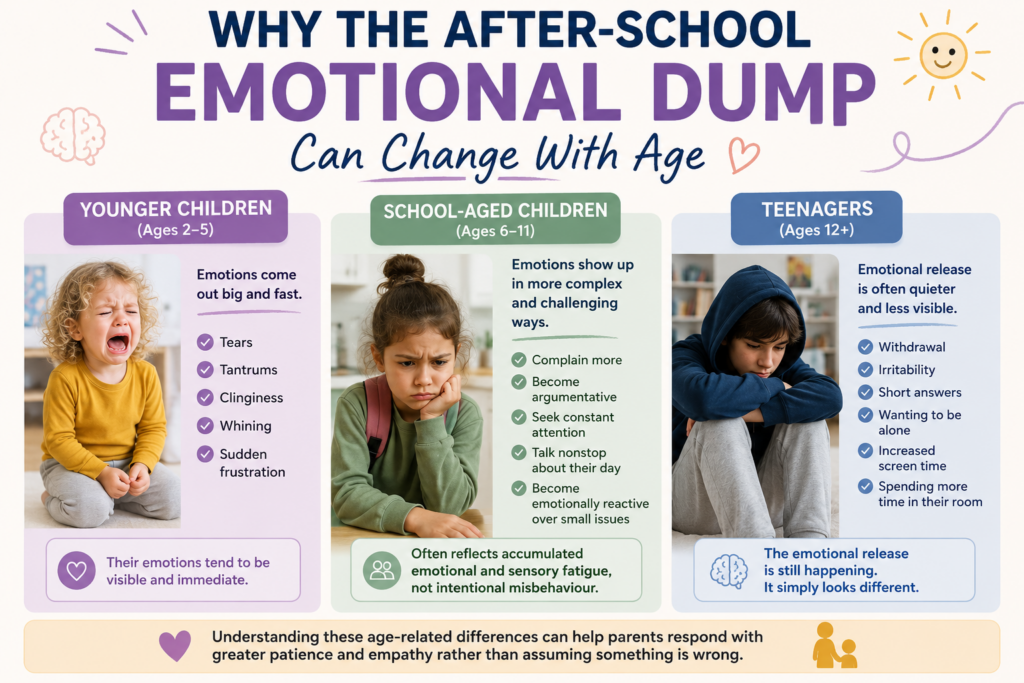
The after-school emotional dump does not always look the same.
As children grow, the way they release stress and process emotions often changes.
Younger Children
Younger children are more likely to release emotions through:
- Tears
- Tantrums
- Clinginess
- Whining
- Sudden frustration
Their emotions tend to be visible and immediate.
School-Aged Children
Children in primary school may:
- Complain more
- Become argumentative
- Seek constant attention
- Talk nonstop about their day
- Become emotionally reactive over small issues
This often reflects accumulated emotional and sensory fatigue rather than intentional misbehaviour.
Teenagers
Teenagers often express after-school stress differently.
You may notice:
- Withdrawal
- Irritability
- Short answers
- Wanting to be alone
- Increased screen time
- Spending more time in their room
The emotional release is still happening.
It simply looks different.
Understanding these age-related differences can help parents respond with greater patience and empathy rather than assuming something is wrong.
Why Empath Parents Feel the After-School Dump So Deeply
Parents naturally care about their children’s emotions.
Empath parents often experience something more.
They absorb them.
Their Mask Comes Off at Home
Your child has likely spent all day managing themselves.
Home is where the mask comes off.
The emotions you’ve been spared all day suddenly arrive at once.
You’re Doing Double Processing
Most empath parents process:
- What their child says
- What their child feels
- What is happening underneath the words
- Their own emotional response
At the same time.
That is a huge amount of emotional data.
Your Nervous System Is Already Loaded
Pickup time often happens after:
- Work
- Household responsibilities
- Mental fatigue
- Decision-making
- Sensory overload
You may already be running on low emotional bandwidth before your child even gets into the car.
Helper Wiring Creates Fixer Mode
Many empaths grew up learning to manage other people’s emotions.
As adults, this can create a strong urge to:
- Fix
- Rescue
- Solve
- Absorb
Instead of simply supporting.
This is one reason emotional exhaustion builds so quickly.
If emotional overload has become a regular part of parenting, you may also benefit from reading Empath Burnout: Signs, Causes and Recovery.
What Emotional Absorption Looks Like in Daily Life
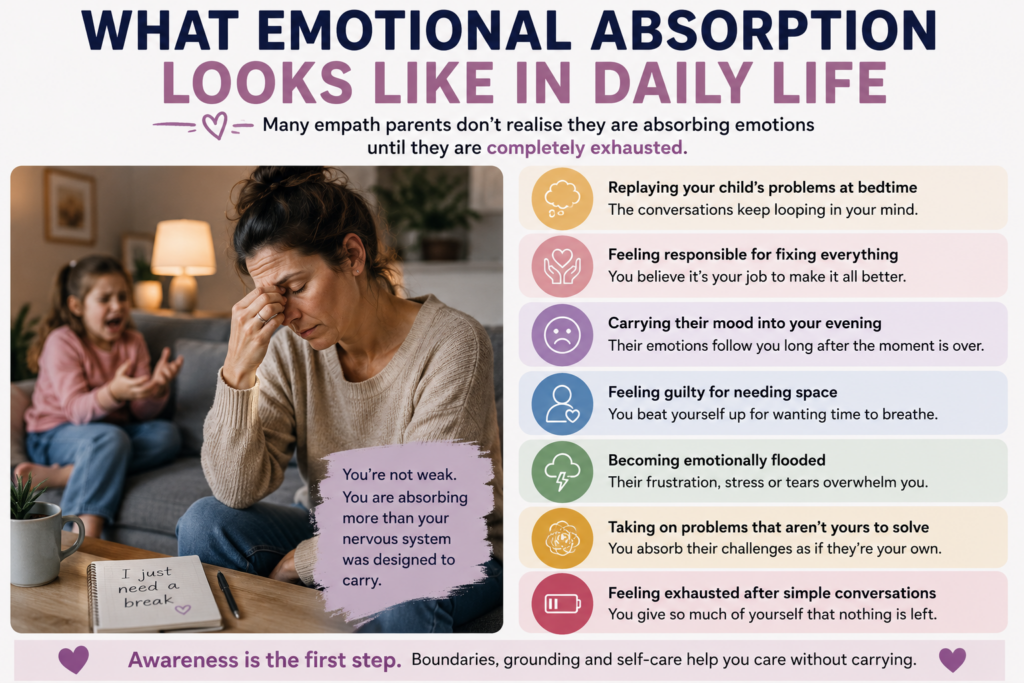
Many empath parents don’t realise they are absorbing emotions until they are completely exhausted.
Emotional absorption often looks like:
- Replaying your child’s problems at bedtime
- Feeling responsible for fixing everything
- Carrying their mood into your evening
- Feeling guilty for needing space
- Becoming emotionally flooded by their frustration
- Taking on problems that are not yours to solve
- Feeling exhausted after simple conversations
You are not only responding to your child’s emotions.
You are processing them inside your own nervous system.
What the After-School Emotional Dump Can Look Like in Real Life
Every child releases stress differently.
This is one reason the after-school emotional dump can be difficult to recognise.
Child A: The Unexpected Meltdown
A child is quiet during pickup.
Everything seems fine.
Then they burst into tears because the wrong cup was used at home.
The cup is rarely the real issue.
More often, it is the final straw after a long day of emotional regulation.
Child B: The Nonstop Talker
Another child talks continuously from pickup until bedtime.
Every detail of the day needs to be processed out loud.
They are not seeking attention.
They are trying to make sense of everything they experienced.
Child C: The Argument Starter
Some children pick fights with siblings or become oppositional shortly after arriving home.
What looks like defiance is often overstimulation, fatigue, or emotional overload.
The behaviour may differ, but the underlying need is often the same:
Safety, regulation, and decompression.
Signs the After-School Dump Is Draining You
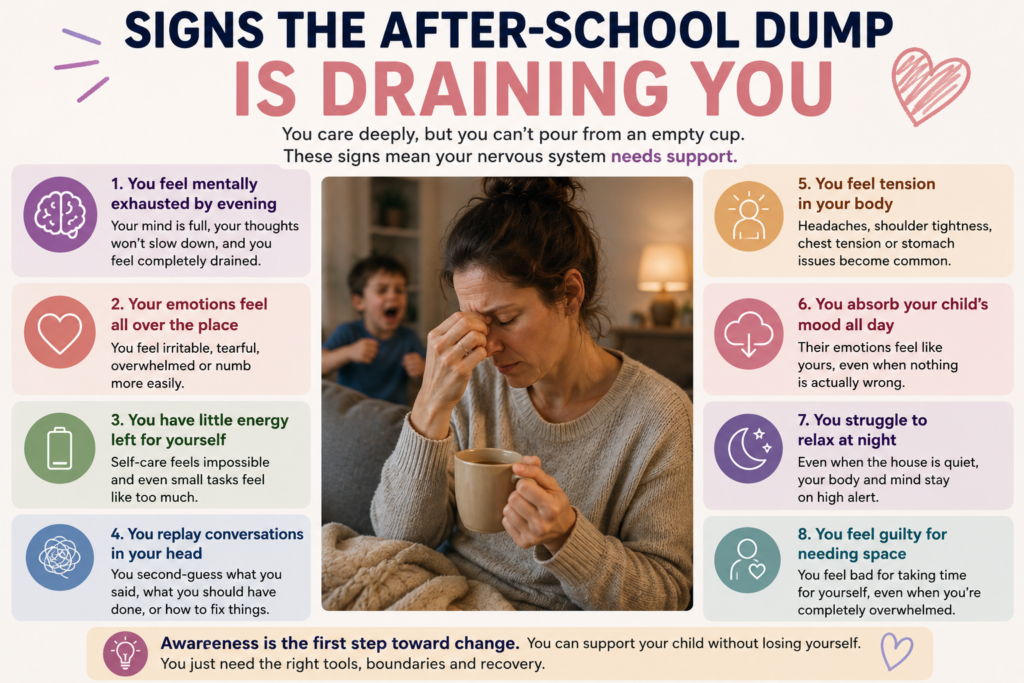
The after-school emotional dump can gradually wear down even the most caring parent.
Common signs include:
- Tensing up before pickup
- Feeling emotionally braced for impact
- Irritability at small noises or interruptions
- Difficulty relaxing after school
- Constant mental replaying of conversations
- Emotional exhaustion by bedtime
- Feeling emotionally responsible for everyone’s mood
- Wanting to hide, scroll, snack, or zone out
These are not signs that you are a bad parent.
They are signs that your nervous system needs support too.
The Difference Between an Emotional Dump and a Red Flag
Most after-school emotional dumping is completely normal.
However, there are times when additional support may be helpful.
Usually Normal
- Complaining after school
- Emotional release
- Irritability
- Tiredness
- Wanting connection
- Needing quiet time
May Need Extra Support
- Daily extreme meltdowns
- School refusal
- Ongoing anxiety
- Withdrawal from friends
- Significant changes in sleep
- Harsh self-talk
- Persistent sadness
- Frequent panic or overwhelm
Trust your instincts.
If something feels consistently different, speak with a teacher, GP, counsellor, or qualified professional.
Why Some Children Need Quiet Before They Need Conversation
Many parents naturally ask questions the moment their child gets in the car.
- How was your day?
- What happened at school?
- Did anything exciting happen?
- Who did you play with?
For some children, these questions arrive too soon.
After spending hours listening, learning, socialising, and regulating emotions, many children need a brief period of recovery before they are ready to talk.
This recovery period may look like:
- Eating a snack
- Sitting quietly
- Drawing
- Reading
- Listening to music
- Moving their body
- Spending time outdoors
Some children process emotions through conversation.
Others process through quiet.
Neither approach is wrong.
The goal is to meet your child where they are rather than forcing them into a conversation before they are ready.
The 10-Minute Reset for Empath Parents
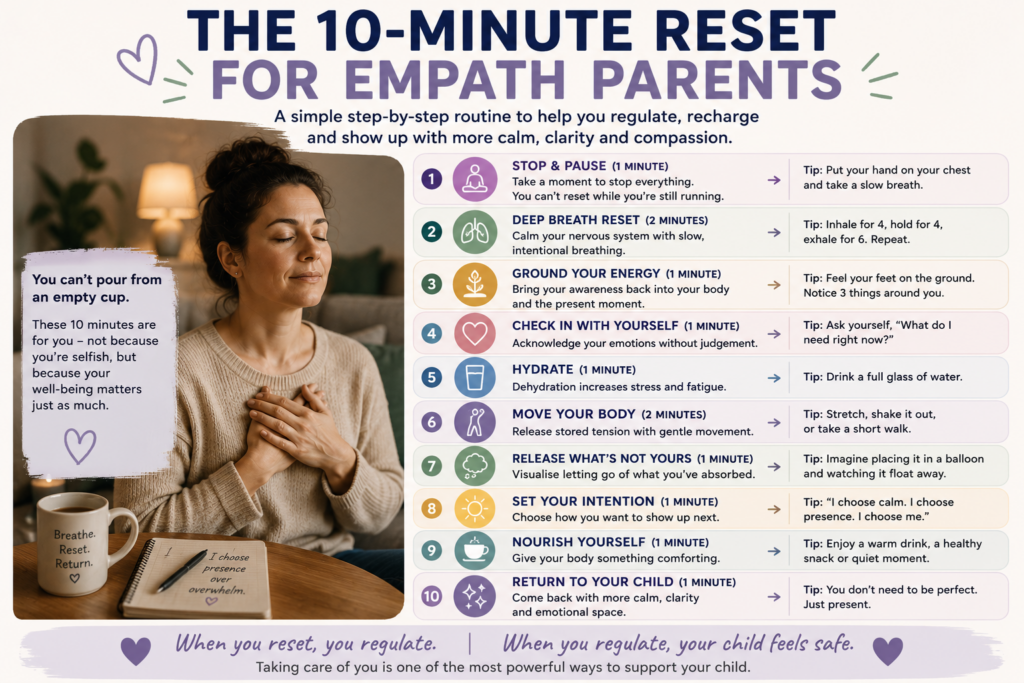
The goal is simple:
Help your child release the day without absorbing it yourself.
Minute 1: Create a Transition Boundary
Before the full emotional download begins, create a pause.
Try:
“Welcome home. Let’s reset first, then you can tell me everything.”
This small moment signals safety and transition.
Minute 2: Water and Snack
Emotions often feel bigger when children are tired, thirsty, or hungry.
Start with nervous system first aid:
- Water
- Fruit
- Protein
- Simple snacks
Minutes 3–4: Shake Off the Day
Make it playful.
Try:
- Shaking arms and legs
- Silly dancing
- Stomping like dinosaurs
- Jumping on the spot
Movement helps discharge stress.
Minutes 5–6: Use Your Parent Filter
Protect your own nervous system.
Try:
- Feet on the floor
- Three slow breaths
- Relaxing your shoulders
- Softening your jaw
Silently repeat:
“I can care without carrying.”
If you need additional grounding support, read Mindfulness Grounding Techniques for Manifestation.
Minutes 7–8: Talk in Chapters
Instead of letting the conversation become overwhelming, create structure.
Ask:
“What was the best part of your day?”
“What was the hardest part?”
“What do you want to be different tomorrow?”
This encourages reflection without emotional flooding.
Minutes 9–10: Close the Loop
Help signal that school is over.
Try:
- Washing hands
- Changing clothes
- Fresh air
- Putting away school bags
The goal is helping the day end rather than dragging it into the evening.
What to Say When You’re Starting to Absorb Their Emotions
Try:
“I’m listening. Let’s slow down so I can hear you properly.”
“I care about this. I’m just taking a breath first.”
“That sounds really frustrating. What would help tomorrow?”
“Let’s take thirty seconds of quiet together.”
These responses support your child while helping you stay regulated.
Common Mistakes Parents Make After School
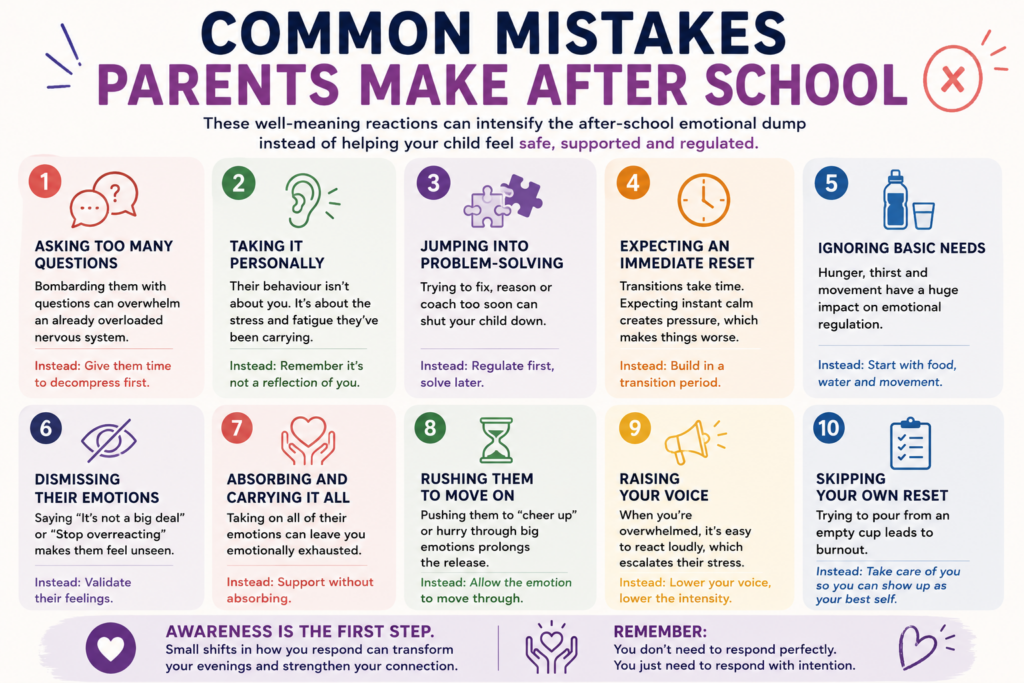
The after-school period is often one of the most emotionally charged parts of the day.
When parents are tired and children are overwhelmed, small habits can accidentally make things harder.
Try to avoid:
Asking Too Many Questions Immediately
Children often need decompression before discussion.
Jumping Into Problem-Solving Mode
Sometimes children need to feel heard before they need solutions.
Taking the Behaviour Personally
The emotional dump is usually about accumulated stress rather than anything you have done wrong.
Over-Scheduling Afternoons
Children who move directly from school to activities without downtime often have fewer opportunities to regulate.
Talking Children Out of Their Feelings
Phrases such as:
“It’s not a big deal.”
“You’re fine.”
“Don’t worry about it.”
can unintentionally shut down emotional processing.
Instead, focus on creating safety, structure, and support.
How to Prevent Daily Emotional Burnout
Create a Pickup Ritual
One breath.
One intention.
“Only what is mine stays with me.”
Build a Predictable Decompression Routine
A simple rhythm might look like:
- Snack
- Water
- Quiet activity
- Connection time
- Homework or dinner
Children thrive on predictability.
So do empaths.
Share the Load
You do not need to carry every emotional moment alone.
If possible, rotate responsibilities with another supportive adult.
Prioritize Your Own Recovery
Many empath parents focus entirely on their children’s needs.
Your nervous system matters too.
Why Empath Parents Need a Recovery Routine Too
Many parents focus entirely on helping their children recover from the day.
Very few stop to ask:
“Who helps the parent recover?”
Empath parents often spend so much time supporting others that they forget their own nervous systems require care too.
Even five minutes of intentional recovery can make a difference.
Consider:
- Sitting outside in silence
- Deep breathing
- Gentle stretching
- Journaling
- Drinking tea without distractions
- Grounding exercises
Recovery does not need to be complicated.
The goal is simply to give your nervous system a chance to reset before carrying the next part of the day.
If you often feel completely depleted by evening, read:
👉 Empath Grounding Rituals: Why You Feel Wiped Out and How to Get Your Energy Back
When the After-School Dump May Need Additional Support
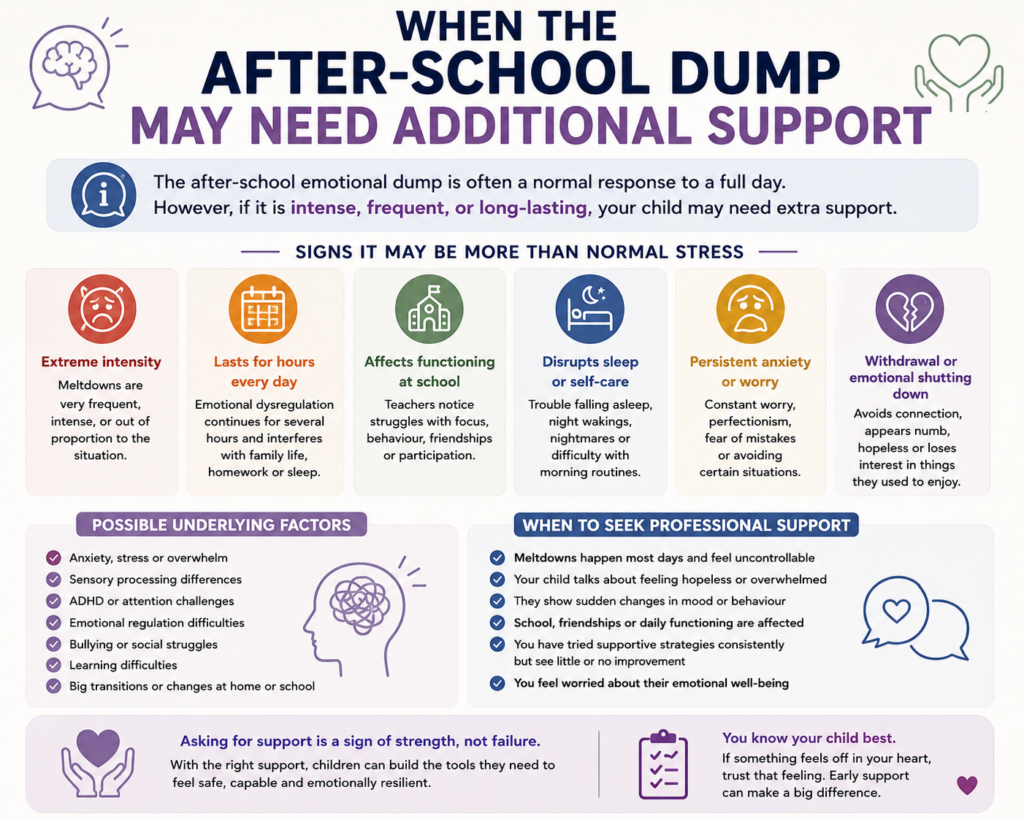
Pay attention if:
- Meltdowns happen daily for weeks
- Anxiety seems constant
- Sleep changes significantly
- School refusal develops
- Self-esteem drops noticeably
- Your child appears persistently withdrawn
Early support is often easier than waiting for things to escalate.
Frequently Asked Questions
Why does my child melt down after school?
Because they have spent the entire day regulating emotions, managing expectations, processing sensory input, and navigating social situations. Home often becomes the place where they can finally release the stress and fatigue they have been carrying.
Why do empath parents feel drained after school?
Empath parents often absorb emotional energy, process emotional information deeply, and feel responsible for helping everyone regulate. Over time, this can become emotionally exhausting without healthy boundaries and recovery practices.
What is the fastest after-school reset?
Pause, offer food and water, encourage movement, regulate yourself first, then create structured conversation. Even a simple 10-minute transition can help prevent emotional overwhelm from escalating.
Why does my child behave better at school than at home?
Children often release their strongest emotions around the people they trust most. School requires self-control and emotional regulation. Home provides an environment where they feel safe enough to let their guard down.
Is the after-school emotional dump normal?
Yes.
Many children release emotions at home because it feels safe. After spending hours managing expectations, social interactions, and sensory stimulation, home often becomes the place where they can finally relax and decompress.
How long does the after-school emotional dump last?
It varies from child to child.
Many children begin settling within 10 to 30 minutes when given food, hydration, movement, and emotional space. Others may need longer depending on their temperament, age, and what happened during the day.
Can highly sensitive children experience stronger after-school emotional dumps?
Yes.
Highly sensitive children often process emotions, sensory information, and social interactions more deeply than their peers. As a result, they may become overwhelmed more easily and require additional recovery time after school before they feel regulated again.
Struggling With More Than Just the School Run?
If you constantly feel emotionally drained, absorb other people’s stress, or end each day exhausted, the after-school emotional dump may be only one part of a larger pattern.
Helpful next reads:
👉 How to Stop Absorbing Your Child’s Emotions
👉 Empath Burnout: Signs, Causes and Recovery
👉 Why Empath Parents Feel Wrecked After Kids Sleep
👉 Empath Parent Burnout Isn’t Laziness: The 7 Leaks Draining You Daily
Together, these resources can help you better understand the connection between emotional absorption, burnout, boundaries, and nervous system regulation.
Helpful Resource for Empath Parents
🌙 Moon Planner Journal

Many empath parents use the Moon Planner Journal to track:
- Emotional triggers
- Energy levels
- Parenting challenges
- Monthly patterns
- Self-care habits
Understanding your own emotional rhythms often makes it easier to support your child’s emotional needs without becoming overwhelmed yourself.
Final Thoughts
The after-school emotional dump is not usually a sign that something is wrong.
More often, it is a sign that your child finally feels safe enough to stop holding everything in.
The challenge for empath parents is learning how to support that release without carrying it.
You can listen without absorbing.
You can care without fixing.
You can support your child without sacrificing your own emotional well-being.
The goal is not to stop the after-school emotional dump entirely.
The goal is to create a rhythm that helps both of you move through it with greater calm, awareness, and resilience.
Remember, your child’s emotional release is not a sign that you’re doing something wrong.
In many cases, it is a sign that they trust you enough to stop carrying everything alone.
If emotional overload has become a daily pattern in your home, your next step is understanding where your own energy is leaking.
👉 Read: Empath Parent Burnout Isn’t Laziness: The 7 Leaks Draining You Daily
feelbetterwithin.com participates in the Amazon Services LLC Associates Program, an affiliate advertising program designed to provide a means for sites to earn advertising fees by advertising and linking to Amazon.com and other affiliate programs.