

A spiritual bedtime routine is a collection of intentional practices that help you release the day, calm your mind, process emotions, and create a sense of peace before sleep. Unlike traditional nighttime routines that focus only on physical habits, a spiritual bedtime routine supports your emotional, mental, and inner well-being.
Many people arrive at bedtime physically exhausted but mentally wide awake. Their body is ready for sleep. Their mind is not. Thoughts replay conversations. Worries about tomorrow begin to surface.
Unfinished emotions demand attention. As a result, falling asleep can feel far more difficult than it should.
A spiritual bedtime routine creates space to slow down before your head reaches the pillow. Instead of carrying the entire day into bed with you, you intentionally create a transition between activity and rest.
The goal is not perfection. The goal is peace.
Why Some People Feel Tired but Can’t Sleep

One of the most frustrating experiences is feeling exhausted while still struggling to fall asleep.
Many people assume this is simply a sleep problem.
Often, it is much more than that.
Mental exhaustion does not automatically lead to rest.
In fact, when the mind becomes overstimulated, sleep can become even harder.
Common causes include:
- Emotional overload
- Chronic stress
- Overthinking
- Information overload
- Unresolved worries
- Constant digital stimulation
For some people, anxiety also plays a role. Racing thoughts and future-focused worries can keep the mind active long after the body is ready to rest.
If anxiety regularly affects your evenings, you may also find value in understanding the deeper connection between emotions and inner awareness through our article on Anxiety Spiritual Meaning.
Your Mind Isn’t the Only Thing Awake at Night
Most sleep advice focuses on the brain.
However, many people are also carrying emotional weight into bed.
Think about your day.
Perhaps you absorbed tension from work.
Maybe you worried about a loved one.
Perhaps you ignored difficult feelings because you were too busy to process them.
When bedtime finally arrives, those emotions often reappear.
For highly sensitive people and empaths, this experience can feel even more intense.
Many find themselves carrying emotional energy that does not belong to them.
The result can be mental restlessness, emotional heaviness, and difficulty relaxing.
This is one reason a spiritual bedtime routine can feel so powerful.
It provides an opportunity to consciously release what you no longer need to carry.
Feeling emotionally drained by other people’s energy?
Read Empath Burnout: Signs, Causes and Recovery to understand why emotional overload can follow you into the night.
What Makes a Spiritual Bedtime Routine Different?
Traditional bedtime routines often focus on practical habits such as:
- Brushing your teeth
- Turning off electronics
- Adjusting room temperature
- Following a consistent sleep schedule
These habits are valuable and can support healthy sleep.
A spiritual bedtime routine adds another layer.
It focuses on preparing your inner world for rest, not just your physical environment.
Instead of simply putting your body to bed, you also help your:
- Mind
- Emotions
- Nervous system
- Energy
- Awareness
begin to settle.
This creates a deeper sense of calm that supports more restful sleep.
A Shift From Doing to Being
Many people spend the entire day doing.
Working.
Solving problems.
Responding to messages.
Meeting responsibilities.
By the time evening arrives, the body may be tired, but the mind is still operating at full speed.
A spiritual bedtime routine creates an intentional pause.
Rather than filling every moment with activity, it encourages you to slow down, reflect, and reconnect with yourself.
It Helps You Process the Day
Most of us carry more into bed than we realise.
Unfinished thoughts.
Stress.
Worries.
Conversations that are still replaying in our minds.
A spiritual bedtime routine creates space to acknowledge these experiences rather than taking them into sleep unconsciously.
Simple practices such as journaling, gratitude, mindfulness, or quiet reflection can help bring a sense of closure to the day.
It Creates a Sense of Inner Safety
Sleep is often easier when the mind and body feel safe enough to let go.
When we remain overstimulated, anxious, or emotionally activated, the nervous system may struggle to relax.
A spiritual bedtime routine sends a gentle message that the day is complete and it is okay to rest.
For many people, this feeling of inner safety becomes one of the most valuable benefits of the practice.
Rather than viewing sleep as something to achieve, a spiritual bedtime routine helps create the conditions that allow rest to happen naturally.
9 Spiritual Bedtime Routine Rituals for Better Sleep
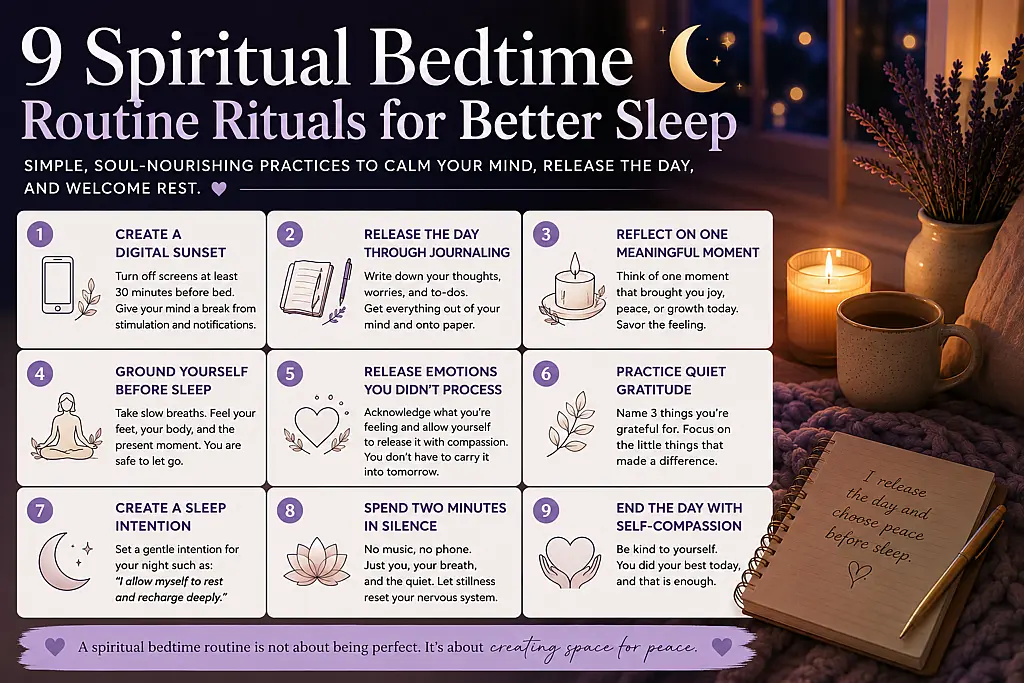
1. Create a Digital Sunset
One of the simplest ways to improve a spiritual bedtime routine is to reduce stimulation before bed.
Many people scroll until the moment they attempt to sleep.
The mind remains engaged long after the screen is switched off.
Try creating a digital sunset.
Turn off phones, tablets, and television at least 30 minutes before bedtime.
Use this time to reconnect with yourself instead.
2. Release the Day Through Journaling
Journaling can act as a bridge between the busyness of the day and the quietness of the evening.
Rather than carrying every thought into bed, place those thoughts onto paper.
You might write:
- What happened today
- What is on your mind
- What you need to let go of
- What you learned
This simple practice often creates surprising mental clarity.
3. Reflect on One Meaningful Moment
Gratitude practices are helpful.
However, many people rush through them.
Instead, choose one meaningful moment from your day.
Ask yourself:
- Why did this moment matter?
- What did it teach me?
- How did it make me feel?
This creates a deeper sense of appreciation and presence.
4. Ground Yourself Before Sleep
Grounding is often associated with daytime stress management, but it can also strengthen a spiritual bedtime routine.
A simple exercise:
- Sit comfortably
- Take slow breaths
- Feel your feet touching the floor
- Notice physical sensations in your body
- Bring your attention to the present moment
Grounding reminds the nervous system that it is safe to relax.
5. Release Emotions You Didn’t Process
Many people go to sleep carrying emotions that were never acknowledged.
Ask yourself:
- What am I feeling right now?
- What happened today that affected me?
- What do I need to release?
Simply recognising an emotion often reduces its intensity.
You do not need to solve everything before bed.
You simply need to acknowledge what is there.
6. Practice Quiet Gratitude
A spiritual bedtime routine does not need to be complicated.
Take a moment to reflect on:
- One thing that brought you peace
- One thing you appreciate
- One thing that went better than expected
Small moments often create the biggest shift.
7. Create a Sleep Intention
Rather than focusing on sleep itself, create an intention.
Examples:
- Tonight I allow myself to rest.
- I release today’s worries.
- I trust tomorrow can wait.
- I am safe to relax.
Intentions create a sense of permission rather than pressure.
8. Spend Two Minutes in Silence
Silence has become rare.
Most people move from noise throughout the day directly into sleep.
Spend two minutes sitting quietly.
No phone.
No music.
No distractions.
Just stillness.
Many people discover this becomes the most valuable part of their spiritual bedtime routine.
9. End the Day With Self-Compassion
Before sleep, ask yourself:
What would I say to a friend who had the same day I just had?
Then offer those words to yourself.
Many people are far kinder to others than they are to themselves.
Ending the day with self-compassion creates emotional softness rather than self-judgment.
A 5-Minute Spiritual Bedtime Routine for Busy Nights
Not every evening allows for a long self-care ritual.
Some nights are busy, stressful, or simply exhausting.
The good news is that a spiritual bedtime routine does not need to take an hour to be effective.
If you’re short on time, try this simple 5-minute routine before bed.
Minute 1: Take Slow, Deep Breaths
Close your eyes and focus on your breathing.
Slowly inhale through your nose and exhale through your mouth.
Allow your shoulders to soften and your body to relax.
This simple practice helps signal to your nervous system that it is safe to slow down.
Minute 2: Write Down What’s On Your Mind
Grab a notebook and write down any worries, tasks, or thoughts that keep circling in your head.
You do not need to solve them.
Simply getting them onto paper can help create mental space.
Minute 3: Reflect on One Positive Moment
Think about one moment from your day that made you smile, brought you peace, or taught you something valuable.
It doesn’t need to be extraordinary.
Small moments often have the greatest impact.
Minute 4: Set a Sleep Intention
Choose a simple intention for the night ahead.
Examples include:
- Tonight I allow myself to rest.
- I release what I cannot control.
- My mind and body are ready for sleep.
- I welcome peace and relaxation.
Intentions help shift your focus away from stress and toward rest.
Minute 5: Sit Quietly in Stillness
Spend the final minute doing nothing.
No phone.
No television.
No distractions.
Simply sit with yourself and allow the day to come to a close.
This brief moment of stillness can create a surprising sense of calm before sleep.
Remember, a spiritual bedtime routine is not about perfection. Even five intentional minutes can help you feel more grounded, relaxed, and ready to rest.
Common Mistakes That Make Sleep Harder
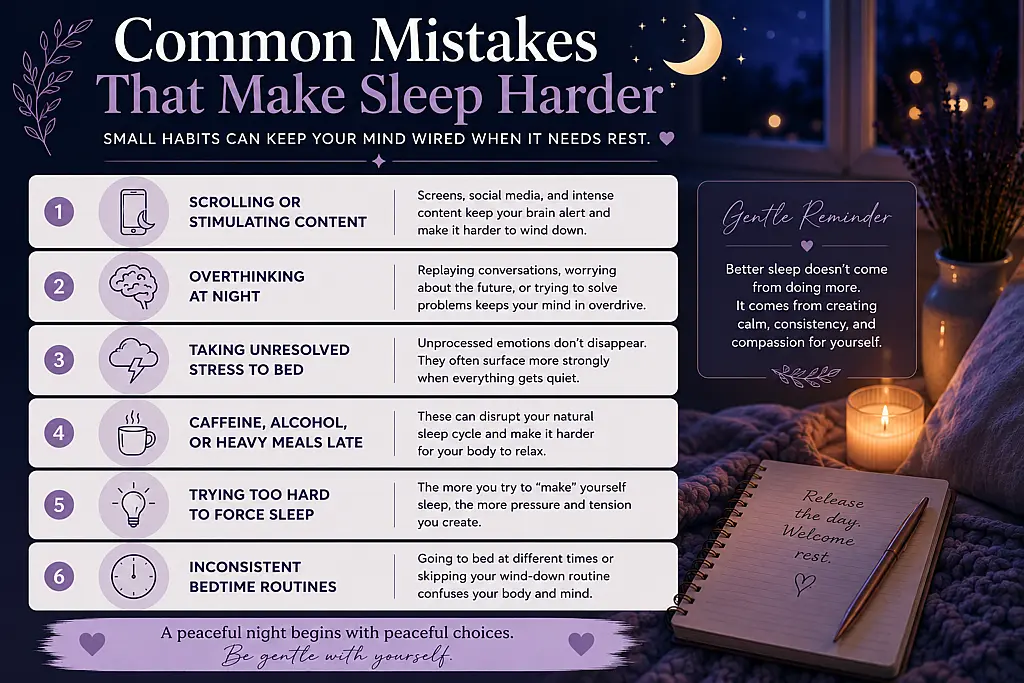
Many people focus on what they should do to improve sleep but overlook the habits that may be making rest more difficult in the first place.
Even small choices during the evening can influence how easily your mind and body settle down for the night.
Consuming Emotional Content Before Bed
News updates, social media debates, crime documentaries, and emotionally charged conversations can leave your nervous system feeling activated.
Although you may stop watching or scrolling, your mind often continues processing what you have seen long after you get into bed.
A spiritual bedtime routine creates space for calmer, more intentional input before sleep.
Trying to Force Sleep
The harder you try to make yourself sleep, the more pressure you create.
Sleep responds best to relaxation, not control.
Instead of focusing on whether you are asleep yet, focus on creating a peaceful environment and allowing rest to happen naturally.
Ignoring Emotional Stress
Many people spend the entire day pushing their emotions aside.
When everything becomes quiet at night, those feelings often return.
Unprocessed stress, sadness, frustration, or worry can keep the mind active.
Taking a few moments to acknowledge your emotions before bed can help create a sense of release.
Moving Directly From Screens to Sleep
Modern life rarely gives us time to slow down.
Many people go from answering emails, watching videos, or scrolling social media straight into bed.
This leaves little opportunity for mental decompression.
Even ten minutes of quiet reflection can help create a healthier transition into sleep.
Carrying Tomorrow Into Tonight
Planning and preparing for the future is important.
However, bedtime is not the best time to solve tomorrow’s problems.
If your mind constantly jumps ahead, try writing down your thoughts and reminding yourself that tomorrow will still be there in the morning.
Expecting Every Night to Be Perfect
Not every night will be the same.
Stressful periods, life changes, and emotional challenges can affect sleep from time to time.
One restless night does not mean your routine is failing.
A spiritual bedtime routine is not about perfection. It is about creating consistency, self-awareness, and a sense of calm that supports better rest over time.
Why Better Sleep Begins Before You Get Into Bed
One of the biggest misconceptions about sleep is that it begins when your head touches the pillow.
In reality, sleep often begins much earlier.
The final hour of your day has a powerful influence on how easily your mind and body transition into rest.
During this time, your nervous system is responding to everything you experience.
Your thoughts, emotions, habits, and environment all help shape whether your body prepares for relaxation or remains in a state of alertness.
This is why what you do before bed matters so much.
If the final hour of your evening is filled with stress, endless scrolling, work emails, or emotional stimulation, your mind may still be processing those experiences long after the lights go out.
On the other hand, when you intentionally create space for reflection, stillness, and relaxation, you send a different message to your body.
You are telling yourself that the day is coming to an end.
You are creating a bridge between activity and rest.
A spiritual bedtime routine works because it helps guide that transition.
Rather than expecting sleep to happen instantly, you begin preparing for it.
You release mental clutter.
You acknowledge your emotions.
You slow your breathing.
You step away from constant stimulation.
Over time, these small actions can make it easier to relax, unwind, and welcome sleep naturally.
Instead of fighting for sleep, you create the conditions that allow sleep to happen.
For many people, this simple shift in perspective changes everything.
The goal is not to make yourself sleep.
The goal is to create an environment where rest feels safe, natural, and supported.
Many people begin a spiritual bedtime routine with one goal in mind: better sleep.

While improved sleep is often one of the first benefits people notice, many discover that the positive effects extend far beyond the bedroom.
This is because a spiritual bedtime routine is not simply about preparing for sleep. It is also about creating a daily opportunity to slow down, reconnect with yourself, and process the experiences of the day.
Over time, this small habit can influence many areas of your emotional and mental well-being.
Greater Emotional Awareness
When life feels busy, it is easy to ignore your emotions and move from one task to the next.
A spiritual bedtime routine creates a quiet moment to check in with yourself.
As a result, many people become more aware of their thoughts, feelings, and emotional patterns, helping them respond with greater understanding rather than reacting on autopilot.
Reduced Overwhelm
Mental clutter often builds throughout the day.
Unfinished tasks, worries, responsibilities, and constant information can leave the mind feeling overloaded.
By creating space to reflect and release these thoughts before bed, many people experience a greater sense of calm and mental clarity.
Improved Mindfulness
A spiritual bedtime routine encourages you to be present rather than constantly thinking about the future or replaying the past.
Practices such as journaling, gratitude, deep breathing, and reflection help bring your attention back to the current moment.
Over time, this awareness often carries into daily life.
Better Stress Management
Stress does not disappear simply because the day is over.
However, learning to acknowledge and process stress before sleep can help prevent it from building up over time.
Many people find they feel more emotionally balanced and resilient when they regularly create space to unwind and reflect.
Increased Self-Compassion
For many of us, the harshest voice we hear is our own.
A spiritual bedtime routine offers an opportunity to replace self-criticism with kindness.
Instead of ending the day focused on mistakes or unfinished tasks, you begin to recognise your efforts, celebrate small wins, and treat yourself with greater understanding.
A Stronger Sense of Inner Peace
Perhaps the most meaningful benefit is a deeper sense of peace.
Not because life becomes perfect, but because you develop a habit of slowing down, letting go, and returning to yourself each evening.
Sleep may be the starting point.
But over time, a spiritual bedtime routine can become a daily act of self-care that supports your emotional well-being, personal growth, and overall sense of balance.
Want a gentle monthly reset?
Pair your spiritual bedtime routine with a deeper reflection practice using this New Moon Ritual for Beginners
Frequently Asked Questions
What is a spiritual bedtime routine?
A spiritual bedtime routine is a collection of intentional practices designed to help you relax, process emotions, and create a sense of inner calm before sleep. It may include journaling, meditation, gratitude, reflection, breathing exercises, or other mindfulness practices that support emotional and mental well-being.
How long should a spiritual bedtime routine be?
A spiritual bedtime routine can be as short as five minutes or as long as an hour. The most important factor is consistency rather than length. Even a few intentional minutes of reflection and relaxation can help prepare your mind and body for sleep.
Can a spiritual bedtime routine help with anxiety at night?
Many people find that a spiritual bedtime routine helps reduce nighttime anxiety by creating space to process thoughts and emotions before bed. Practices such as journaling, deep breathing, mindfulness, and gratitude can help quiet mental chatter and encourage relaxation.
What should I avoid before bed?
Try to limit activities that overstimulate your mind before sleep, including excessive screen time, emotionally intense content, stressful conversations, and late-night work. Creating a calmer evening environment can make it easier to unwind.
Do I need to meditate as part of a spiritual bedtime routine?
No. Meditation can be helpful, but it is not required. A spiritual bedtime routine can include any practice that helps you feel calm, present, and connected to yourself. Journaling, gratitude, prayer, deep breathing, or quiet reflection can be just as valuable.
Why do I feel more emotional at night?
Many people notice stronger emotions at night because daytime distractions fade away. Thoughts and feelings that were pushed aside during the day often become more noticeable when everything becomes quiet. A spiritual bedtime routine can help you acknowledge and process these emotions in a healthy way.
Final Thoughts
A spiritual bedtime routine is not about adding more tasks to your evening.
It is about creating space.
Space to reflect.
Space to breathe.
Space to release what no longer needs your attention.
Sleep is not something you force.
It is something you allow.
The more gently you prepare your mind, emotions, and nervous system for rest, the easier it becomes to let go of the day and welcome the night.
Create a calmer night-time reflection practice
If your evenings often feel mentally busy or emotionally heavy, the Moon Planner Journal can help you slow down, track your moods, set gentle intentions, and create a more mindful rhythm before sleep.

👉 Explore the Moon Planner Journal

Tools that may help
A few practical options connected to the ideas in this guide. Choose only what genuinely fits your routine.
As an Amazon Associate I earn from qualifying purchases.

Manta Sleep Mask
Best for: People who are sensitive to light at bedtime or while travelling
A comfortable sleep mask can make it easier to create a darker evening environment without changing the whole room. It may be useful during travel, early mornings or a bedtime reset when screens and outside light keep pulling your attention away. Fit is personal, so check the shape and adjustability before choosing.
Check on Amazon
Blackout Sleep Mask
Best for: People who are distracted by light at bedtime, travelling or creating a more deliberate wind-down ritual
A comfortable sleep mask is a simple way to reduce visual distraction during rest or meditation. Look for soft materials, an adjustable fit and enough room around the eyes. Consumer Reports, Travel + Leisure, WIRED and The Guardian have all published current sleep-mask testing or recommendation guides, showing sustained interest in the category. ([consumerreports.org](https://www.consumerreports.org/health/sleeping/best-sleep-masks-a1045869826/?utm_source=openai))
Check on AmazonCite or share this page
Want to reference this guide? Please link to the canonical page rather than copying the article.