
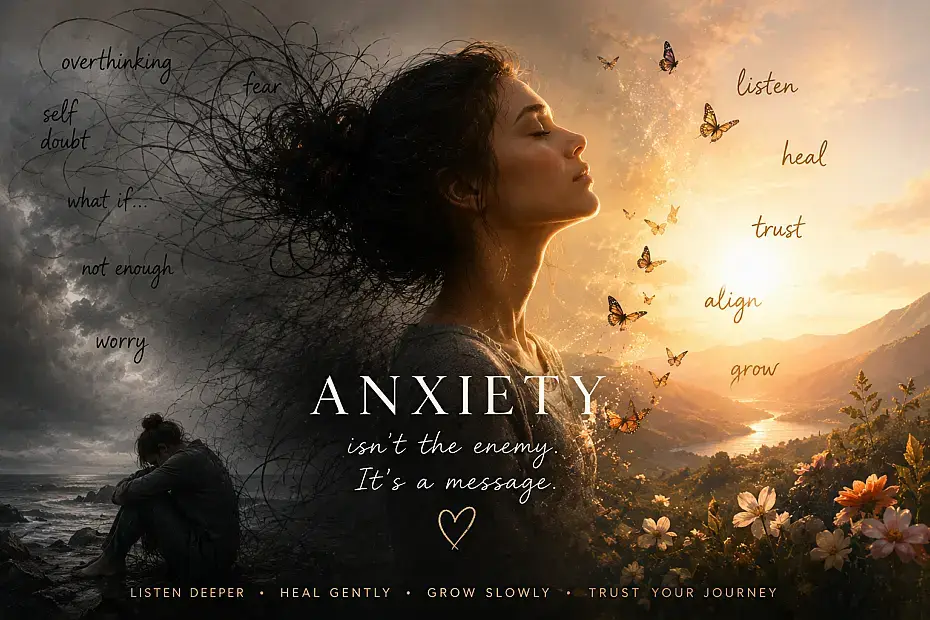
From a spiritual perspective, anxiety can be interpreted as an invitation to examine stress, boundaries, values, unresolved feelings or change. It is not proof of a spiritual awakening, personal misalignment or harmful energy, and it can also have psychological, physical and situational explanations. A grounded approach uses reflection as one lens while taking the experience seriously and seeking appropriate support when needed.
If you explore the spiritual meaning of anxiety, treat it as a question rather than a verdict: “What needs attention, and what ordinary context might explain what I am feeling?” This keeps spiritual inquiry connected to evidence, daily circumstances and care.
Is anxiety always spiritual?
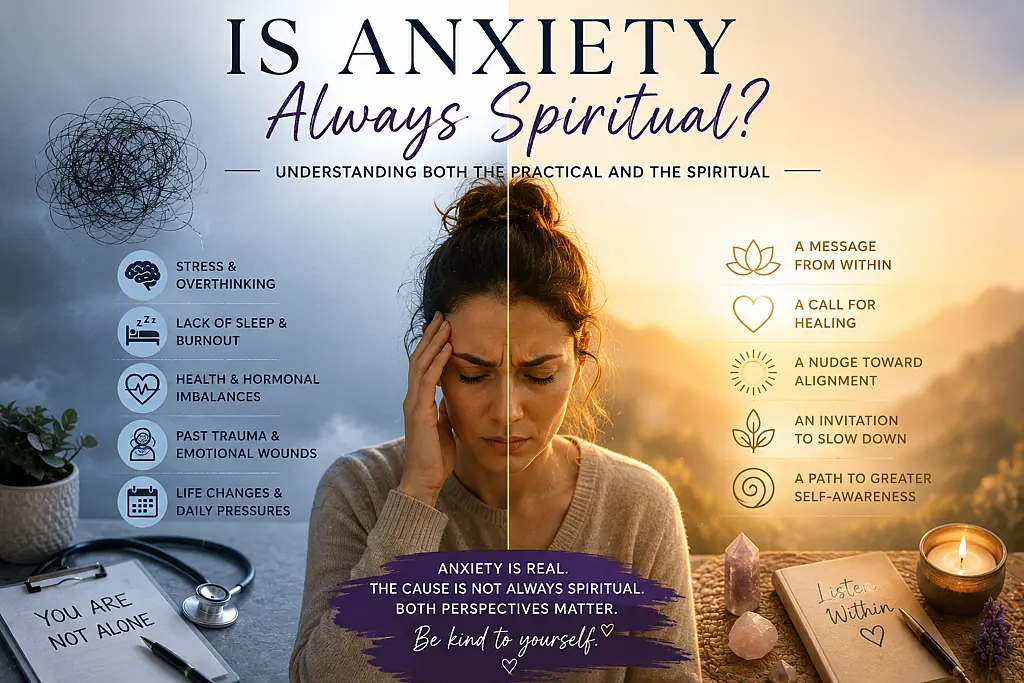
No. Anxiety does not always carry a spiritual message, even when spirituality is important to you.
Contexts worth considering include:
- Sustained stress, overload or burnout
- Grief, trauma or another difficult experience
- Poor sleep or inadequate rest
- Health concerns
- Changes involving work, relationships or home
- Mental health concerns
These possibilities are not a self-diagnosis, and several may be present at once. Seeking counselling, therapy, medical advice or other qualified support does not invalidate a spiritual outlook. It gives the experience the practical attention it deserves.
What a spiritual lens can offer
Spiritual traditions and individuals do not offer one universal interpretation of anxiety. In a belief-based reading, it may be treated symbolically as a cue to pause, review how you are living and notice needs that have been overlooked.
A useful interpretation names a possible theme without claiming to know the cause. For example, anxiety before a difficult conversation may invite reflection on boundaries, but it does not prove that the relationship is spiritually wrong.
Use two questions together: What meaning does this hold for me? and What else could be contributing? The first allows personal reflection; the second keeps ordinary explanations and appropriate support in view.
Why anxiety can seem to appear for no reason
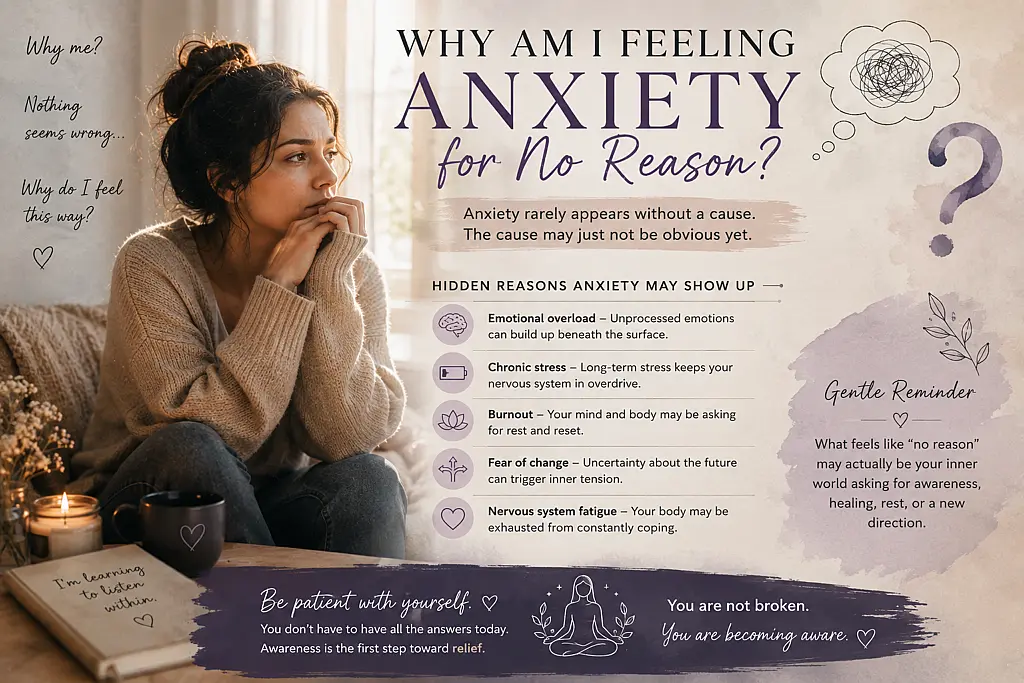
Feeling anxious when nothing obvious is wrong can be confusing, but an unclear cause does not require a supernatural explanation. Stress may have accumulated gradually, a recent change may not yet have been fully acknowledged, or relevant context may be easy to overlook in the moment.
A brief record can help organise what you notice. Consider noting:
- When the feeling began and what happened beforehand
- Your recent rest, workload and responsibilities
- Any conflict, decision or change occupying your attention
- The environment, including noise, crowds or information overload
- The thoughts and physical sensations present at the time
A pattern does not establish a cause, but it can make reflection more specific and provide useful context if you discuss the experience with a qualified professional.
Nine grounded themes to explore
These themes are possibilities for reflection, not a checklist or diagnosis. More than one may fit, or your anxiety may have a different explanation.
1. Your values and daily choices are in conflict
Spiritual language sometimes describes this as being “out of alignment”. In practical terms, it may mean that a role, habit or obligation conflicts with something you value.
- You agree to requests while wanting to say no
- You neglect rest to meet other people’s expectations
- You remain in a role that no longer suits your priorities
- You hide an honest opinion to avoid disapproval
Make the theme concrete by writing down one value, one current behaviour that conflicts with it and one realistic adjustment. This is more useful than concluding that your whole life is wrong.
2. A decision or conversation is being postponed
If a decision is overdue, repeated mental rehearsal may accompany anxiety. The feeling itself cannot tell you which choice is correct, so separate what you know from what you fear.
- Facts: What has actually happened?
- Assumptions: What are you predicting or attributing to someone else?
- Next information: What would help you make a more informed choice?
If you need time, a simple script is: “I cannot answer today. I will consider it and come back to you on Friday.”
For more reflective prompts, see Intuitive Journaling: How to Hear Your Inner Wisdom.
3. You are taking responsibility for other people’s feelings
People who identify as empaths or highly sensitive may pay close attention to tone, facial expressions and conflict. They may then feel responsible for settling the situation or keeping everyone comfortable. This does not mean they literally absorb another person’s energy.
Before intervening, ask: “Did this person ask for my help?”, “Is this mine to resolve?” and “What limit would let me remain caring without taking over?”
A boundary can sound like: “I care about what you are going through, but I cannot take responsibility for fixing it.”
4. You need to return attention to the present
Grounding is a practical way to orient yourself to what is happening now rather than treating every feared possibility as an immediate fact. Try this short sequence:
- Name the date, your location and what you are doing.
- Notice where your feet, back or hands are supported.
- Name three things you can see, two sounds and one physical sensation.
- Choose the next small action that the present situation requires.
This does not identify or eliminate the cause of anxiety, but it may create enough space to respond more deliberately.
For additional options, see Mindfulness Grounding Techniques for Manifestation.
5. Change has made certainty unavailable
Career moves, relationship changes, relocation and new responsibilities can all involve uncertainty. Anxiety during a transition does not prove that you are moving in either the right or wrong direction.
Divide a page into three parts: facts known now, unknowns that cannot be resolved today and the next action within your control. This prevents uncertainty from being mistaken for a spiritual warning.
6. Other emotions have had little space
Grief, anger, fear or disappointment may sit alongside anxiety, especially when attention has been focused on coping with responsibilities. Acknowledging another feeling does not guarantee that anxiety will disappear, but it can clarify what the situation means to you.
Try completing three statements: “Another feeling present may be…”, “It seems connected to…” and “The support or boundary I need is…”. If the material feels overwhelming or relates to trauma, consider exploring it with a qualified professional rather than forcing yourself to continue alone.
7. Daily demands have exceeded your available capacity
Work, caregiving, notifications, noise, news and social obligations can leave little room for recovery. Before searching for a symbolic explanation, check whether your current load is sustainable.
Choose one realistic adjustment for a defined period. You might mute non-essential notifications for an evening, decline one optional commitment or protect a quiet break. Observe what changes without treating the result as a diagnostic test.
8. Your beliefs or identity are changing
Some people use the idea of a spiritual awakening to describe a period of questioning old beliefs, priorities or identities. Anxiety may coincide with such a period, but its presence does not prove that an awakening is occurring or causing the feeling.
Distinguish observation from interpretation. “My priorities have changed and this friendship feels different” is an observation. “I am awakening” is a spiritual interpretation. The interpretation may hold personal meaning, while the observation points more directly to a conversation, choice or source of support.
9. You are rebuilding self-trust
Anxiety can prompt repeated reassurance-seeking, prolonged research or a search for a sign that guarantees the right choice. Spiritual reflection becomes less helpful if every feeling or coincidence is treated as a definite instruction.
Practise self-trust with a low-stakes decision: note what you chose, why you chose it and what you learnt afterwards. Self-trust is not certainty; it is confidence that you can respond to new information and revise a decision. For choices involving health, safety, finances or legal matters, appropriate professional advice still matters.
A practical response when anxiety shows up
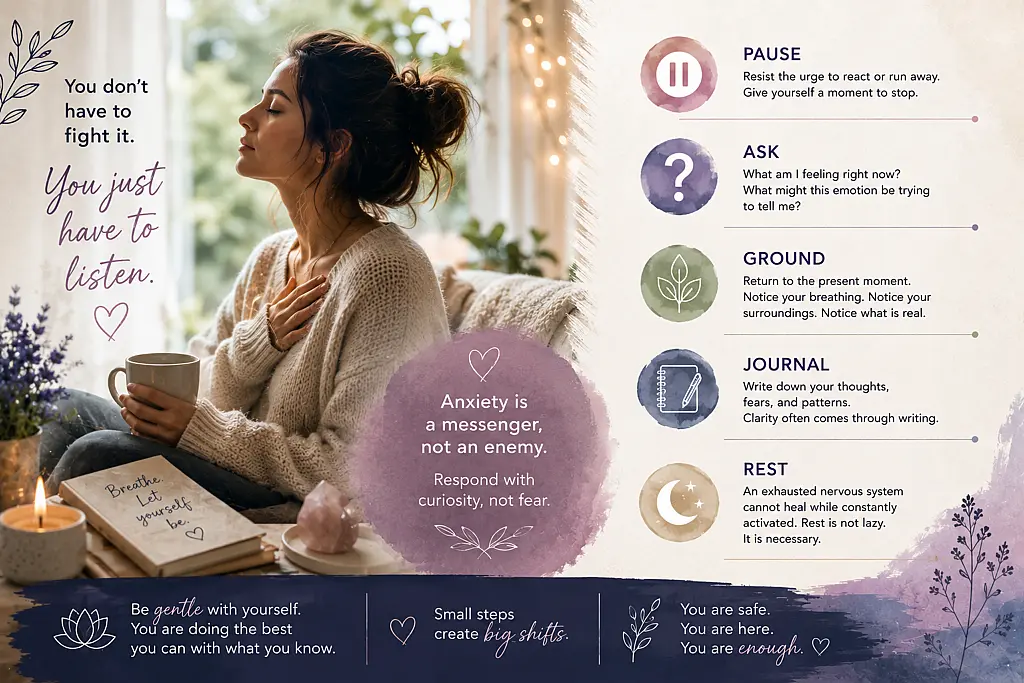
- Name the experience without explaining it: “I notice anxiety” is more grounded than immediately deciding “This is a warning”.
- Orient to the facts: Identify where you are, what is happening and which feared events have not actually occurred.
- Check the context: Consider recent rest, workload, conflict, change, overstimulation and any health concerns.
- Choose one proportionate action: Move to a quieter setting, postpone a non-urgent decision, contact a trusted person, set a boundary or arrange qualified support.
- Reflect later: Journal about possible meaning once there is enough space to consider alternatives rather than reaching a conclusion under pressure.
The purpose is not to force the feeling away or decode it perfectly. It is to respond to what is happening and decide what support is appropriate. Persistent, severe or concerning anxiety deserves attention from a qualified professional; spiritual reflection should not delay that care.
A hypothetical example: anxiety before a family call
Imagine Sam feels anxious for hours before a weekly family call. A spiritual interpretation might be that a boundary needs attention, but that remains a hypothesis. Looking at the context, Sam notices that the calls regularly run late and that relatives ask them to mediate an argument.
Sam could try a clear limit: “I can talk for 20 minutes, but I cannot mediate this disagreement.” If the anxiety appears in many other situations or remains concerning, the boundary explanation may be incomplete and further support may be appropriate.
Questions about spiritual interpretations
Can anxiety be part of a spiritual awakening?
Anxiety can occur during a period someone interprets as spiritual growth, particularly when beliefs, relationships or priorities are changing. The timing does not prove a spiritual cause, and anxiety alone is not evidence that an awakening is taking place.
Which chakra is associated with anxiety?
There is no universal chakra interpretation. Some contemporary chakra frameworks use the root chakra as a symbol when reflecting on safety and stability. This is a belief-based association, not a medical explanation for anxiety.
Can anxiety be caused by an energy shift?
Anxiety occurring during a period described as an “energy shift” does not establish that the shift caused it. Energy language can be used as a personal metaphor for change, while practical circumstances, health and emotional support still need consideration.
Does anxiety mean my intuition is warning me?
No. Anxiety by itself cannot confirm danger, another person’s intentions or a future outcome. It may prompt you to look more closely, but any impression should be compared with observable behaviour, relevant context and reliable advice.
A journal method that keeps reflection grounded
Divide a page into three parts so that observations and interpretations do not become confused:
- Observation: Record what happened, what you noticed and what was said or done.
- Interpretation: Write the practical or spiritual meaning you are considering, clearly labelling it as an interpretation.
- Response: Choose one useful action, boundary, question or source of support.
You can then ask what evidence supports your interpretation, which ordinary explanations also fit and what information is still missing.
If you prefer a structured option for regular reflection, you can explore the Moon Planner Journal.
Use meaning as a question, not a verdict
Spiritual reflection is most useful when it opens a careful inquiry rather than declaring that anxiety is punishment, bad energy or proof of transformation. It may highlight values, boundaries, difficult emotions or change, but it cannot establish the cause on its own.
Respond first to the real experience in front of you. Consider the circumstances, take a manageable practical step and involve qualified support when needed. Any spiritual meaning can then remain a source of reflection rather than a substitute for care.
Related reading
Use these grounding steps when intuition feels too loud or overwhelming.

Cite or share this page
Want to reference this guide? Please link to the canonical page rather than copying the article.