
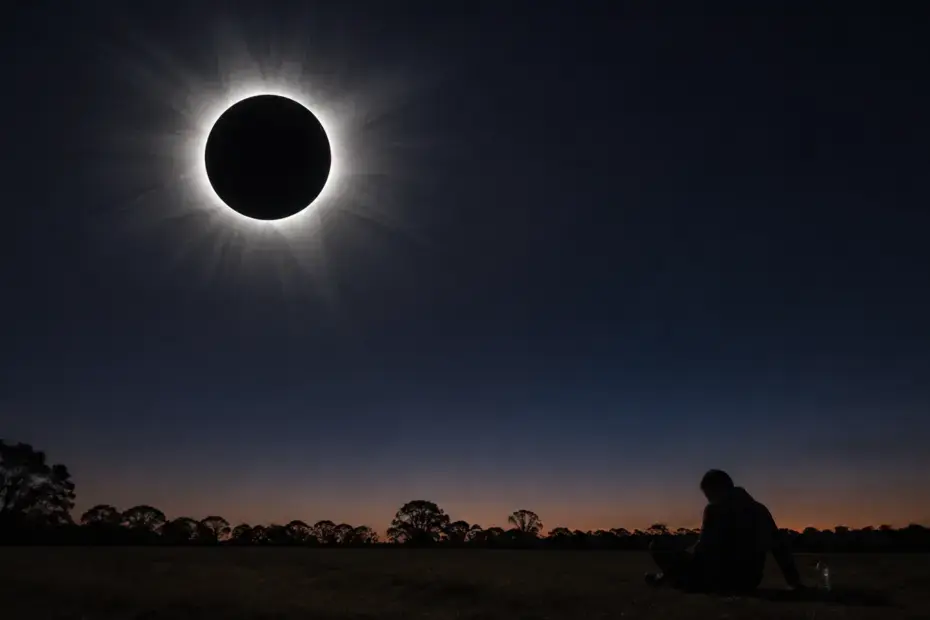
An eclipse can make an ordinary day feel unusually charged. The event is visually dramatic, widely discussed and often surrounded by strong predictions online. That combination can bring existing worries, hopes, memories or uncertainty closer to the surface. You can take your response seriously without assuming it is a sign that something bad is about to happen or that you must make a major change.
For some people, an eclipse is a meaningful symbolic pause. For others, it is an interesting natural event. Either approach is valid. The useful question is not whether you are reacting in the “right” way, but whether your response is helping you feel more present, steady and able to care for yourself.
Why you may feel emotional during a solar eclipse
There is no established scientific evidence that an eclipse itself causes a particular emotional or energetic response in people. It can, however, create conditions in which emotions are more noticeable. You may be anticipating the event, changing your routine, seeing dramatic imagery or taking in a constant stream of posts about what the eclipse supposedly means.
Repeated predictions can turn a passing concern into a mental loop. If people around you are worried, excited or certain that a major shift is coming, their mood may affect your own sense of safety. This does not mean you are gullible or doing spirituality incorrectly. It may mean you are responding to attention, uncertainty and social cues.
Highly sensitive people may also register stimulation and other people’s tension quickly. Sensitivity is not a diagnosis, and it does not mean you are destined to be overwhelmed. It may simply mean that a quieter environment, reliable routines and clear information matter more when the atmosphere around you feels intense.
If you are exploring why sensitivity can feel stronger during personal growth, keep one foot in daily life: eat, rest, work, connect and check what is actually happening around you.
A spiritual interpretation can still have a place. Some people use an eclipse as a marker for reflection, release or renewed attention. That is a personal practice, not proof of a predicted outcome. You do not need fear, urgency or perfect certainty for a reflective moment to be worthwhile.
The difference between noticing feelings and predicting danger
A strong feeling is real, but it is not automatically a forecast or an instruction. Sadness may point to a need for comfort. Irritability may signal tiredness or too much input. Fear may be asking for reassurance and practical information. None of these feelings, by themselves, can tell you that a relationship is doomed, a disaster is imminent or that you must act today.
It may be time to step back if you are compulsively checking eclipse posts, interpreting every mood shift as a warning, sleeping poorly, cancelling ordinary plans or feeling pressure to perform a ritual exactly right. These are signs that content may be escalating your worry rather than supporting thoughtful reflection.
Before sharing a frightening claim or acting on it, pause. Ask: Who is making this prediction? Are they presenting an interpretation as certainty? Does this message leave room for choice, rest and ordinary explanations? You may also find it helpful to ground yourself when intuition feels too loud before deciding what deserves your attention.
What to do when you feel emotional during a solar eclipse
When you feel emotional during a solar eclipse, begin with five minutes of less input rather than more analysis. Put the phone down or move away from predictions. Place both feet on the floor. Look around and name five neutral things you can see: a door, a cushion, a cup, a tree, a patch of light. Drink some water, then take a few slower breaths if that feels comfortable. There is no need to force a breathing pattern or make yourself calm on demand.
Next, choose one ordinary stabiliser. Have something nourishing to eat, take a shower, walk around the block, fold laundry, sit with a pet, rest or speak to someone calm. Ordinary actions are not less spiritual because they are practical. They can be the most supportive response when your thoughts are running ahead of you.
If you still feel emotional during a solar eclipse after stepping away from the noise, choose a small practice that settles rather than intensifies you. A brief prayer, a candle lit with an intention, a few minutes of meditation or quiet music may be enough. Stop or adapt the practice if it increases fear, makes you feel pressured or leaves you searching for hidden meanings in every sensation.
For further ideas, this guide to simple breathing practices for settling your body may be useful. Keep the practice gentle. If focusing on your breath makes you dizzy, panicky or uncomfortable, return to a supported seated position, look around the room or use movement instead.
A 10-minute eclipse emotional reset
This short reset is designed to interrupt a prediction spiral before it takes over your evening. You do not need special tools. A glass of water, a chair and a note on your phone or in a journal are enough.
- Minutes 1–2: Rate the intensity from 0 to 10. Name the clearest emotion without judging it: fear, sadness, tenderness, anger, restlessness or something else.
- Minutes 3–4: Identify the immediate trigger. Was it the eclipse itself, a prediction, a conversation, lack of sleep, a personal memory or uncertainty about something in your life?
- Minutes 5–7: Settle your body. Sit with your back supported, gently stretch your shoulders, walk slowly through one room or notice the contact between your feet and the floor.
- Minutes 8–10: Write one next action that is within your control today. Then close the app, put the journal away or move into the next part of your day.
For example: “I saw a frightening post, my chest tightened, and I started assuming something bad would happen. My next action is to make tea, mute eclipse accounts for tonight and revisit this thought tomorrow.” This does not deny the feeling. It gives it a container and returns some choice to you.
If eclipse content has left your thoughts noisy or your emotions close to the surface, use the to slow down, name what is happening and choose one steady next step.
If the intensity continues, an emotional reset when you feel overwhelmed can help you return to basics without trying to solve your whole life in one sitting.
Use eclipse reflection without handing over your judgement
Feeling emotional during a solar eclipse can be an invitation to check in with yourself, but it is not evidence that you have received a final answer about the future. A symbolic moment can help you notice what has been neglected, what needs care or what you want to change over time. It cannot reliably tell you which job to leave, who to trust or whether a major decision must happen now.
Try using reflection to widen your perspective rather than narrow it. These journal prompts can bring you back to what is workable:
- What has been asking for my attention lately?
- What would help me feel steadier this week?
- What decision can wait until I am rested and calm?
Consider a 24-hour pause before making a major decision that arrives with a rush of emotion. Sleep, food, time away from social media and a conversation with a trusted person can change how clear a situation feels. The exception is an immediate safety issue, where seeking practical help promptly matters more than waiting.
A grounded spiritual practice should leave room for discernment. If an interpretation makes you less able to think, work, rest or stay connected with supportive people, it may be time to simplify the practice rather than search for a deeper explanation.
A quick self-check: reflection or overload?
If you feel emotional during a solar eclipse, this self-check is not about proving the cause of your emotion. It is about choosing the kind of support you need next.
- Reflection often feels quiet and flexible. You may have feelings, but you can still eat dinner, answer a message, change your mind and take one practical next step.
- Overload often feels urgent, catastrophic, isolating or impossible to switch off. You may feel driven to keep searching for predictions until you find certainty.
If it is reflection, a short journal entry or calm conversation may be enough. If it is overload, reduce eclipse content, return to routine and speak with someone steady rather than looking for more readings, videos or warnings. Support is not a failure of intuition; it is one way of caring for your capacity.
Set boundaries around eclipse predictions and group energy
You do not have to ridicule spiritual communities, leave every group or reject meaningful practices to protect your peace. You can simply decide that fear-based content is not useful for you. Accounts that rely on deadlines, alarming certainty or warnings of consequences for “missing” a ritual are often asking for more attention than they deserve.
Try muting relevant words or accounts for a day or two, and choose a deliberate media window rather than all-day scrolling. If you want practical information about an eclipse, seek established astronomy and local safety guidance. You can enjoy a natural event without assigning it a life-changing meaning.
A clear boundary can sound like this:
“I am keeping eclipse content light at the moment. I do not want predictions or warnings sent to me, but I am happy to talk about how you are doing.”
This wording is firm without attacking another person’s beliefs. It also makes room for genuine connection. If someone repeatedly ignores the boundary, it is reasonable to mute the conversation, step away or say less.
When extra support is a good idea
Not every difficult feeling needs professional care, but significant or persistent distress should not be explained away as an awakening, energetic clearing or eclipse effect. It is a good idea to speak with a qualified health professional if low mood, panic, poor sleep or emotional overwhelm continues, worsens or begins to interfere with daily life.
Seek urgent local help if you feel unsafe, have thoughts of self-harm or cannot manage essential daily tasks. In Australia, a GP, local emergency service or current national crisis-support service can help direct you to appropriate care. If you are elsewhere, use local emergency and mental-health support pathways.
This article offers general wellbeing ideas, not diagnosis or medical advice. Feelings can be meaningful without being a command. Choosing steadiness, practical support and a slower pace is a valid spiritual choice.

Cite or share this page
Want to reference this guide? Please link to the canonical page rather than copying the article.