

A “spiritual headache” is a non-medical phrase some people use when giving spiritual meaning to head pain or pressure. Depending on their beliefs, they may connect it with vivid dreams, meditation, emotional energy, chakra symbolism or a period of spiritual change. The sensation itself does not establish a spiritual cause, and ordinary factors such as sleep, concentration, posture, screens or a changed routine may also be involved.
That still leaves room for personal symbolism. A useful approach to spiritual headache meaning is to consider what was happening around the experience, which interpretation genuinely resonates and whether that interpretation brings clarity rather than fear. Meaning and physical cause are not the same question.
What Can a Spiritual Headache Mean?
Because “spiritual headache” is an interpretive label rather than a defined condition, its meaning depends on the person and the tradition they follow. Common spiritual readings include:
- An invitation to step back from mental or energetic noise
- Emotional material seeking acknowledgement after a dream or intense experience
- A symbolic focus on intuition, discernment or the upper chakras
- A period of inner change in which familiar beliefs no longer fit
These are possible lenses, not verdicts. The most useful interpretation behaves like a question: What might this moment be asking me to notice? It does not insist that pain proves spiritual advancement, divine contact or a blocked chakra.
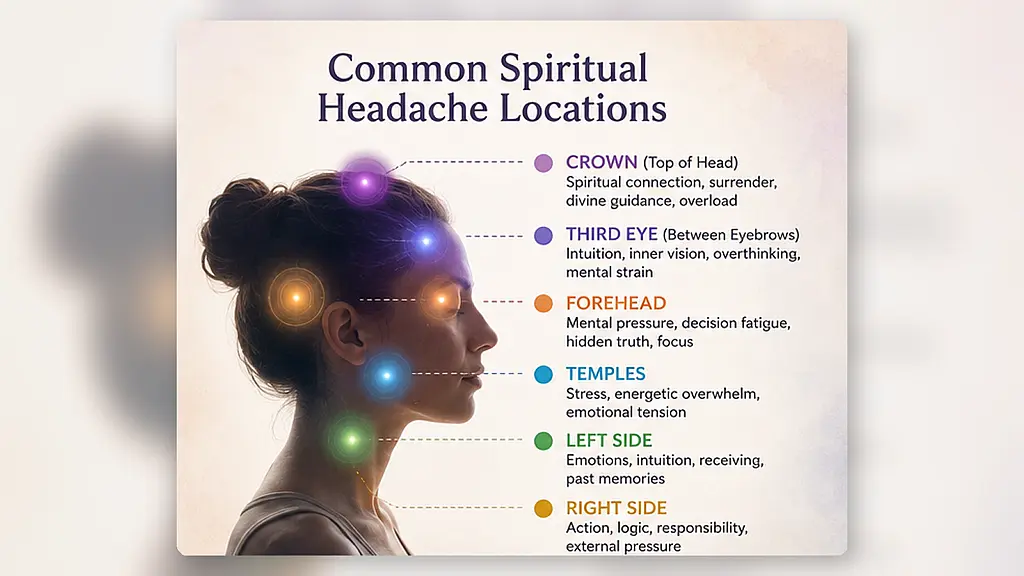
Experiences Associated With Spiritual Headaches
There is no agreed set of spiritual headache symptoms. People tend to use the phrase when they notice experiences such as:
- A tight, heavy or pressurised feeling around the head
- Discomfort near the forehead, temples or crown
- A headache during or after meditation, prayer or energy work
- Head discomfort on waking from a vivid dream
- A recurring sensation during emotional or spiritual change
These descriptions explain when someone might apply the label; they do not reveal what caused the sensation. Context is more revealing than a checklist. A headache after a broken night of dreaming, for example, carries a different story from pressure noticed during an unusually intense visualisation practice.
Headache After Dreaming: What Could It Mean Spiritually?
Spiritually, a headache after dreaming may be interpreted as an invitation to process the emotional or symbolic residue of the dream. This can feel especially significant when the dream was unusually vivid, involved someone who has died, repeated an important symbol or seemed to speak directly to a current decision.
Some traditions view dreams as a meeting place for intuition, spiritual guidance, ancestral connection or the deeper self. Within those beliefs, the dream may deserve attention. The headache does not confirm where the dream came from, whether it predicts anything or whether every image carries a message.
Begin with the dream rather than using the discomfort as proof. Consider:
- Which feeling remained strongest after waking?
- What person, object or place held the most energy in the dream?
- Did the dream reflect a transition, conflict or truth already present in waking life?
- Was its tone comforting, urgent, confusing or protective?
- Am I forcing a definite spiritual answer because uncertainty feels uncomfortable?
Record the dream before consulting a fixed symbol list. Personal associations often matter more than generic definitions. Our guide to the Spiritual Meaning of Dreams explains how to explore imagery, recurring themes and possible guidance without treating a dream as a guaranteed prediction.
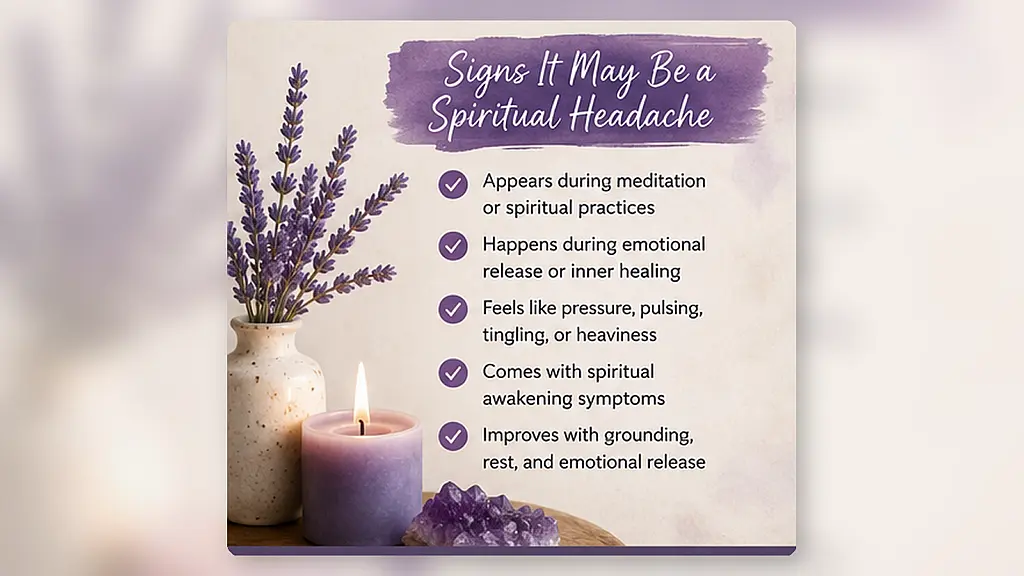
Pressure in the Head and Its Spiritual Meaning
Pressure in the head can attract spiritual interpretations because the forehead and crown carry symbolic importance in chakra systems and contemplative traditions. They are often associated with perception, wisdom and connection beyond the everyday self. Even within those traditions, however, there is no dependable dictionary that assigns one meaning to each location.
Location can be used as a reflective prompt rather than a code. Intense concentration, tiredness, a fixed posture or a change in routine may also overlap with the experience, so spiritual symbolism need not be treated as the only explanation.
Forehead Pressure and Third-Eye Symbolism
The area between the eyebrows is associated with the third-eye chakra in some spiritual systems. It represents inner vision, discernment and the ability to see beneath appearances. Pressure there may therefore be interpreted as heightened intuitive attention or an effort to gain clarity.
A revealing question is: Am I allowing insight to emerge, or am I straining to receive a sign? The distinction matters. Pursuing certainty can make a spiritual practice feel crowded with expectation, while genuine intuition is often quieter and less theatrical.
Pressure at the Crown
The crown is commonly linked with spiritual connection, unity and openness to a larger reality. A sensation there during prayer or meditation may feel like a moment of contact. It may also symbolise a desire for expansion that has not yet been integrated into ordinary life.
Rather than declaring that the crown chakra is opening, consider what spiritual connection currently means to you. Is it changing how you live, or has it become something you are trying to prove through sensations?
One-Sided or Whole-Head Pressure
Some teachings associate the left side with receptivity and the right with action. Others reverse, reinterpret or ignore those correspondences. Whole-head pressure is sometimes described spiritually as overload or excessive energetic input. These ideas can support reflection, but they are not universal rules.
Ask what feels out of balance in your actual circumstances. You may be taking in more information than you can meaningfully absorb, delaying a decision or trying to think your way into an answer that requires patience.
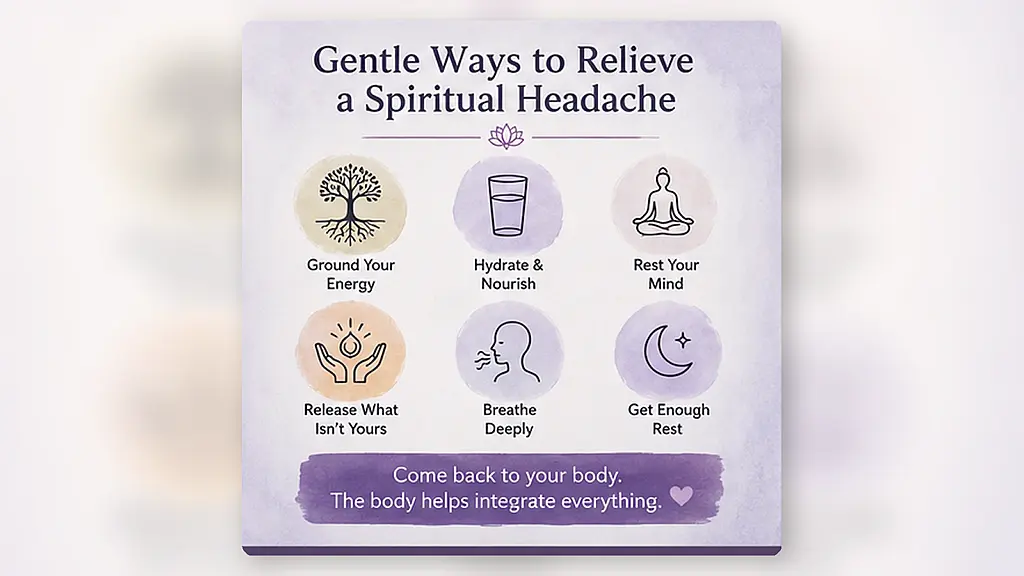
Headache After Meditation, Prayer or Energy Work
A headache noticed after meditation can seem spiritually significant because it follows a deliberate inner practice. Some traditions describe energy gathering around the upper chakras or awareness adjusting to a subtler state. Those are belief-based interpretations rather than conclusions that can be drawn from timing alone.
The details of the practice also matter. A longer session, forceful breathing, intense visualisation, a fixed gaze or an unfamiliar posture may all form part of the context. Recognising those details does not cancel a meaningful meditation; it simply prevents one explanation from taking over.
For spiritual discernment, ask:
- Was I practising gently, or striving for a dramatic result?
- Did I expect a sensation that would confirm the practice was working?
- Was the technique or session length different from usual?
- What insight remains when I stop treating the discomfort as evidence?
A spiritual practice does not become more authentic because it produces intense sensations. Pain is not an initiation, a measure of progress or proof that energy has been activated.
Emotional Intensity, Empath Energy and “Release”
Head discomfort sometimes appears around crying, conflict, grief, journalling or a demanding social encounter. Spiritually, this may be described as emotional energy moving or a release taking place. “Release” can be a helpful metaphor for finally acknowledging what has been held back, but the timing does not establish a separate energetic cause.
People who identify as empaths may interpret the experience as a sign that they have absorbed another person’s energy. Energetic language can help describe the feeling of becoming overwhelmed or losing a clear sense of what belongs to you. The sensation itself cannot confirm that someone else’s energy caused it.
More useful questions include:
- Which interaction felt unusually intense?
- What emotion have I been containing or explaining away?
- Did I ignore a boundary because I wanted to remain available?
- What part of this situation is genuinely mine to carry?
A boundary can be a spiritual act when it protects the clarity needed for compassion and discernment. It need not be framed as punishment or rejection.
For a fuller exploration of energetic depletion after demanding interactions, read The Empath Hangover.
Spiritual Headaches and Awakening Are Not the Same Thing
“Spiritual headache” is the broader term. It may be used for an isolated experience after a dream, meditation or emotionally charged event. An awakening headache is a narrower interpretation, placing the discomfort within a sustained period of changing values, heightened sensitivity, vivid inner experiences and deep questioning about identity or purpose.
Head pain alone does not confirm an awakening or indicate spiritual advancement. The awakening interpretation becomes more relevant only when it sits within that wider personal story. Our separate guide to Spiritual Awakening Headaches explores that specific framework in greater depth without making physical sensations the centre of awakening.

A Five-Layer Discernment Method
This framework allows spiritual meaning and everyday context to remain in view without forcing them into competition.
- Name the event plainly. Record when the discomfort appeared, where it was felt and what immediately preceded it. Avoid beginning with labels such as chakra activation or psychic pressure.
- Examine the setting. Note the dream, meditation, conversation or emotional event involved, along with ordinary details such as sleep, concentration and changes in routine.
- Identify the spiritual lens. Ask which belief is shaping the interpretation. Is it drawn from chakra teaching, empath language, dream symbolism or your own intuitive association?
- Look for the invitation. A worthwhile interpretation may encourage honesty, a clearer boundary, patience or a simpler spiritual practice. It should offer something more useful than “this proves I am awakening”.
- Consider its effect. Notice whether the interpretation creates perspective or fuels fear and compulsive sign-seeking. Leave room for uncertainty when several explanations remain possible.
For example, imagine waking with forehead pressure after dreaming of waiting at a crowded railway station. Broken sleep belongs to the setting; the station may symbolise transition; the crowd may reflect competing demands. The possible message could be to stop forcing a decision. That insight may be valuable without claiming that the dream spiritually caused the headache.
A Quiet Ritual for Spiritual Clarity
This short ritual is designed to ease the pressure to interpret everything immediately. It does not attempt to explain or change the physical sensation.
- Write one factual sentence about what happened before the headache appeared.
- Write the first spiritual meaning that came to mind.
- Place a familiar spiritual object nearby, such as a crystal, journal or meaningful symbol.
- Sit quietly for a few moments without pursuing another sign or forcing an insight.
- Finish with the question: What is the simplest honest invitation I can take from this experience?
I can honour the experience without making it prove anything. Clarity does not have to arrive all at once.
If no answer comes, leave the page unfinished. Not every sensation needs to become a message.
When Spiritual Interpretation Stops Being Helpful
Step back from an interpretation when it:
- Assigns a fixed meaning to every headache location
- Creates fear about blocked energy or missed guidance
- Pressures you to intensify a practice to trigger more sensations
- Treats discomfort as proof of another person’s intentions or energy
- Turns pain into a badge of spiritual status
A sound spiritual interpretation widens your choices; it does not corner you. It can hold symbolism, practical context and uncertainty at the same time.
Reflection Tools and Printable Journals
Browse reflective journals and other spiritual resources at Feel Better Within. These tools provide space to notice personal patterns without turning every entry into a prediction.
🌙 Moon Planner Journal
The Moon Planner Journal helps you record lunar cycles, emotions, perceived energy and spiritual practices. Over time, it can reveal which associations feel personally meaningful and which were based on a single moment.

💎 Crystal Journal PDF
The Crystal Journal offers structured pages for recording crystals, personal observations and chakra practices. Use it to compare experiences rather than to make a sensation fit a predetermined crystal or chakra meaning.

A spiritual journal works best as a record, not an oracle. Let it show patterns while preserving your right to remain uncertain.
This article offers general wellbeing education and spiritual reflection. It is not medical or mental health advice, and a spiritual interpretation should not replace professional assessment. Seek qualified support for persistent fatigue, pain, sleep disruption, anxiety, low mood or other symptoms that concern you.
Cite or share this page
Want to reference this guide? Please link to the canonical page rather than copying the article.