

For people who identify as empaths, a spiritual awakening can affect career and life purpose by making conflicts around values, emotional demands and neglected interests harder to overlook. It may prompt a role redesign, firmer limits, a gradual move or a decision to seek purpose outside paid work. It does not, by itself, mean you must resign.
Here, spiritual awakening is a way of interpreting a shift in meaning, identity or values. “Empath” describes someone who experiences strong sensitivity to other people’s moods and cues; it is not proof that they literally take in another person’s energy. Workload, unclear roles, conflict, health, sleep, caring duties and financial pressure can shape the same experience, so practical context matters.

What may change at work
An awakening may change what you notice and what you are willing to tolerate. A goal that once represented success may now feel inherited from someone else. Work that uses your skills may still conflict with your ethics, pace or preferred way of relating to people.
Experiences worth investigating include:
- Dread that appears before particular meetings, shifts or tasks
- Fatigue after unstructured emotional labour rather than after the core work
- Difficulty concentrating on work that no longer seems worthwhile
- Frustration with practices that conflict with your values
- A wish for more autonomy, quiet, creativity or visible social benefit
- Repeated interest in a different field, working pattern or form of service
These patterns are information, not proof of a spiritual cause. If you are also noticing wider changes in identity, meaning or spiritual practice, Spiritual Awakening Symptoms: 7 Signs You’re Shifting & Grounding Tips offers a separate reflection on that experience.
Is the problem the career, the conditions or the current season?
For empaths, awareness of tone, tension and competing needs can make a busy workplace especially demanding. Even so, the issue may be one manager, an unrealistic workload, poor role design, sensory overload or pressures outside work rather than the whole profession.
For ten working days, keep a brief audit using these prompts:
- What happened? Record the task, setting, people involved and workload.
- What did you notice? Name the emotion or physical tension and how long it lasted.
- What was missing? Consider clarity, time, privacy, support, autonomy or recovery between tasks.
- What else may have contributed? Note sleep, caring demands, conflict, illness or an unusually difficult week.
Look for specific patterns. If one recurring meeting causes most of the strain, communication or boundaries may be the first issue to address. If meaningful tasks are still exhausting because the workload is excessive, changing profession may not solve the capacity problem. If an ethical conflict persists across better days and lighter weeks, it may indicate a deeper mismatch worth testing.
A four-stage route from insight to action
Stage 1: Translate sensitivity into work conditions
Move from broad statements such as “this job drains me” to conditions you can evaluate or request. Ask:
- Which tasks leave me satisfied, and which leave me resentful or depleted?
- Do I work better with long periods of focus, frequent collaboration or a mixture?
- Where am I taking responsibility for feelings or problems that are not part of my role?
- Which values am I being asked to compromise?
- What would a tolerable week look like in hours, meetings, deadlines and contact with others?
For example, “I need peace” is difficult to apply, while “I need two meeting-free hours on most days” gives you something concrete to discuss or seek.
Explore Spiritual Protection for Empaths if you would like optional visualisation and boundary practices. Treat these as centring rituals and pair them with practical limits on workload, availability and emotional labour.
Stage 2: Test intuition against evidence
Intuition may draw attention to a preference before you can explain it, but it cannot confirm what colleagues think or guarantee that a new path will succeed. Treat an intuitive pull as the beginning of an enquiry.
- Write the change you are considering in one sentence.
- List the evidence supporting it, including repeated experiences rather than one difficult day.
- Separate your assumptions from other people’s stated expectations.
- Identify what you still need to verify about duties, qualifications, income or working conditions.
If pausing helps, take three comfortable breaths and ask, “What do I know, what am I imagining, and what information is missing?”
For a spiritually framed approach to difficult environments, see How To Protect Your Aura From Toxic Environments. “Aura” can be understood as symbolic language for personal space and emotional boundaries rather than evidence of literal contamination.
Stage 3: Define a viable direction
Choose up to five values and convert each one into a work condition. Freedom might mean control over schedule or method. Compassion might mean contributing to useful outcomes, not necessarily working in a care role. Creativity might mean producing original work for part of the week rather than turning every interest into a business.
Then build an evidence-based skills inventory. For each skill, record:
- A task that demonstrates it
- A result, example or piece of feedback
- The setting in which you perform it best
- Any training or qualification needed to use it professionally
For a related reflection, see Awakening Impacts Career and Life. Use any insight as a prompt, then translate it into criteria such as hours, duties, training and minimum income.
If a gentle breathing practice already suits you, Healing Through Breath — Emotional Release Breathwork Guide is an optional reflective exercise. Stop the exercise if it feels uncomfortable rather than forcing a particular emotional result.
Stage 4: Run a limited experiment
Instead of demanding a permanent answer, choose one career hypothesis and test it over four to twelve weeks. A useful experiment names the action, time commitment and review date.
For example: “For the next six weeks, I will spend two hours each week creating sample work and speak with two people who know the field. I will then review my interest, skill gaps, likely duties and practical constraints.”
Possible experiments include:
- Updating one section of your CV or portfolio
- Completing a sample task before enrolling in a long course
- Asking to trial a different responsibility in your current role
- Interviewing someone about the ordinary working day in a field you admire
- Reducing one avoidable obligation and observing whether work becomes more manageable
- Testing a creative project without requiring it to produce immediate income
Explore careers without typecasting yourself
No career is automatically suitable for every empath. A caring title can hide heavy caseloads and limited autonomy, while a technical role may offer quiet focus, ethical work and a supportive team. Examine the actual tasks and conditions rather than whether the job sounds spiritual.
Possible areas to investigate include:
- Writing, editing, design, content strategy and storytelling
- Teaching, facilitation and learning design, with relevant qualifications where required
- Community work, customer support, people and culture or values-led administration
- Research, user research, analysis and project coordination
- Sustainability, animal care and nature-based work
- Qualified health, counselling or wellbeing roles that match your training and professional scope
- Spiritual education or facilitation practised with clear ethics, boundaries and honest claims
Empathy can support listening and communication, but it is not a substitute for professional training. Before choosing a path, ask about supervision, workload, difficult conversations, administrative duties, schedule and pay.
For broader spiritual perspectives, Spiritual Awakening Books For A Deeper Journey may offer reflection prompts, but no book can determine the right occupation for you.
Protect your capacity while work is changing

Career transition can bring excitement, grief, fear and hope at the same time. Some empath traditions describe this as absorbing energy. A more actionable interpretation is that you may notice other people’s moods, monitor their reactions or remain tense after demanding interactions. Optional energy practices can coexist with clear communication and ordinary recovery habits.
Before work
Choose your two main priorities and decide when you will be unavailable. If visualisation is meaningful to you, imagine a boundary and use the reminder: “I can care without taking responsibility for every feeling in the room.”
During work
Pause briefly between demanding tasks. Notice clenched muscles, shallow breathing or the urge to agree too quickly. Treat these as cues to check your workload or response, not as proof that an emotion belongs to somebody else.
After a difficult conversation
Write down the facts, your response and the next action required. Separate what belongs to your role from the other person’s reaction. A useful reminder is: “I am responsible for being clear and respectful; I am not responsible for controlling their response.”
At the end of the day
Create a clear stopping point by recording tomorrow’s first task and closing work systems. A walk, stretch, shower, quiet time or personally meaningful salt-bath ritual may help mark the transition, without needing to be treated as a literal removal of someone else’s energy.
Keep purpose and financial stability in the same plan
A spiritual sense of purpose does not remove financial constraints or shared responsibilities. A gradual transition may protect both the new direction and the rest of your life.
- Estimate essential monthly costs, irregular expenses and likely transition costs.
- Check notice periods, leave arrangements, required qualifications and any shared financial commitments.
- Identify the lowest income and schedule you could realistically accept.
- Test demand for a new service or skill before relying on it for income.
- Set a timeline based on evidence and responsibilities rather than an arbitrary deadline.
- Keep a current or bridge role if it supports a safer transition.
- Agree on a contingency if training, applications or self-employment take longer than expected.
A bridge job is not a spiritual failure. It may fund training, provide structure or leave enough attention for meaningful work elsewhere.
Compare options with a career clarity matrix
Rate each option from 1 to 5, where 1 is a poor match and 5 is a strong match. Mark an item as unknown rather than guessing, then list the information needed to score it.
| Category | Question |
|---|---|
| Energy | Can my nervous system handle this sustainably? |
| Purpose | Does this feel meaningful to me? |
| Income | Can this support my real-life needs? |
| Values | Does this match what I believe in? |
| Growth | Does this help me become more myself? |
| Daily reality | Would I enjoy the actual tasks, not just the idea? |
Use the matrix to reveal trade-offs, not to manufacture certainty. In a hypothetical comparison, a community-support role might score highly for purpose but poorly for daily reality because it requires rotating shifts. A design role might score moderately for purpose but strongly for schedule and income. The useful next questions are whether the community role offers daytime work and whether the design role could serve an organisation whose values matter to the applicant.
Your physical response is another observation, not the deciding vote. A tight chest may reflect interview anxiety, uncertainty or a genuine concern; it does not automatically mean an option is wrong.
Scripts for practical career conversations
To request a role adjustment
“I’ve noticed my strongest results come from X and Y. Could we trial a change for six weeks in which I spend more time on Z, then review the outcome?”
To set a workload boundary
“I can complete A by Friday, or A and B by Tuesday. Which outcome should I prioritise?”
To limit emotional labour
“I have ten minutes to discuss this now. After that I need to return to my scheduled work.”
To request flexibility
“I believe this schedule would support the quality of my work. Could we trial it for two weeks and review the results against agreed measures?”
To leave clearly
“I have decided to resign from my role. I appreciate what I have learned here, and I will document my current work to support an orderly handover.”
A script cannot guarantee the response you want, but it can prevent sensitivity from turning into vague requests or unnecessary over-explanation.
When your sense of purpose is still unclear
Life purpose does not have to be one job title. It may be a recurring way of contributing—creating, explaining, organising, caring, teaching or advocating—that appears across paid work, relationships and community life.
Keep a weekly evidence log with four points:
- The activity and setting
- What held your attention
- The skill you used
- Who benefited and what the activity cost you in time or effort
After several weeks, look for activities that remain engaging without consistently exceeding your capacity. Select one clue and test it through a conversation, sample task or short project.
If lunar symbolism is meaningful to you, How To Perform A Full Moon Ceremony For Manifestation can be used as an intention-setting ritual rather than as a source of career certainty.
A 30-day career awakening plan
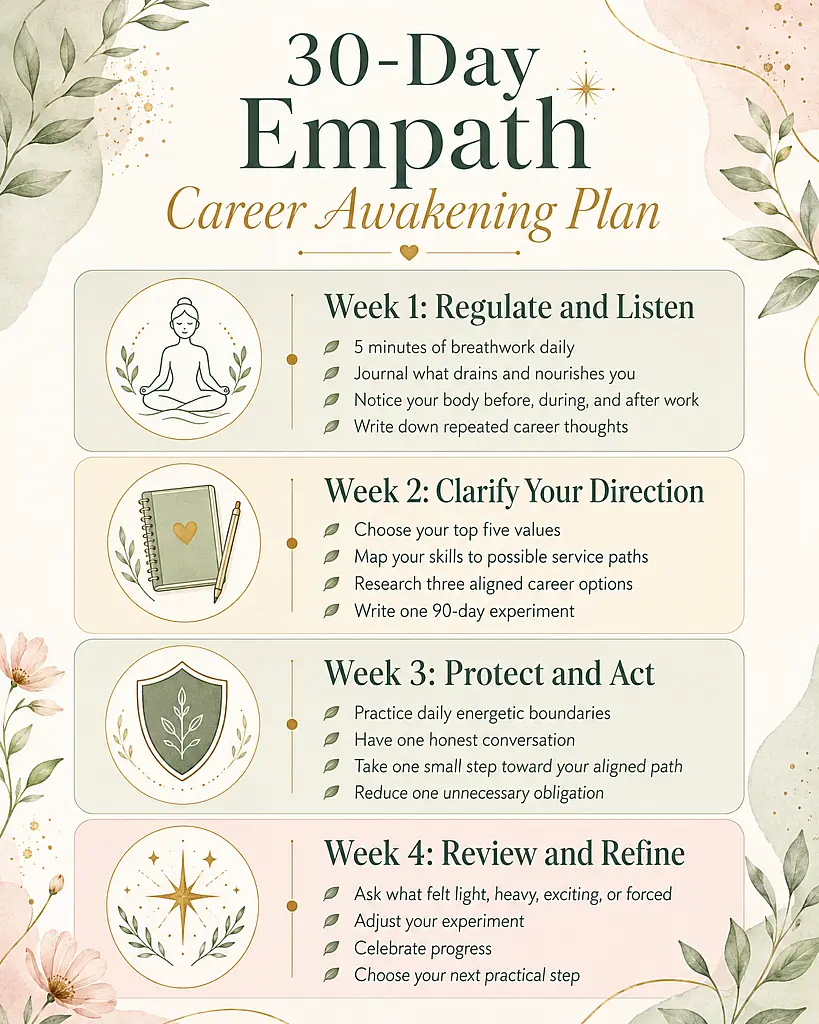
Days 1–7: Observe the current reality
- Complete the workday audit after each shift or work session.
- Record tasks, workload, interactions and relevant pressures outside work.
- Identify one recurring strain and one condition that helps you work well.
- Make one reversible adjustment, such as a clearer stopping time or meeting boundary.
Days 8–14: Define your criteria
- Choose five work conditions that matter most now.
- Separate essential requirements from preferences.
- Build a skills list supported by examples.
- Shortlist your current role, an adjusted version of it and up to three alternatives.
Days 15–21: Gather real information
- Speak with someone who understands one field or role you are considering.
- Review ordinary duties, schedule, qualifications and likely income.
- Complete one small sample task or course preview.
- Use one of the scripts to request information, flexibility or a role adjustment.
Days 22–30: Compare and choose the next test
- Score the realistic options with the career clarity matrix.
- Investigate every item marked unknown.
- Review finances and discuss shared consequences with the people affected.
- Choose whether to stay and adjust, prepare to move or continue testing.
- Put one dated action in your calendar for the following 30 to 90 days.
For background on Donna and Iain and the site’s perspective, visit About Us.
Questions about awakening and work
Can a spiritual awakening make a job feel wrong overnight?
The awareness may feel sudden even when dissatisfaction has been developing for some time. Intensity is not the same as certainty, so check whether the concern repeats across different days and conditions before treating it as a career instruction.
What if I am good at my job but no longer connected to it?
Skill and fit are different questions. You might use the same ability in another setting, redesign the current role or keep the job while expressing purpose through another part of life.
Is this an awakening or burnout?
The feeling alone cannot answer that question, and the two interpretations are not mutually exclusive. A spiritual framework may help you examine meaning, while sustained exhaustion or difficulty functioning may also reflect workload, life pressures or health concerns. Look at the wider pattern rather than using spiritual language as a diagnosis.
Can I stay in my current job and still live with purpose?
Yes. Paid employment can provide stability, useful skills and relationships without carrying your entire sense of meaning. Purpose may also be expressed through family, creative work, volunteering, spiritual practice or community contribution.
Do empaths need to choose healing or caring careers?
No. Highly interpersonal work can be satisfying, but it can also involve substantial emotional demands. Research, design, administration, skilled trades, analysis and many other fields may offer an equally strong match.
What if my family does not understand the change?
Separate personal preferences from decisions that affect shared income, housing or caring responsibilities. For shared consequences, present the practical figures, proposed timeline and contingency rather than asking others to accept a spiritual explanation.
How can I reduce the risk of an impulsive decision?
Where circumstances allow, use a pause, compare repeated evidence, verify the finances and test the idea on a small scale. Seek an independent perspective from someone who will ask practical questions rather than simply confirm the outcome you want.
Make the next decision meaningful and workable

An awakening can be a valuable invitation to reconsider how you work, contribute and define success. It is most useful as a framework for questions, not as a command or prediction.
Choose one concrete next action: request a change, investigate a qualification, test a project, calculate a transition budget or decide that your current job can support a purpose expressed elsewhere. The aim is a life in which sensitivity informs your choices without overruling evidence, responsibilities or personal limits.
Optional tools for symbolic reflection
These resources may suit readers who already use lunar or crystal symbolism. They are optional journalling tools rather than proof of external spiritual forces or substitutes for practical career research.
Moon planner journal
Some people use lunar phases as recurring dates for reflection. The Moon Planner Journal can be used to record goals, moods, personal observations and self-care practices without assuming the moon caused a particular experience.

Crystal journal
For readers who use crystals as symbolic or mindfulness objects, the Crystal Journal can help catalogue a collection and record personal associations, intentions and rituals. These records reflect individual meaning rather than verified healing effects.

This article offers general wellbeing education and spiritual reflection. It is not medical or mental health advice, and a spiritual interpretation should not replace professional assessment. Seek qualified support for persistent fatigue, pain, sleep disruption, anxiety, low mood or other symptoms that concern you.
Cite or share this page
Want to reference this guide? Please link to the canonical page rather than copying the article.