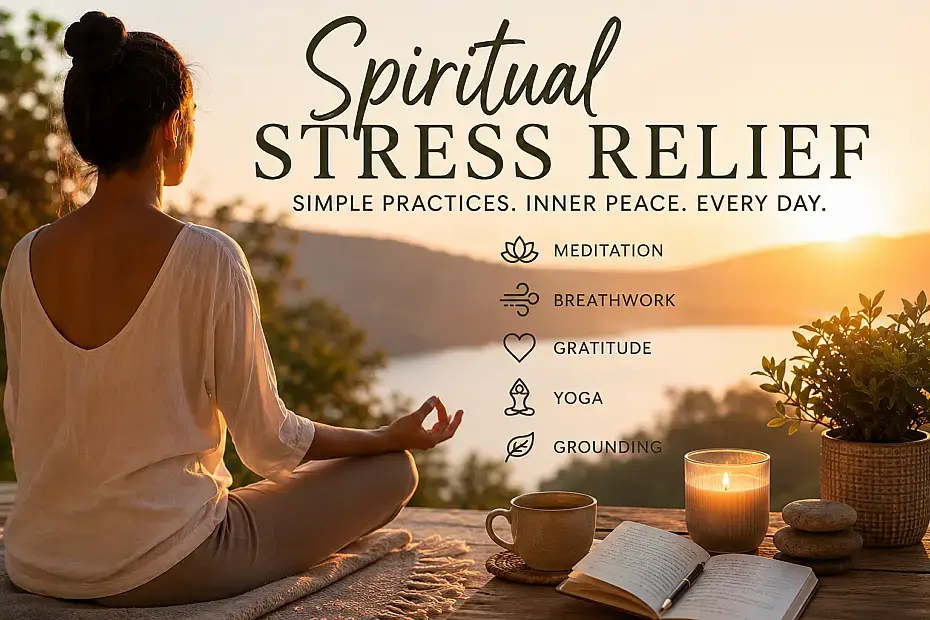
Spiritual Stress Relief is the use of simple daily rituals, such as meditation, breath-work, prayer, gratitude journaling, yoga, and grounding, to calm the mind, relax the body, and reconnect with inner peace. These practices help reduce everyday stress by encouraging you to slow down, feel more present, and respond to life’s challenges with greater emotional balance.
Stress can leave you feeling disconnected from yourself. Your thoughts may race, your body may feel tense, and even small tasks can begin to feel overwhelming. When life feels heavy, Spiritual Stress Relief offers a gentle way to pause, breathe, and return to yourself.
You do not need to follow a specific religion to benefit from these practices. Spirituality can be deeply personal. It may mean connecting with God, nature, your higher self, your inner wisdom, or simply a quiet sense of meaning. What matters most is that the practice helps you feel grounded, supported, and calm.
This guide explores practical ways to bring these calming spiritual practices into everyday life, even if you only have a few minutes a day.
What Is Spiritual Stress Relief?
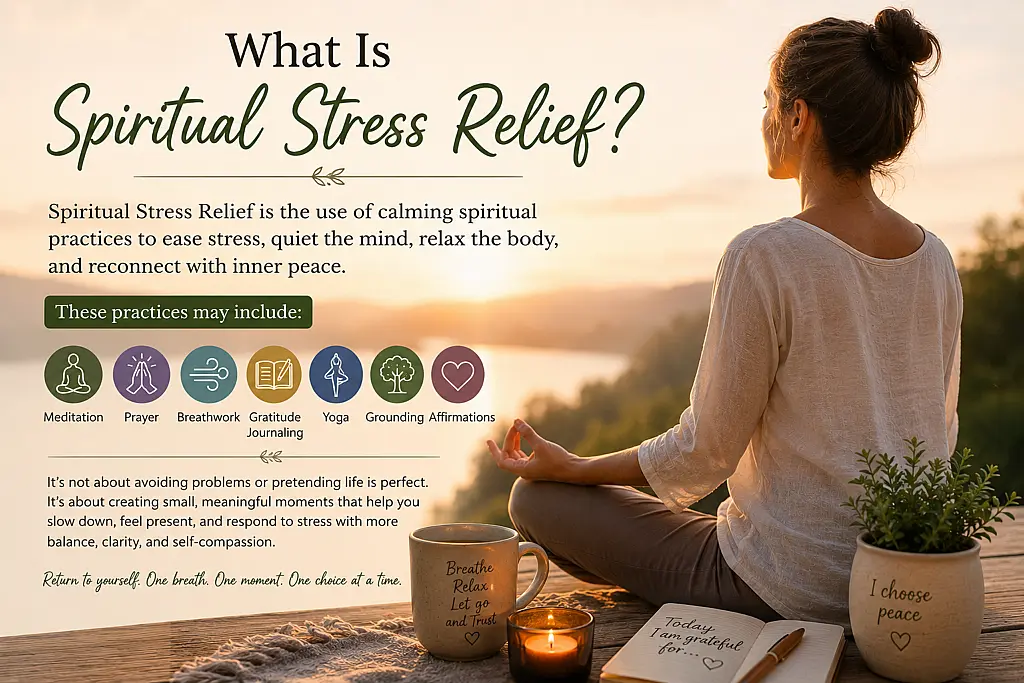
Spiritual Stress Relief means using meaningful, calming practices to ease stress and restore a sense of connection. It is not about escaping your responsibilities or pretending life is easy. It is about creating small moments of peace that help you meet stress with more awareness and less tension.
For some people, this may include prayer, meditation, scripture, or devotional time. For others, it may include journaling, breath-work, mindful movement, time in nature, or quiet reflection. There is no single right way to practice it.
At its heart, Spiritual Stress Relief helps you ask deeper questions during stressful moments:
What do I need right now?
What can I release?
What is still supporting me?
How can I respond with calm instead of fear?
These questions shift your focus from panic to presence. Over time, that shift can change how you experience stress.
Why Spiritual Practices Can Help With Stress
When stress builds up, your nervous system can move into survival mode. You may become irritable, restless, anxious, emotionally drained, or unable to think clearly. Spiritual practices create a pause between what is happening around you and how you respond.
That pause is powerful.
A few deep breaths, a moment of prayer, a grounding ritual, or a quiet meditation can help your body soften and your thoughts slow down. These practices do not remove every problem, but they can help you feel less controlled by stress.
Spirituality can also bring comfort because it reminds you that you are more than your worries. Whether you connect with faith, nature, energy, or your own inner wisdom, a spiritual practice can help you feel held by something bigger than the pressure of the moment.
1. Begin With Mindful Breathing
Breathing is one of the simplest ways to calm stress quickly. When you feel overwhelmed, your breath often becomes shallow without you noticing. By slowing your breathing, you send a gentle signal to your body that it is safe to relax.
Try this simple practice:
Sit comfortably and place one hand on your heart or stomach.
Breathe in through your nose for four counts.
Pause for one count.
Exhale slowly for six counts.
Repeat for one to three minutes.
As you breathe, silently say, “I am here. I am safe. I can take this one moment at a time.”
This is a simple form of Spiritual Stress Relief because it brings your attention away from racing thoughts and back into the present moment. You can use it before a difficult conversation, after a busy day, while sitting in your car, or before going to sleep.
2. Practice Meditation for Inner Calm
Meditation does not require a perfect routine, a silent home, or an empty mind. It simply asks you to sit with yourself and notice what is happening inside.
Start with five minutes.
Close your eyes or soften your gaze. Notice your breath. Let thoughts come and go without chasing them. When your mind wanders, gently return to your breathing. That return is the practice.
For a more spiritual focus, you can repeat a calming phrase such as:
I return to peace.
I release what I cannot control.
I am supported in this moment.
Peace begins with one breath.
Meditation helps you become less tangled in stressful thoughts. Instead of believing every worry, you learn to observe it. With practice, this can make stress feel less overwhelming and easier to manage.
3. Use Prayer or Intention Setting
Prayer gives your worries somewhere to go. It can be deeply comforting because it allows you to speak honestly about what you are carrying.
Your prayer does not need to be formal. It can be as simple as:
“Please help me feel calm. Help me release what is not mine to carry. Guide me toward the next right step.”
If prayer does not feel natural to you, try setting an intention instead. An intention is a simple statement that guides your energy and choices.
You might say:
Today, I choose peace over pressure.
Today, I will move gently.
Today, I will listen to what my body needs.
Today, I allow myself to be supported.
This practice works well in the morning because it gives your day a clear emotional direction before stress has a chance to take over.
4. Keep a Gratitude Journal
Gratitude journaling is not about ignoring what hurts. It is about training your mind to notice what is still steady, beautiful, or supportive, even during difficult seasons.
At the end of the day, write down three things you are grateful for. They can be small:
A warm drink.
A kind message.
A quiet moment.
Fresh air.
A task you completed.
A feeling of relief.
Then write one sentence about why each one mattered. This turns gratitude into reflection instead of a rushed list.
For example, instead of writing “I am grateful for tea,” you might write, “I am grateful for my cup of tea because it gave me five quiet minutes to breathe.”
This simple habit can soften the heaviness of the day and help you end the evening with a calmer heart.
5. Move Your Body With Gentle Yoga or Stretching
Stress often lives in the body. You may feel it in your shoulders, jaw, chest, stomach, or back. Gentle movement helps release that tension and reconnects you with your body in a compassionate way.
You do not need to be flexible or experienced. Try slow, simple movements such as:
Child’s pose
Cat-cow stretch
Seated forward fold
Legs up the wall
Gentle neck rolls
Shoulder circles
As you move, breathe slowly and ask yourself, “Where can I soften?”
Yoga and stretching become Spiritual Stress Relief when you move with awareness instead of rushing through the motions. The aim is not performance. The aim is presence.
Even five minutes of gentle movement can help you feel more settled after a stressful day.
6. Create a Grounding Ritual
Grounding helps bring your attention back to the present when your mind is racing ahead. It is especially useful when stress makes you feel scattered, emotional, or disconnected.
Try this five-senses grounding ritual:
Name five things you can see.
Name four things you can feel.
Name three things you can hear.
Name two things you can smell.
Name one thing you appreciate.
You can also ground yourself through nature. Step outside, feel the air on your face, sit under a tree, walk barefoot on grass, or place your hands in soil while gardening.
Nature has a quiet way of reminding us that life moves in seasons. You do not have to bloom all the time. Rest is also part of growth.
This type of practice is simple, but it can be deeply effective when practiced regularly.
Want to feel even more grounded?
Explore our guide to crystals for protection and grounding to discover simple tools that can support calm, energetic safety, and a stronger connection to the present moment.
7. Repeat Supportive Affirmations
Affirmations are short, intentional phrases that help redirect your thoughts. They work best when they feel honest and believable.
Instead of forcing yourself to say, “I am never stressed,” choose words that meet you where you are.
Try:
I am learning to feel calm.
I can take this one breath at a time.
I do not have to carry everything today.
I am allowed to rest.
I trust myself to move through this.
Repeat your affirmation while breathing, walking, journaling, or standing in front of the mirror. Let the words become a gentle reminder rather than a demand.
Affirmations are most powerful when paired with action. If you say, “I am allowed to rest,” support that statement by taking a real break.
8. Explore Energy-Based Practices
Some people find comfort in energy-based practices such as Reiki, Qi Gong, chakra balancing, or sound healing. These practices are often used to encourage relaxation, emotional release, and a deeper sense of balance.
Qi Gong combines slow movement, breathing, and focused awareness. Reiki is usually experienced as a calming session where a practitioner uses gentle touch or hands-off techniques to support relaxation. Sound healing may use bowls, chimes, or tones to create a soothing environment.
These methods are best used as complementary practices. They should not replace medical care, therapy, or professional mental health support. However, if they resonate with you, they can be a meaningful part of your self-care routine.
Spiritual Stress Relief is personal, so it is okay to explore what feels supportive and leave behind what does not.
Curious about sound as a spiritual practice?
Try these sound healing techniques to create a peaceful ritual using music, vibration, singing bowls, or calming frequencies.
9. Build a Simple Daily Routine
The most helpful spiritual practice is the one you can actually keep doing. A routine does not need to be long or complicated to be effective.
Try this five-minute practice:
One minute of slow breathing
One minute of gratitude
One minute of stretching
One minute of prayer or intention
One minute of silence
That is enough to shift the tone of your day.
You might practice in the morning before checking your phone, during a lunch break, after work, or before bed. Choose a time that feels realistic.
The more often you return to your practice, the more it becomes an anchor. Spiritual Stress Relief works best when it becomes part of your rhythm, not another task you feel guilty about missing.
How to Choose the Right Practice for You
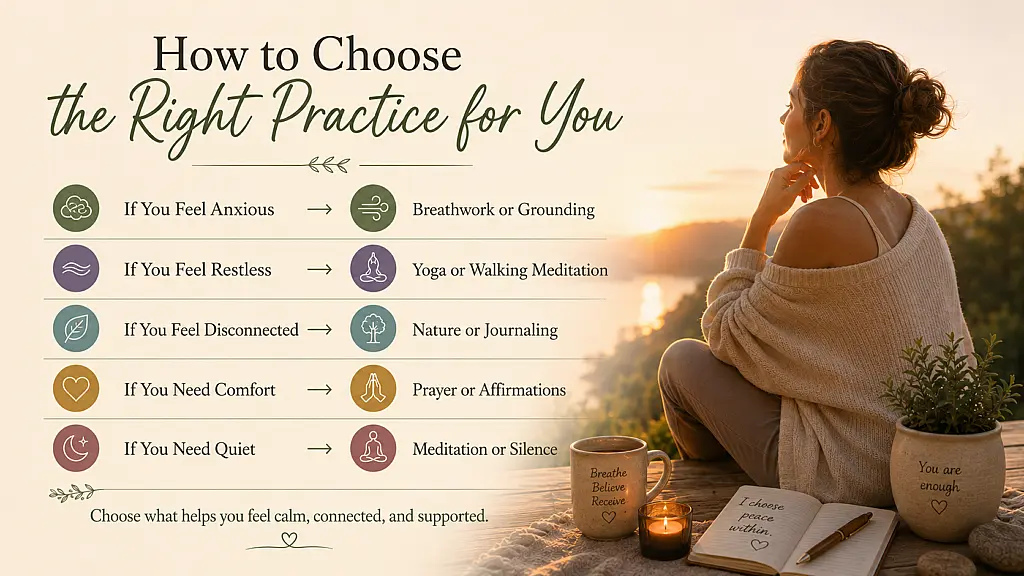
Not every spiritual practice will feel right for every person. That is normal. The best practice is the one that helps you feel calm, connected, and more like yourself.
If sitting still feels difficult, try walking meditation or gentle yoga.
If journaling feels hard, try voice notes.
If prayer feels uncomfortable, try intention setting.
If affirmations feel forced, try grounding.
If you feel disconnected, spend time in nature.
Ask yourself:
What helps me feel safe?
What helps me feel present?
What helps me feel connected?
What feels calming rather than pressured?
Your practice should support you. It should not become another reason to criticize yourself.
When Stress Feels Too Heavy
Spiritual practices can be deeply supportive, but they are not a replacement for professional help. If stress is affecting your sleep, relationships, appetite, work, or ability to cope, consider speaking with a doctor, counsellor, therapist, or mental health professional.
There is strength in asking for support.
Spirituality and professional care can work together. You can meditate and see a therapist. You can pray and ask for help. You can practice gratitude and still admit that life feels hard.
True healing makes room for honesty.
Ready to create a calmer spiritual routine?
Start by refreshing your space with these simple energy clearing home remedies so your environment supports peace, rest, and balance.
Final Thoughts
Stress can pull you away from your center, but small spiritual practices can help you return to yourself. You do not need to change your entire life overnight. Begin with one breath, one prayer, one stretch, one page in your journal, or one quiet moment outside.
This practice is not about escaping life. It is about meeting life with more calm, compassion, and inner strength.
Start with one practice today. Let it be simple. Let it be honest. Let it bring you back to yourself.
FAQs
What is Spiritual Stress Relief?
Spiritual Stress Relief is the use of calming spiritual practices, such as meditation, prayer, breath-work, gratitude, yoga, and grounding, to ease stress and reconnect with inner peace.
What are the best spiritual practices for stress?
The best spiritual practices for stress include mindful breathing, meditation, prayer, gratitude journaling, gentle yoga, affirmations, nature grounding, and quiet reflection.
Can spiritual practices help with anxiety?
Spiritual practices may help some people feel calmer and more grounded. However, ongoing anxiety should be discussed with a qualified mental health professional.
Do I need to be religious to use spiritual practices?
No. Spiritual practices can be religious, non-religious, or deeply personal. What matters is choosing practices that help you feel calm, connected, and supported.
How often should I practice?
Start with five minutes a day. A short daily practice is often more realistic and helpful than a long routine you struggle to maintain.
Support Your Spiritual Self-Care Journey
Want to make your Spiritual Stress Relief practice more intentional? These reader-favorite journals can help you track your emotions, energy, rituals, crystals, and personal growth.
Explore the Moon Planner Journal for lunar reflection and the Crystal Journal for grounding, chakra work, and crystal healing.