Daily spiritual meditation practices for inner peace involve taking a few intentional minutes each day to calm your mind, reconnect with yourself, and cultivate a greater sense of emotional balance. Unlike meditation that focuses only on relaxation, spiritual meditation combines mindfulness with personal reflection, gratitude, compassion, or spiritual beliefs to help you feel more grounded and at peace.
Have you ever reached the end of the day feeling physically present but mentally scattered?
Your body may be sitting quietly, yet your thoughts continue racing. Conversations replay in your mind. Worries about tomorrow compete with regrets from yesterday. Even when everything around you becomes still, finding inner peace can feel surprisingly difficult.
That’s one of the reasons so many people begin exploring daily spiritual meditation practices.
The good news is that you don’t need to meditate for an hour.
You don’t need years of experience.
And you certainly don’t need to “empty your mind.”
A simple daily practice—even just ten minutes—can become a powerful way to slow down, reconnect with the present moment, and create a greater sense of calm in everyday life.
Whether your spirituality comes from faith, nature, mindfulness, gratitude, or simply a desire to understand yourself more deeply, meditation offers an opportunity to pause, breathe, and reconnect with what matters most.
In this guide, you’ll discover:
- What daily spiritual meditation practices really are.
- How spiritual meditation differs from mindfulness alone.
- The emotional and mental benefits of creating a daily practice.
- Seven beginner-friendly spiritual meditation techniques.
- How to build a routine you’ll actually stick with.
- Common mistakes that can make meditation feel harder than it needs to be.
By the end of this guide, you’ll have a practical understanding of how to create a meditation practice that supports your emotional wellbeing, encourages inner peace, and fits naturally into your everyday life.
What Are Daily Spiritual Meditation Practices?
At its heart, daily spiritual meditation practices are about creating intentional moments of stillness to reconnect with yourself.
Unlike meditation that focuses purely on relaxation or concentration, spiritual meditation invites you to explore something deeper. That might be your values, your faith, your purpose, your connection with nature, or simply the quiet awareness that often gets lost in the busyness of everyday life.
There isn’t one “correct” way to practise.
For some people, spiritual meditation includes prayer.
Others prefer silent reflection, mindful breathing, gratitude, visualisation, or spending quiet time outdoors.
The common thread isn’t the technique.
It’s the intention.
Instead of trying to escape your thoughts, spiritual meditation encourages you to observe them with curiosity rather than judgement.
Over time, this simple shift can help you respond more calmly to stress, become more aware of your emotions, and develop a stronger sense of inner balance.
If you’re learning to become more aware of your emotions and energy, you may also enjoy our guide to How to Know If You’re Absorbing Someone Else’s Emotions, which explores why some people feel emotionally affected by the moods and energy of those around them.
One of the biggest misconceptions about meditation is that your mind should become completely empty.
That’s simply not how the human brain works.
Thoughts will come and go.
The goal isn’t to stop them.
The goal is to notice them without allowing every thought to pull you away from the present moment.
Like any skill, this becomes easier with regular practice.
Regular meditation has also been widely studied for its potential wellbeing benefits. According to the American Psychological Association (APA), mindfulness and meditation may help support stress management, emotional regulation, and overall wellbeing when practiced consistently.
That’s why consistency matters far more than perfection.
Even a few minutes each day can gradually become a peaceful habit that supports your emotional wellbeing.
Why Inner Peace Is Something You Practise—Not Something You Find
Many of us spend years searching for peace in the wrong places.
We tell ourselves:
“I’ll feel calmer once work becomes less stressful.”
“Everything will be better after this busy season.”
“I’ll start looking after myself when I have more time.”
The problem is that life rarely slows down on its own.
There will always be another responsibility.
Another deadline.
Another unexpected challenge.
If your peace depends on perfect circumstances, you’ll probably spend a lifetime waiting for them.
Daily spiritual meditation offers a different perspective.
Rather than searching for peace somewhere outside yourself, you begin creating it from within.
You learn to pause before reacting.
To breathe before becoming overwhelmed.
If you’re new to mindful breathing, our guide to Micro Breathwork Practices introduces simple techniques that take just a few minutes and pair beautifully with meditation.
To notice your thoughts without believing every one of them.
To appreciate small moments that would otherwise pass unnoticed.
None of these changes happen overnight.
They’re built quietly through small daily habits.
Five mindful minutes.
Ten peaceful breaths.
A few moments of gratitude before the day begins.
If gratitude and reflection are already part of your routine, you might also enjoy using a Moon Planner Journal to record your intentions, insights, and personal growth after each meditation session.
These simple practices may seem insignificant on their own.
But over weeks and months, they begin changing how you experience everyday life.
Inner peace isn’t usually found in one life-changing moment.
It’s cultivated through hundreds of small, intentional moments that gradually become part of who you are.
Signs You May Benefit From a Daily Spiritual Meditation Practice
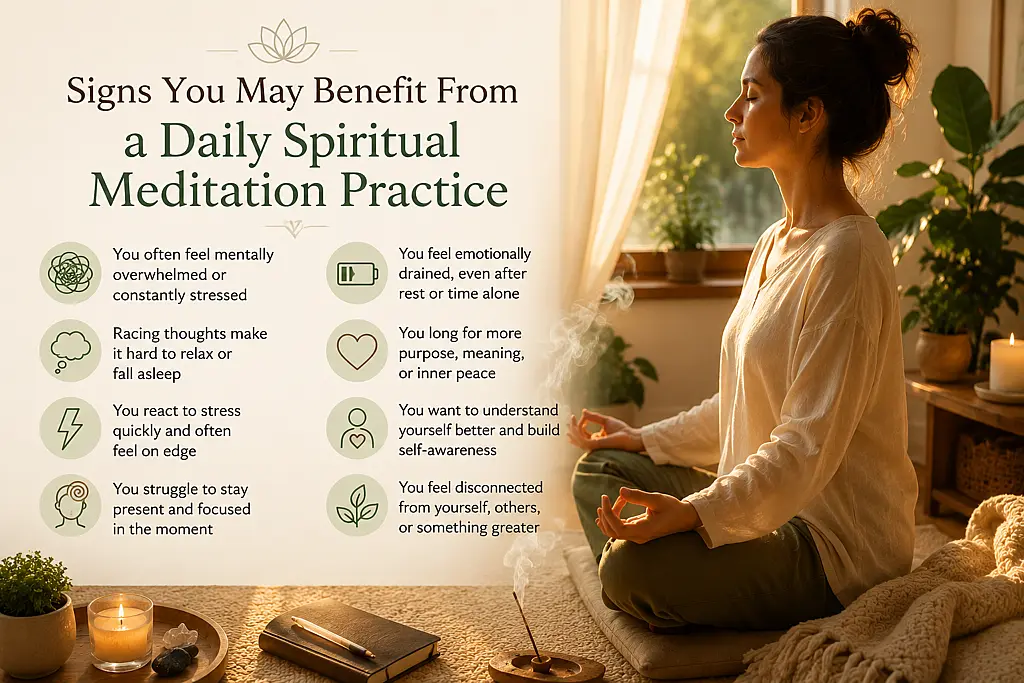
You don’t need to be experiencing a major life crisis to benefit from meditation.
Sometimes the biggest sign is simply feeling disconnected from yourself.
You may find that a daily spiritual meditation practice could help if you:
- Feel mentally overwhelmed, even when life seems relatively calm.
- Struggle to switch off racing thoughts at the end of the day.
- React to stress more quickly than you’d like.
- Find it difficult to stay present in everyday moments.
- Feel emotionally drained after busy days or social situations.
- Long for more purpose, clarity, or inner peace.
- Want to develop a healthier relationship with your thoughts.
- Feel pulled in too many directions and rarely make time for yourself.
If emotional exhaustion sounds familiar, our article Why Do I Feel Drained After Being Around Certain People? explores why some people feel mentally and emotionally depleted after certain interactions and offers practical ways to protect your energy.
These experiences are common.
They don’t mean you’re failing or doing something wrong.
Often, they’re simply signs that your mind has been carrying more than it was ever meant to carry without regular opportunities to rest.
Daily meditation won’t remove every challenge from your life.
What it can do is change how you meet those challenges.
Instead of constantly reacting to life’s demands, you begin responding from a calmer, more grounded place.
And sometimes, that small shift changes everything.
Why Daily Spiritual Meditation Can Transform Your Wellbeing
One of the reasons daily spiritual meditation practices have remained part of cultures around the world for thousands of years is because they offer more than a few moments of relaxation.
With regular practice, meditation can gradually change the way you respond to everyday life.
The challenges around you may not disappear.
Busy schedules still exist.
Difficult conversations still happen.
Unexpected setbacks still arise.
The difference is that your relationship with those experiences begins to change.
Instead of immediately reacting to stress, you become better at pausing.
Instead of feeling controlled by every thought, you learn to observe your thoughts with greater awareness.
That quiet shift often becomes the beginning of lasting inner peace.
Emotional Benefits
Many people begin meditating because they’re searching for relief from emotional overwhelm.
Over time, a consistent practice may help you:
- Feel calmer during stressful situations.
- Become more aware of emotional triggers.
- Respond with greater patience.
- Develop self-compassion.
- Feel less mentally overwhelmed.
- Experience a greater sense of gratitude.
If you’ve been feeling emotionally drained by other people, meditation also complements the techniques discussed in How to Know If You’re Absorbing Someone Else’s Emotions, helping you reconnect with your own thoughts and feelings before carrying everyone else’s.
Mental Benefits
A busy mind rarely becomes quiet overnight.
Meditation teaches you to gently bring your attention back to the present whenever your thoughts begin wandering.
With regular practice, many people notice improvements in:
- Mental clarity.
- Focus.
- Decision-making.
- Self-awareness.
- Emotional resilience.
- Overall mindfulness.
According to the National Center for Complementary and Integrative Health (NCCIH), meditation and mindfulness practices may help reduce stress and improve overall wellbeing for many people, although individual experiences can vary.
Spiritual Benefits
This is where spiritual meditation becomes different from many other forms of meditation.
Rather than focusing only on relaxation, spiritual meditation encourages a deeper connection with your inner world.
For some people, that means:
- Strengthening their faith.
- Feeling more connected to nature.
- Developing greater intuition.
- Living with more gratitude.
- Reflecting on life’s purpose.
- Feeling more present each day.
These experiences are deeply personal.
There is no right or wrong way to experience spiritual growth.
The goal isn’t to force a particular outcome.
It’s simply to create space where insight, peace, and self-awareness have an opportunity to grow naturally.
If you’re exploring your own spiritual journey, you may also enjoy our guide to Ancient Wisdom for Modern Life, which shares timeless practices that encourage greater balance and perspective.
Physical Benefits
Although spiritual meditation is often associated with emotional wellbeing, many people also notice physical changes as they establish a consistent practice.
These may include:
- Feeling more relaxed.
- Improved sleep quality.
- Reduced muscle tension.
- Slower, deeper breathing.
- Greater awareness of physical sensations.
When combined with healthy sleep habits, mindful movement, and breathwork, meditation becomes part of a broader approach to caring for both your mind and body.
If you’re looking to create a more peaceful evening routine, our Spiritual Bedtime Routine guide pairs beautifully with a daily meditation practice and can help you transition more gently into restful sleep.
Small Daily Practices Create Lasting Change
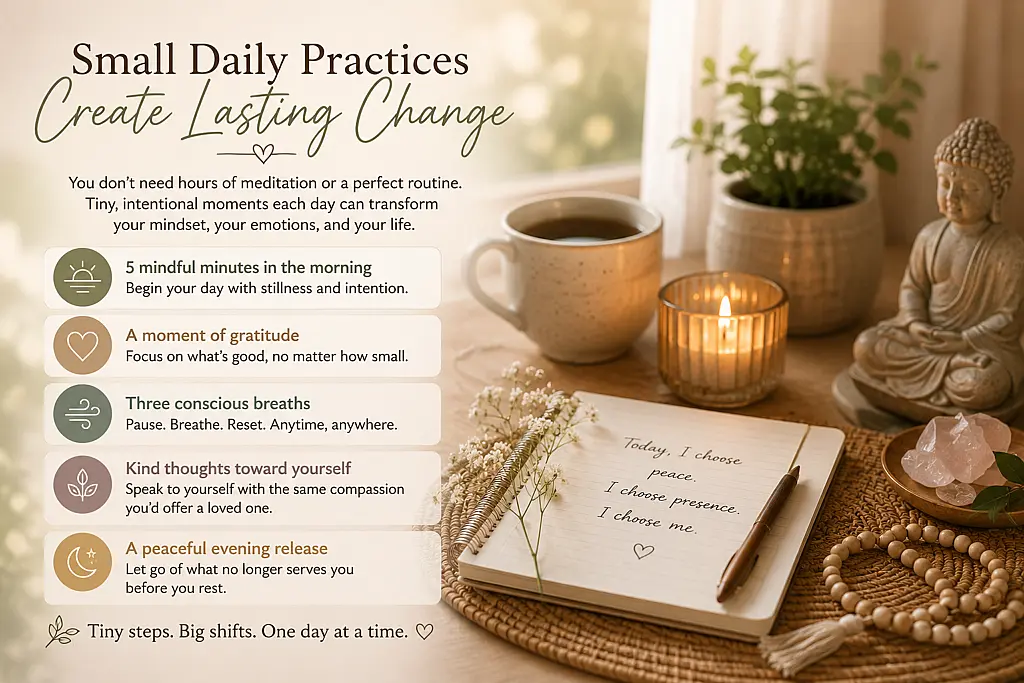
Many beginners believe meditation only works if they can sit perfectly still for thirty minutes every day.
The opposite is often true.
Five mindful minutes each morning.
A few slow breaths before an important meeting.
A moment of gratitude before bed.
These small rituals may seem insignificant on their own.
Yet they’re often the habits that last.
Daily spiritual meditation isn’t about achieving perfection.
It’s about showing up for yourself consistently.
Because lasting inner peace is rarely built through one extraordinary moment.
It’s built through hundreds of ordinary moments where you choose to pause, breathe, and reconnect with yourself.
7 Daily Spiritual Meditation Practices for Inner Peace
One of the biggest myths about meditation is that there’s only one “right” way to do it.
In reality, spiritual meditation is deeply personal.
Some people find peace through silence.
Others connect through gratitude, prayer, nature, or mindful breathing.
The best practice is the one you’ll return to consistently.
Here are seven simple daily spiritual meditation practices that can help you create greater calm, emotional balance, and inner peace.
1. Mindful Breath Meditation
Best for: Calming a busy mind.
Your breath is always with you.
That’s what makes it one of the easiest places to begin.
Sit comfortably.
Close your eyes if it feels comfortable.
Slowly inhale through your nose.
Exhale gently through your mouth.
Instead of trying to stop your thoughts, simply notice your breathing.
When your mind wanders—and it will—gently return your attention to your next breath.
Even five minutes can help create a sense of calm.
If you’d like to deepen this practice, our guide to Micro Breathwork Practices shares simple breathing techniques that complement meditation beautifully.
2. Gratitude Meditation
Best for: Shifting your mindset.
Gratitude doesn’t ignore life’s challenges.
It helps balance them.
Begin by taking a few slow breaths.
Then quietly reflect on three things you’re grateful for today.
They don’t need to be extraordinary.
Perhaps it’s:
- A peaceful morning.
- A supportive friend.
- A warm cup of tea.
- Time spent in nature.
- Your own resilience.
Over time, gratitude gently trains your attention to notice what’s already going well instead of focusing only on what’s missing.
Many people enjoy recording these reflections in a journal after each meditation session.
3. Loving-Kindness Meditation
Best for: Developing compassion without emotional exhaustion.
This meditation begins with yourself.
Silently repeat phrases like:
“May I be safe.”
“May I be peaceful.”
“May I be healthy.”
“May I live with ease.”
Gradually extend those wishes to people you care about, your wider community, and eventually even those you find difficult.
This practice isn’t about excusing harmful behaviour.
It’s about letting go of the emotional weight that resentment often creates.
4. Nature Meditation
Best for: Feeling grounded.
You don’t always need a meditation cushion.
Sometimes nature becomes the meditation.
Sit beneath a tree.
Walk slowly through a park.
Listen to birdsong.
Notice the breeze.
Observe sunlight moving through the leaves.
Allow your attention to rest fully in your surroundings.
Many people find this easier than sitting indoors because nature naturally encourages presence.
5. Visualization Meditation
Best for: Creating emotional calm.
Visualisation uses your imagination as a tool for relaxation.
Picture yourself somewhere peaceful.
Perhaps it’s:
- A quiet beach.
- A forest trail.
- A mountain at sunrise.
- A peaceful garden.
Notice the colours.
The sounds.
The air.
Allow yourself to experience the place as though you’re already there.
For many people, visualisation becomes one of the easiest ways to quiet a racing mind.
6. Silent Reflection Meditation
Best for: Self-awareness.
Sometimes the most meaningful meditation contains no guidance at all.
No music.
No affirmations.
No expectations.
Simply sit quietly.
Observe your thoughts.
Notice your emotions.
Allow whatever arises to come and go without judgement.
These moments often become opportunities to better understand yourself.
Not because you’re searching for answers.
But because you’re finally giving yourself permission to listen.
7. Evening Release Meditation
Best for: Ending the day peacefully.
Before bed, spend a few quiet minutes reflecting on your day.
Ask yourself:
- What challenged me today?
- What brought me joy?
- What can I let go of before tomorrow?
- What am I grateful for?
Take a few slow breaths.
Allow the day to come to a close.
This simple ritual can help create a clearer boundary between today’s worries and tomorrow’s possibilities.
You Don’t Need to Practice Every Technique
Reading seven meditation practices can feel overwhelming.
Please don’t feel like you need to do all of them.
Choose one.
Practise it for a week.
Notice how you feel.
Then decide whether you’d like to continue or explore another technique.
The most effective daily spiritual meditation practice isn’t the most advanced one.
It’s the one that becomes part of your everyday life.
A few mindful minutes each day will always have a greater impact than an hour-long meditation you only do once a month.
How to Build a Daily Spiritual Meditation Routine You’ll Actually Stick With
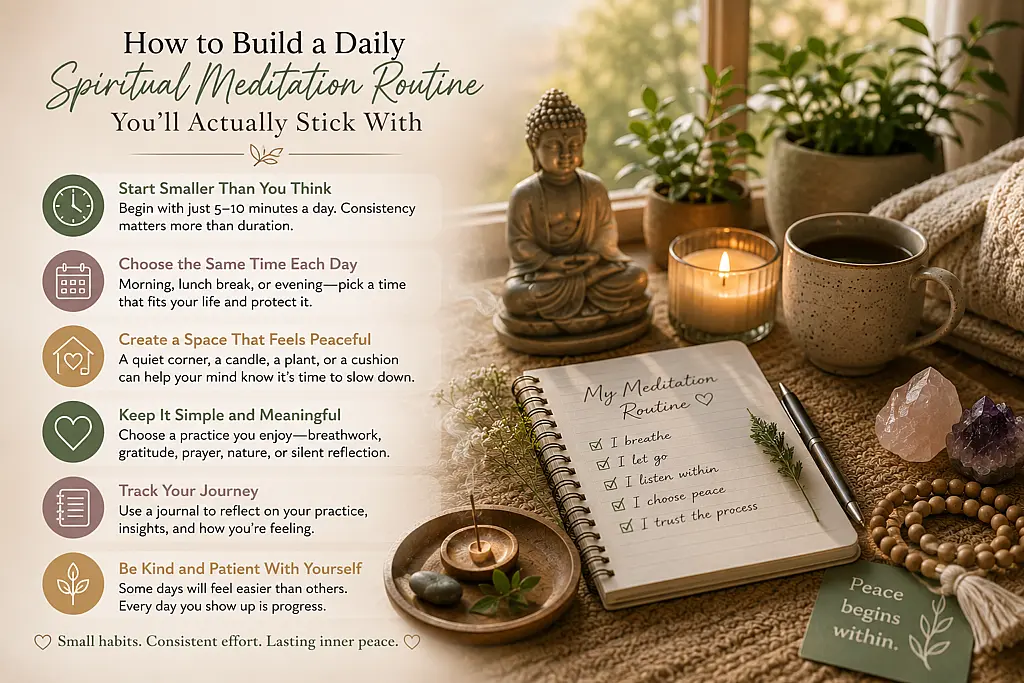
Starting a meditation practice is easy.
Sticking with it is where many people struggle.
The good news is that you don’t need perfect discipline.
You simply need a routine that feels realistic.
Many beginners give up because they believe meditation should look a certain way.
They think they need:
- Thirty uninterrupted minutes.
- Complete silence.
- A perfectly clear mind.
- A beautiful meditation room.
- Years of experience.
None of those things are necessary.
The most effective meditation practice is the one that naturally becomes part of your everyday life.
Start Smaller Than You Think
If you’re completely new to meditation, begin with just five minutes.
That’s enough.
As the habit becomes more comfortable, you can gradually increase the time if you wish.
Remember…
Consistency will always have a greater impact than occasional long sessions.
Five minutes every day is far more valuable than an hour once every few weeks.
Choose the Same Time Each Day
Our brains respond well to routines.
Meditating at the same time each day removes the need to constantly decide when you’ll do it.
Some people enjoy meditating:
- First thing in the morning.
- During a lunch break.
- After work.
- Before bed.
There isn’t a perfect time.
The best time is the one you can maintain consistently.
If you’re looking for a peaceful way to finish the day, our Spiritual Bedtime Routine shares simple habits that combine beautifully with evening meditation.
Create a Space That Feels Peaceful
You don’t need a dedicated meditation room.
A quiet corner is enough.
Consider adding a few calming touches, such as:
- A comfortable meditation cushion.
- A journal for reflection.
- Soft lighting.
- A candle.
- An essential oil diffuser.
- A favourite blanket.
- A small plant or natural elements.
The goal isn’t to create the perfect aesthetic.
It’s to create a space your mind begins associating with calm.
If you’re building a peaceful environment at home, our guide to Empath Tools shares simple products that support relaxation and mindfulness without feeling overwhelming.
Common Mistakes That Make Meditation Feel Harder Than It Needs to Be
If meditation hasn’t worked for you in the past, it doesn’t necessarily mean you were doing it wrong.
Many beginners simply expect too much too soon.
Here are some of the most common misconceptions.
Expecting Your Mind to Become Completely Quiet
Thoughts are normal.
Meditation isn’t about eliminating them.
It’s about noticing them without allowing every thought to carry you away.
Every time you gently return your attention to your breath or your chosen focus, you’re strengthening your mindfulness.
That’s the practice.
Judging Yourself
Many people finish a meditation session thinking:
“I wasn’t very good at that.”
There isn’t a score.
No one is grading your meditation.
Simply showing up is enough.
Progress comes through consistency, not perfection.
Waiting Until Life Feels Less Busy
Ironically, the times when meditation feels hardest are often the times when it’s needed most.
You don’t have to wait until everything settles down.
Meditation can become the very thing that helps you navigate life’s busy seasons with greater clarity.
Comparing Your Journey to Someone Else’s
Every person’s meditation practice looks different.
Some people enjoy silence.
Others prefer guided meditations.
Some connect through prayer.
Others feel closest to themselves while walking in nature.
There is no single path to inner peace.
Trust the practice that feels meaningful to you.
How Long Does It Take to Notice the Benefits?
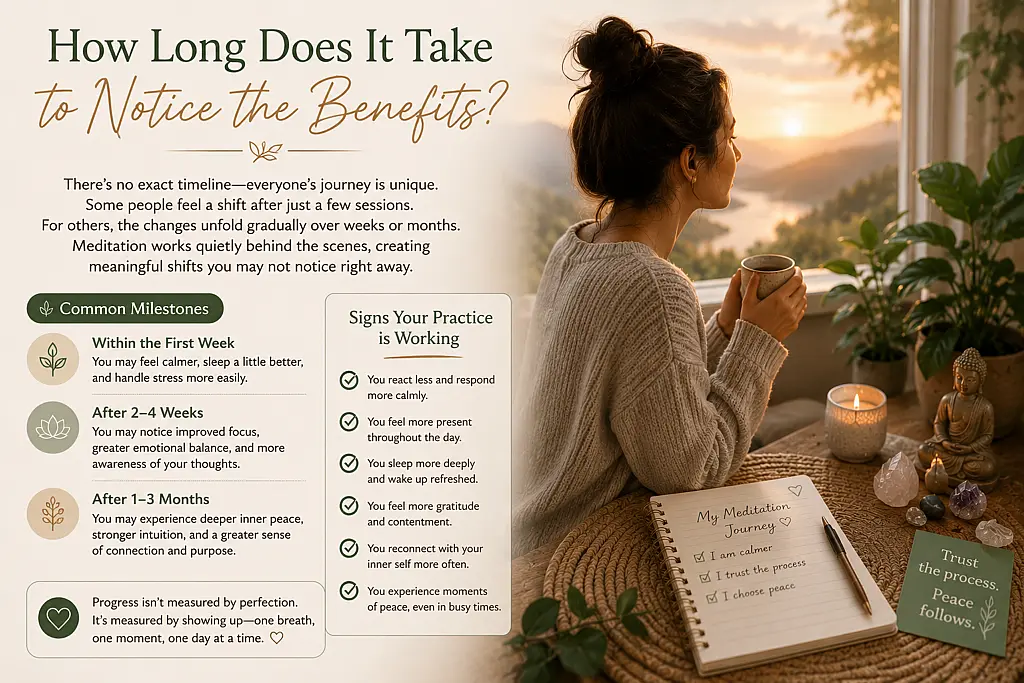
One of the most common questions beginners ask is:
“When will I start feeling different?”
The honest answer is…
Everyone’s experience is different.
Some people notice a sense of calm after their very first session.
Others don’t notice significant changes until they’ve practised consistently for several weeks.
Instead of looking for one dramatic breakthrough, pay attention to the small changes.
Perhaps you:
- Pause before reacting.
- Sleep a little better.
- Feel less overwhelmed.
- Become more patient.
- Recover from stressful situations more quickly.
- Notice moments of gratitude throughout your day.
These quiet changes often become the strongest signs that your meditation practice is taking root.
Inner peace rarely arrives all at once.
It grows gradually through consistent, intentional practice.
And before you realise it, those few quiet minutes each day begin shaping the way you experience the rest of your life.
Frequently Asked Questions
How long should I practice spiritual meditation each day?
If you’re just starting, five to ten minutes is more than enough.
Building a consistent habit is far more important than meditating for long periods.
As your practice develops, you may naturally choose to meditate for longer, but there’s no ideal length that works for everyone.
Can beginners practice spiritual meditation?
Absolutely.
You don’t need previous experience, special equipment, or extensive knowledge to begin.
The simplest practices—such as mindful breathing, gratitude, or quiet reflection—are often the most effective places to start.
What’s the difference between mindfulness and spiritual meditation?
Mindfulness focuses on paying attention to the present moment without judgement.
Spiritual meditation also encourages presence, but often includes a deeper exploration of purpose, gratitude, compassion, faith, or your personal connection to something greater than yourself.
Many people naturally combine both practices.
Can spiritual meditation reduce stress?
Many people find that regular meditation helps them feel calmer and better able to manage everyday stress.
Research also suggests that mindfulness and meditation may support stress reduction and emotional wellbeing when practised consistently.
However, meditation isn’t a replacement for professional medical or mental health care when it’s needed.
What if my mind won’t stop thinking?
That’s completely normal.
Meditation isn’t about having no thoughts.
It’s about noticing your thoughts without becoming caught up in every one of them.
Every time you gently return your attention to your breath or your chosen point of focus, you’re strengthening your mindfulness practice.
Do I need to follow a particular religion?
No.
Spiritual meditation can be practised by people from many different faiths, as well as those who don’t identify with any religion.
Your practice can reflect your own beliefs, values, and personal experiences.
Is morning or evening meditation better?
Both have unique benefits.
Morning meditation can help you begin the day feeling calm and focused.
Evening meditation provides an opportunity to release stress and transition into restful sleep.
The best time is simply the time you’re most likely to practise consistently.
Final Thoughts
Developing daily spiritual meditation practices for inner peace isn’t about escaping life’s challenges.
It’s about changing the way you meet them.
Life will always include busy days.
Unexpected setbacks.
Moments of uncertainty.
Meditation doesn’t remove those experiences.
What it often changes is your response.
Instead of reacting automatically, you begin responding with greater awareness.
Instead of feeling overwhelmed by every thought, you learn to observe them with compassion.
Instead of searching for peace somewhere outside yourself, you gradually discover that it has been quietly growing within you all along.
Remember…
You don’t need the perfect routine.
You don’t need expensive equipment.
You don’t need an hour of uninterrupted silence.
All you need is the willingness to pause.
To breathe.
To listen.
And to return to yourself, one peaceful moment at a time.
If you’re continuing your journey towards greater emotional wellbeing and spiritual growth, you may also enjoy these guides:
- Micro Breathwork Practices – Learn simple breathing techniques that naturally complement meditation.
- Empath Tools – Create a calming environment that supports mindfulness and daily self-care.
- How to Know If You’re Absorbing Someone Else’s Emotions – Explore emotional awareness and healthy energetic boundaries.
- Why Do I Feel Drained After Being Around Certain People? – Understand emotional exhaustion and practical ways to protect your energy.
- Spiritual Bedtime Routine – Build an evening ritual that encourages deep relaxation and restorative sleep.
- Ancient Wisdom for Modern Life – Discover timeless practices for living with greater intention and balance.
- Spiritual Awakening Books – Explore thought-provoking books that inspire personal growth and self-discovery.
Wherever you are on your journey, remember this:
Inner peace isn’t something you eventually arrive at.
It’s something you gently practice, nurture, and choose—one mindful breath, one quiet moment, and one day at a time.

This guide was written and edited by Donna and Iain at Feel Better Within. It combines spiritual self-care, beginner-friendly meditation practices, and general wellbeing education to help readers create a simple daily routine for inner peace. It is designed for reflection and support, not diagnosis or treatment.
Cite or share this page
Want to reference this guide? Please link to the canonical page rather than copying the article.