

You may be absorbing someone else’s emotions if your mood suddenly changes after being near them, talking to them, texting them, or thinking about them — especially when the feeling does not match what was happening in your own life. Many empaths describe this as walking into a room feeling fine, then leaving anxious, sad, tense, angry, guilty, or heavy without knowing why.
This can also show up as physical empath traits, where your body reacts to emotional energy before your mind has caught up.
This article explores emotional absorption from an empath and spiritual self-care perspective. Mood changes can also be connected to stress, anxiety, trauma, relationship pressure, tiredness, health issues, or other life factors. Use this as a reflection tool, not a diagnosis.
Signs You May Be Absorbing Someone Else’s Emotions
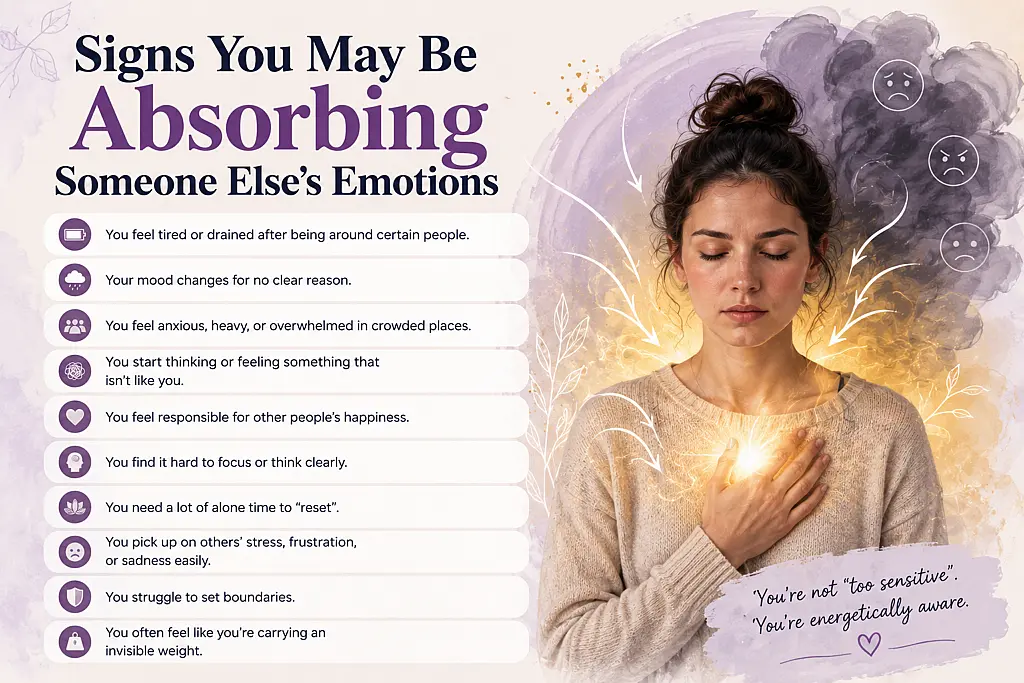
You might be absorbing someone else’s emotions if you feel anxious after speaking to an anxious person, sad after comforting someone, angry after being around conflict, or guilty when you create space.
You may also notice:
- Your mood shifts quickly around certain people.
- You feel heavy after emotional conversations.
- You feel responsible for fixing someone’s feelings.
- You cannot tell whether the emotion started with you.
- You feel better after distance, quiet, or grounding.
- You absorb the atmosphere of a room almost instantly.
If you often feel responsible for fixing people’s moods, read how to stop feeling responsible for everyone’s emotions.
Empathy Vs Emotional Absorption
Empathy says, “I understand how you feel.”
Absorption says, “Now I feel it too, and I think it belongs to me.”
That difference matters.
Healthy empathy lets you care while staying connected to yourself. Emotional absorption blurs the line. You may begin managing someone else’s mood as if it is yours to solve.
This is where empath boundaries become essential. Boundaries are not walls. They are the front door to your peace.
The Three-Question Energy Check
When your mood suddenly changes, pause and ask:
1. What was I feeling before this interaction?
This helps you spot whether the emotion was already present or arrived later.
2. What changed in my body?
Notice tension, heaviness, stomach knots, pressure in the chest, or sudden fatigue.
3. Is this mine to process, or theirs to carry?
This question helps you step out of automatic rescuing.
Then say:
“I can witness this without becoming it.”
“I can care without carrying.”
“I return to myself now.”
If you often feel emotionally porous, these energy shielding techniques for empaths can help you feel less exposed.
If absorption happens strongly after certain people, read why you feel drained after being around certain people.
FAQ
Can You Really Absorb Someone Else’s Emotions?
From a spiritual empath perspective, many people describe it that way. From a practical wellness perspective, it can also mean you are highly responsive to tone, tension, body language, conflict, or emotional pressure. Either way, the solution is similar: slow down, check what is yours, and build boundaries.
How Do I Stop Taking On Other People’s Feelings?
Start by pausing before reacting. Ask whether the emotion belongs to you. Use grounding, take space, reduce over-explaining, and practice clear boundaries. You can care without making someone else’s mood your full-time job.
Final Thought
If you If you’re highly responsive to other people’s tone, tension, or visible emotions, your sensitivity may be strong — but it still needs structure. easily, your sensitivity may be strong — but it still needs structure. A gift without boundaries becomes a leak. Your compassion deserves a container.

This article offers general wellbeing education and spiritual reflection. It is not medical or mental health advice, and a spiritual interpretation should not replace professional assessment. Seek qualified support for persistent fatigue, pain, sleep disruption, anxiety, low mood or other symptoms that concern you.
Cite or share this page
Want to reference this guide? Please link to the canonical page rather than copying the article.