

Physical empath traits are emotional and physical experiences reported by some people who identify as highly sensitive or empathic. These experiences may include feeling tired after intense conversations, developing muscle tension in stressful environments, becoming overwhelmed in crowds, or noticing that your mood changes around certain people.
The term “physical empath” is commonly used in spiritual and wellness communities. It is not a recognised medical or psychological diagnosis, and there is no reliable evidence that one person’s physical symptoms are directly transferred into another person’s body.
That does not mean your experience is imaginary. Stress, empathy, emotional labour, sensory overload, hypervigilance, poor sleep, dehydration, anxiety, posture, illness, and other factors can all create genuine physical sensations.
The safest approach is to remain curious without immediately deciding that every headache, racing heartbeat, pain, or feeling of exhaustion belongs to someone else.
Important health note: New, severe, unexplained, or persistent physical symptoms should be discussed with a qualified health professional. Do not use the empath label to explain away chest pain, breathing difficulties, fainting, severe headaches, heart palpitations, or other concerning symptoms.
What Is A Physical Empath?
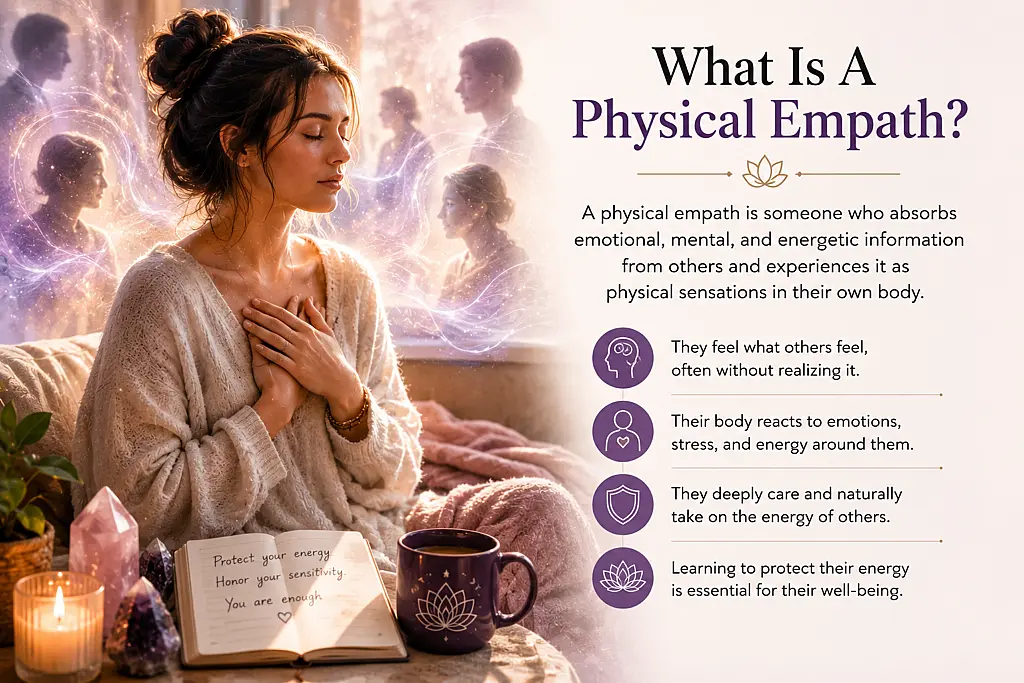
A physical empath is a non-clinical term used by someone who feels strongly affected by the emotions, stress, or atmosphere around them and notices those experiences through bodily sensations.
For example, they may feel tense during conflict, exhausted after supporting a distressed friend, overwhelmed in a crowded environment, or physically unsettled when a room feels emotionally charged.
These reactions do not prove that another person’s pain or energy has entered their body. They may reflect emotional attunement, observation of subtle social cues, sensory overload, stress responses, past experiences, or a combination of several factors.
You can respect the spiritual meaning you give these experiences while also considering ordinary physical and psychological explanations.
Why Physical Empaths Feel Emotions In Their Bodies
One of the biggest questions people ask after learning about physical empath traits is simple:
Why does someone else’s stress feel like it’s happening inside my body?
While many physical empaths describe their experiences in spiritual or energetic terms, there are also practical explanations that can help make sense of what you’re feeling.
Some people naturally process emotional information more deeply than others.
Research into highly sensitive people suggests that certain individuals are more aware of subtle emotional cues, facial expressions, body language, tone of voice, and changes in their environment. Instead of filtering out this information, their brains absorb and process it on a much deeper level.
Imagine walking into a room where nobody is speaking.
Most people might simply notice that it’s quiet.
A physical empath often notices much more.
The tension between two people avoiding eye contact.
The sadness hidden behind a smile.
The nervous energy of someone trying to appear confident.
The emotional atmosphere that seems to linger in the air.
Even when nobody says a word, your nervous system may already be responding.
Over time, this heightened awareness can create physical reactions.
You might notice:
- Tightness in your shoulders
- A sudden headache
- A knot in your stomach
- Unexpected fatigue
- Difficulty concentrating
- Emotional overwhelm
These experiences don’t necessarily mean something is wrong with you.
In many cases, they simply reflect how deeply your mind and body process the world around you.
This is one reason why so many people who identify with physical empath traits often feel exhausted after spending time in emotionally charged environments.
Their nervous system has been working overtime.
The challenge isn’t that you’re imagining things.
The challenge is that your body may be responding to emotional information that most people never consciously notice.
Understanding this can be incredibly freeing.
Because when you realize your sensitivity has a purpose, you stop viewing it as a weakness.
You begin viewing it as information.
Information that can help you make healthier choices about the people, environments, and situations you allow into your life.
The goal isn’t to become less sensitive.
The goal is to learn how to support your nervous system so your empathy becomes a strength rather than a source of constant exhaustion.
And that starts with understanding how deeply connected your emotions and physical experiences truly are.
If you’re unsure whether you are an empath, a highly sensitive person, or both, this guide on highly sensitive person vs empath explains the key differences clearly.
Why Physical Empath Traits Feel So Intense
The world can feel overwhelming when you notice and respond to a great deal of emotional and sensory information.
Many people who identify with physical empath traits become the listeners, helpers and comforters others turn to during difficult times. Supporting people can feel meaningful, but it can also require sustained attention and emotional effort.
Over time, you may become tired from listening to distressing experiences, worrying about someone after the conversation has ended or feeling responsible for improving their situation.
This does not mean that you have absorbed their stress, anxiety, grief or emotional energy. The exhaustion may be connected to empathy, emotional labour, sensory overload, worry, poor boundaries or not allowing yourself enough recovery time.
You may also find it difficult to distinguish between your own emotional reaction and concern about what another person is experiencing. That is different from another person’s emotions entering your body.
The challenge is not that you care too much. It is learning to care without automatically accepting responsibility for everyone else’s feelings, decisions and problems.
If you want to become more aware of these patterns, the Moon Planner Journal provides space to record your mood, routines, stressful situations and personal observations.
Many empaths spend years carrying emotional weight that was never theirs to hold.
If you’re ready to become more intentional about your emotional energy, the Moon Planner Journal offers a beautiful space to reflect, track patterns, and reconnect with yourself before overwhelm takes over.
17 Physical Empath Traits You Should Never Ignore

If the label is new to you, begin with what it means to be an empath before exploring the physical traits people describe.
1. You Feel Exhausted Around Negative People
One of the most common physical empath traits is sudden exhaustion after interacting with emotionally draining individuals.
You may feel energized before seeing them and completely depleted afterward.
2. Crowded Places Leave You Drained
Shopping centres, airports, concerts and large gatherings contain constant sound, movement, conversation, lighting and social information.
People who are emotionally or sensory sensitive may process more of this input and become tired more quickly. This offers a grounded explanation for experiences sometimes described spiritually as taking on the energy of people around you.
3. You Notice Physical Stress After Intense Situations
Some people notice headaches, shoulder tension, neck tension, digestive discomfort, fatigue, or a racing heart after stressful interactions.
The timing can make the symptom feel connected to another person. However, timing alone does not prove that you absorbed their physical or emotional state. Stress, muscle tension, anxiety, dehydration, poor sleep and health conditions can produce similar symptoms.
Record when the symptoms happen, what you were doing, how you slept, what you ate or drank, and how long they lasted. Speak with a health professional if symptoms are severe, persistent, worsening, or concerning.
4. You Notice Emotional Atmospheres Quickly
You may enter a room and quickly notice tension, sadness, excitement, anger, or discomfort.
This may come from changes in tone, facial expression, body language, silence, movement, or previous knowledge of the people involved. You might interpret this awareness spiritually, psychologically, or as a mixture of both.
Noticing an atmosphere does not make you responsible for fixing it.
5. You Need Significant Time Alone
Solitude isn’t a luxury for physical empaths.
It’s a necessity.
Alone time provides a break from conversation, noise, social expectations and other forms of stimulation. It may help you settle, notice what you are feeling and recover after a demanding day.
6. Your Mood Changes Around Certain People
You begin the day feeling positive.
After spending time with a stressed friend or coworker, you suddenly feel overwhelmed.
The emotional shift can happen within minutes.
7. You Struggle With Emotional Boundaries
Many people who identify with physical empath traits feel responsible for fixing other people’s problems.
You may listen for longer than you have the capacity for, agree when you want to say no or continue worrying about someone long after the conversation has ended.
The concern is not a proven transfer of emotions between people. Rather, empathy can gradually turn into over-responsibility when your own needs and limits are repeatedly pushed aside.
You might lose sight of where your responsibility ends and another person’s responsibility begins. Over time, this pattern can contribute to exhaustion, resentment and burnout.
Compassion does not require self-sacrifice. You can care about someone while still allowing them to manage their own emotions, decisions and recovery.
Healing begins when you recognize that compassion does not require self-sacrifice.
The Printable Moon Phase Tracker & Manifestation Workbook can help you create intentional self-care rituals, set healthy intentions, and build stronger emotional boundaries throughout each lunar cycle.
8. Emotional Conversations Affect You Physically
When someone shares painful experiences, you may notice:
- Upset stomach
- Tight chest
- Increased heart rate
- Emotional heaviness
Your body joins the conversation even when you’re trying to remain calm.
9. Sleep Doesn’t Always Restore You
Many physical empaths wake up exhausted despite getting plenty of sleep.
The reason?
Your nervous system may still be processing emotional information long after your interactions have ended.
10. You Know When Something Is Wrong Before Others Do
People often ask:
“How did you know?”
You usually can’t explain it.
You simply feel it.
11. You Are Naturally Drawn To Helping Others
Many physical empaths are found in professions focused on healing and support, including:
- Coaching
- Counseling
- Teaching
- Healthcare
- Wellness
Helping others feels natural because empathy is part of who you are.
12. Conflict Feels Physically Painful
Arguments don’t simply make you uncomfortable.
They can leave you feeling physically sick, anxious, or emotionally exhausted.
13. You Notice Energy Shifts Quickly
One of the lesser-known physical empath traits is sensing emotional changes before they become visible.
You often notice tension building long before conflict occurs.
While this sensitivity can feel overwhelming at times, it can also become a powerful tool for self-understanding.
The Printable Crystal Planner, Chakra Guide & Crystal Collection Tracker allows you to record energetic observations, chakra work, and crystal experiences, helping you identify patterns and strengthen your intuitive awareness over time.
14. Nature Helps You Feel Like Yourself Again
Many physical empaths feel an immediate sense of relief around:
- Oceans
- Forests
- Parks
- Mountains
- Gardens
Nature provides a break from constant emotional stimulation.
Nature has a remarkable way of helping physical empaths return to themselves.
The quiet, the stillness, and the absence of emotional noise create space to breathe again.
For additional support, read our guide on Healing Through Breath and discover simple breathwork techniques that help release emotional heaviness stored in the body.
15. Other People’s Pain Deeply Affects You
Whether it’s a friend, stranger, or someone on television, their pain feels personal.
You don’t just witness suffering.
You feel it.
16. You Feel Responsible For Everyone’s Happiness
This is one of the most emotionally exhausting physical empath traits.
You constantly try to:
- Prevent conflict
- Solve problems
- Keep peace
- Make others happy
Unfortunately, this often comes at the expense of your own well-being.
17. You’ve Always Felt Different
Not better.
Not worse.
Different.
You’ve always sensed things deeply and struggled to explain experiences that others didn’t seem to understand.
How to Understand Sudden Emotional Shifts Around Other People
One of the most confusing experiences connected with physical empath traits is noticing that your mood changes after a conversation, family gathering or crowded outing.
You may begin the day feeling calm, then later feel anxious, irritable, overwhelmed or exhausted.
When nothing obvious has changed in your own life, it can be tempting to assume that you have picked up someone else’s emotions. However, a sudden emotional shift does not prove that an emotion has transferred from one person to another.
Your reaction may be influenced by:
- The other person’s tone, behaviour or body language
- Conflict or tension you noticed during the interaction
- Worry about someone you care about
- Feeling responsible for improving another person’s mood
- Noise, crowds or sensory overload
- Hunger, dehydration, pain or poor sleep
- Memories or concerns triggered by the conversation
- The effort required to remain calm, helpful or socially engaged
These influences can be real and powerful without involving emotional absorption.
The useful question is not, “Whose emotion is this?” Instead, ask:
- What changed during the interaction?
- What did I notice?
- What meaning did I give it?
- What am I feeling now?
- What do I need next?
This approach respects your experience without treating another person’s emotions as something that has entered your body.
Patterns to Notice After Emotionally Intense Situations
Everyone’s experience is different, but certain patterns may show that particular people, settings or situations require more emotional effort from you.
Notice whether:
- Your mood regularly changes after spending time with a particular person.
- You feel drained after listening to someone vent for a long time.
- You become anxious after tense or uncertain interactions.
- You feel relief after leaving a noisy or demanding environment.
- Crowds and stressful settings make your emotions feel stronger.
- Physical symptoms appear during or after emotionally intense situations.
- You continue thinking about another person’s problems for hours.
- You feel responsible for making everyone feel better.
These patterns do not establish that emotional energy has transferred from someone else. They can help you identify stressors, triggers, social demands and situations where clearer boundaries or more recovery time may be needed.
Keep an open mind about physical symptoms. Speak with a health professional if they are new, severe, recurring, worsening or concerning.
The Difference Between Compassion and Over-Responsibility
Compassion allows you to listen, offer appropriate support and care about what another person is experiencing.
Over-responsibility begins when you believe you must solve the problem, remove their distress or remain available regardless of your own capacity.
It may look like:
- Replaying the conversation repeatedly
- Worrying about situations you cannot control
- Feeling guilty when you cannot help
- Checking constantly to see whether the person is okay
- Neglecting your own responsibilities or recovery
- Believing another person’s happiness depends on you
Feeling affected does not mean another person’s emotions have literally transferred to you. Your own thoughts, worries and sense of responsibility may simply remain active after the interaction has ended.
Recognizing that difference allows you to remain compassionate without treating every problem as yours to solve.
A Simple Reality Check
The next time you notice a sudden emotional shift, pause for a moment and ask yourself:
“Was I feeling this way before I walked into this situation?”
That one question can be surprisingly powerful.
It creates a small gap between what you’re experiencing and what you’re automatically assuming is yours.
The more often you ask it, the easier it becomes to identify emotional overload before it takes over your day.
Learning To Return To Yourself
One of the most important skills a physical empath can develop is the ability to come back to their own emotional center.
Not everyone else’s expectations.
Not everyone else’s worries.
Your own.
Sometimes that means taking a walk.
Sometimes it means journaling.
Sometimes it means sitting quietly for ten minutes without solving anyone’s problems.
The goal isn’t to stop caring.
The goal is to stop carrying.
Because the moment you learn the difference, your sensitivity starts feeling less like a burden and more like a gift you can actually live with.
When Awareness Changes Everything
Many people spend years wondering why they feel so overwhelmed.
Then one day they begin noticing the patterns.
The exhaustion after certain conversations.
The heaviness that appears after spending time with emotionally demanding people.
The relief that comes when they’re finally alone.
That awareness can feel empowering.
But it can also bring up something unexpected.
Grief.
Because once you realize how much you’ve been carrying, you begin to see how long you’ve been carrying it.
And that’s where the deeper emotional journey begins.
The Hidden Heartbreak Behind Physical Empath Traits

Perhaps the hardest part of living with strong physical empath traits isn’t feeling overwhelmed.
It’s what happens after years of putting yourself last.
At first, it doesn’t seem like a problem.
You help because you care.
You listen because it feels natural.
You show up because that’s who you are.
But slowly, almost without noticing, you begin building your life around everyone else’s emotional needs.
You become the person who remembers how everyone is doing.
The person who checks in.
The person who notices when something feels off.
The person who carries the emotional temperature of every room they enter.
Most people appreciate that about you.
Few people understand the cost of it.
Over time, many physical empaths become so focused on caring for others that they lose touch with their own internal signals.
You tell yourself you’ll rest later.
You’ll deal with your stress later.
You’ll process your emotions later.
Later becomes months.
Months become years.
And one day you realize you’ve become incredibly skilled at understanding everyone except yourself.
That realization can be painful.
Not because you’ve done anything wrong.
But because you’ve spent so much energy tending to other people’s emotional worlds that your own has been left waiting patiently in the background.
This is where many people begin to experience emotional burnout.
Not from a lack of strength.
Not from a lack of resilience.
But from constantly extending compassion outward without allowing enough of it to flow inward.
The loneliness that comes with strong physical empath traits isn’t always about being alone.
Sometimes it’s about feeling unseen.
It’s about being surrounded by people who love you while quietly wondering if anyone truly understands how much effort it takes to carry what you carry.
You become known as the calm one.
The supportive one.
The dependable one.
Yet beneath that image may be someone who feels exhausted from always being the emotional anchor.
Someone who wishes they could put the weight down for a while.
Someone who needs support just as much as everyone else.
The good news is that awareness changes everything.
The moment you begin recognizing your patterns, you create the opportunity to change them.
You start asking different questions.
What do I need?
What am I feeling?
What would happen if I gave myself the same kindness I give everyone else?
For many physical empaths, that is where healing truly begins.
Not when the sensitivity disappears.
Not when life becomes easier.
But when they finally understand that empathy should never come at the expense of their own well-being.
Because caring for others is beautiful. But caring for yourself is necessary. And you deserve both.
How To Protect Your Energy As A Physical Empath
Understanding your physical empath traits is only half the journey.
Learning to manage them is where transformation begins.
Create Stronger Emotional Boundaries
Ask yourself:
- What am I feeling right now?
- What happened before this feeling appeared?
- Am I choosing to help, or do I feel obligated?
- Is this situation actually my responsibility?
- What boundary would respect both people?
- Do I need to pause, leave or respond later?
Awareness helps you separate observable events from assumptions about what another person may be feeling.
Prioritize Daily Recovery
Your nervous system needs support.
Focus on:
- Quality sleep
- Movement
- Hydration
- Nature exposure
- Quiet reflection
Small habits create significant long-term resilience.
Learn To Say No
Every “yes” costs energy.
Not every request deserves access to your emotional resources.
Boundaries are not selfish.
They’re essential.
Keep An Emotional Awareness Journal
Writing can help you compare how you felt before, during and after a difficult interaction.
A short daily check-in may reveal connections involving particular people, environments, expectations, sleep patterns or sources of stress. The aim is to understand your reactions rather than determine whether emotions have transferred from someone else.
Start a daily emotional check-in practice. Even five minutes of journaling can help you identify what belongs to you and what doesn’t.
The Beautiful Gift Hidden Inside Physical Empath Traits
For a long time, you may have viewed your sensitivity as a burden.
Something that made life harder.
Something you wished you could turn off.
But many of the qualities that make life challenging are also the qualities that make you extraordinary.
Because of your empathy:
- People feel safe around you.
- People feel understood.
- People feel seen.
- People feel less alone.
The goal isn’t to become less empathetic.
The goal is to stop abandoning yourself while caring for everyone else.
When you learn to balance compassion with boundaries, your gift becomes sustainable.
And that’s when everything changes.
Many people spend years fighting their sensitivity when what they really need is a strategy for working with it.
Your empathy isn’t the problem.
Lack of recovery is.
Explore our growing Empath Hub for practical tools, grounding practices, and emotional recovery techniques designed specifically for highly sensitive people.
When Physical Symptoms Need Medical Advice
Emotional sensitivity can affect how stressful an experience feels, but it should never be used to dismiss a possible health problem.
Speak with a doctor about symptoms that are new, unexplained, recurring, worsening, or interfering with everyday life.
Call emergency services if you experience severe or worsening chest pain, chest tightness lasting longer than 10 minutes, difficulty breathing, fainting, sudden weakness, or other urgent symptoms.
Spiritual reflection may help you explore how an experience felt. Medical assessment helps determine what may be happening physically. One does not need to cancel out the other.
Frequently Asked Questions
Are Physical Empath Traits Real?
Many highly sensitive individuals report experiencing physical sensations connected to emotional environments. While experiences vary, heightened sensitivity and nervous system responses are well-documented psychological phenomena.
What Does “Absorbing Negative Energy” Mean for Physical Empaths?
There is no reliable evidence that people absorb negative energy from other people.
Someone may still feel emotionally or physically affected by conflict, criticism, intense conversations, distressing behaviour or overstimulating environments. Boundaries, breaks and recovery habits may help reduce the effect these situations have on you.
What Is The Difference Between A Physical Empath And An Emotional Empath?
Both terms are non-clinical descriptions used in spiritual and wellness communities.
A person using the term “physical empath” may notice bodily sensations during emotionally intense situations. Someone using “emotional empath” may focus more on changes in mood or emotional reactions.
Neither description means that another person’s symptoms or emotions have transferred into your body.
Why Do Physical Empaths Feel Tired All The Time?
Constant emotional processing can create mental and physical fatigue, especially without adequate recovery and boundaries.
Can Physical Empath Traits Become Stronger Over Time?
Many people report increased awareness as they become more connected to their emotional experiences and personal growth journeys.
Final Thoughts
If you recognise yourself in these physical empath traits, remember that caring deeply does not make you responsible for everyone else’s emotional wellbeing.
A difficult conversation can affect you without any literal transfer of another person’s pain. Listening closely, noticing tension, worrying about someone and trying to remain supportive can all require genuine emotional effort.
Your empathy may be an important part of who you are, but your wellbeing matters too.
Sustainable empathy means remaining compassionate while recognising your capacity, communicating boundaries and allowing other people to take responsibility for their own emotions and choices.
Continue Your Healing Journey
Understanding your physical empath traits is more than simply learning why you feel overwhelmed. It’s about recognizing that your sensitivity is not a flaw to fix—it’s a gift to nurture.
The more aware you become of your emotional patterns, energy shifts, and intuitive insights, the easier it becomes to protect your peace while remaining connected to the compassion that makes you who you are.
If you’re ready to deepen your self-discovery journey, these reader-favorite resources can help support your growth:
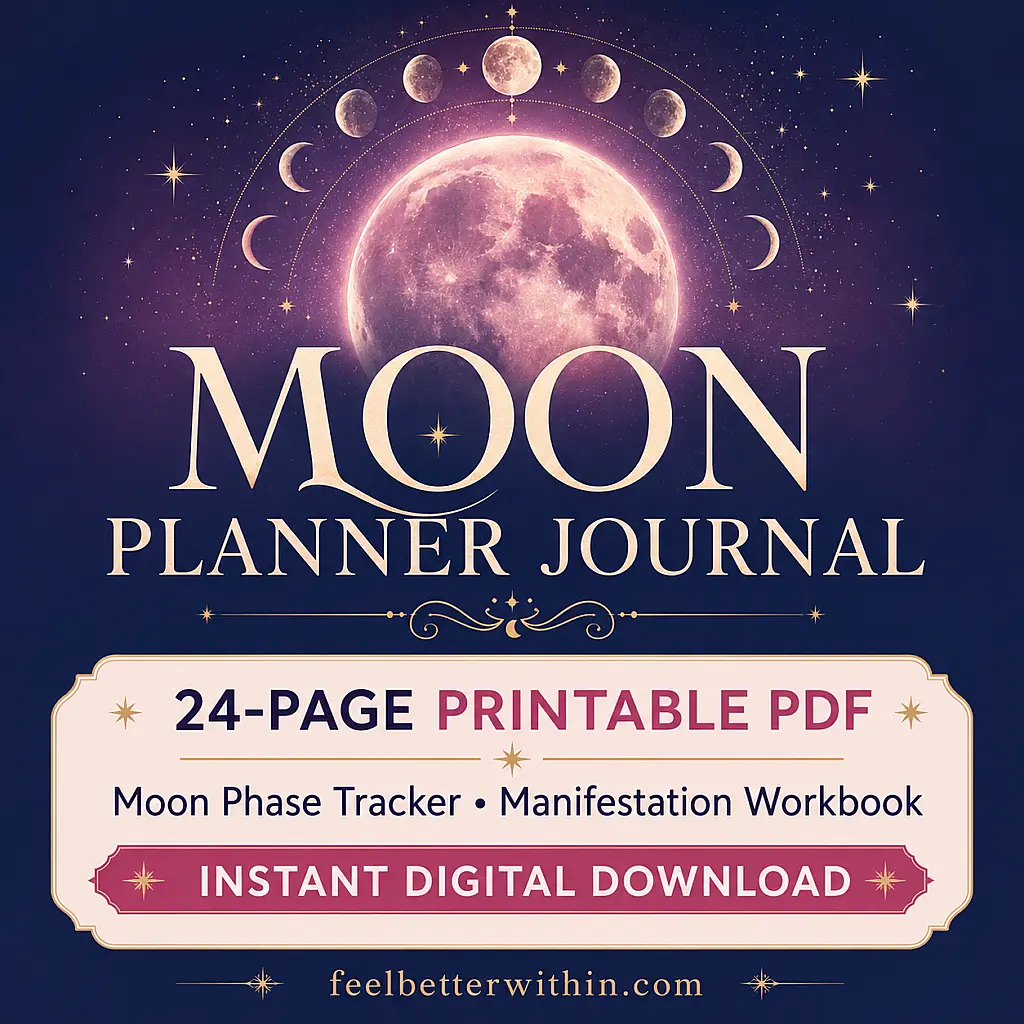
🌙 Moon Planner Journal
Many empaths notice that their emotions, energy levels, and intuition fluctuate throughout the month.
The Moon Planner Journal helps you track lunar cycles, emotional patterns, personal growth, and self-care practices so you can better understand your unique rhythms and create more balance in your life.

💎 Crystal Journal PDF | Printable Crystal Planner, Chakra Guide & Crystal Collection Tracker
For empaths who enjoy crystal healing, chakra work, or mindfulness practices.
The Crystal Journal provides a beautiful way to organize your crystal collection, record personal insights, track chakra healing progress, and create intentional grounding rituals that support emotional well-being.
A Gentle Reminder
You do not have to solve every problem to prove that you care.
You do not have to remain available when you are exhausted or overwhelmed.
You can support someone without assuming responsibility for everything they feel.
The more you understand your physical empath traits, the easier it becomes to recognise your limits, strengthen your boundaries and respond to sensitivity in a grounded way.
Explore Feel Better Within And Find The Tools That Support Your Journey Toward Greater Peace, Clarity, And Emotional Balance.

This article offers general wellbeing education and spiritual reflection. It is not medical or mental health advice, and a spiritual interpretation should not replace professional assessment. Seek qualified support for persistent fatigue, pain, sleep disruption, anxiety, low mood or other symptoms that concern you.
Cite or share this page
Want to reference this guide? Please link to the canonical page rather than copying the article.