
Empath boundaries are the emotional, mental, and personal limits that help sensitive people care deeply without carrying responsibilities, emotions, or problems that do not belong to them. If you constantly feel drained after helping others, struggle to say no, or feel responsible for everyone’s happiness, strengthening your empath boundaries may be one of the most important forms of self-care you can practice.
Many empaths spend years believing their exhaustion comes from caring too much.
In reality, the problem is often not compassion.
The problem is often a lack of healthy boundaries.
When boundaries are weak, empathy can slowly transform into emotional over-responsibility. You begin becoming highly responsive to others' visible tension and stress that is not yours to carry, solving problems that are not yours to fix, and sacrificing your own well-being to avoid disappointing others.
From a spiritual perspective, boundaries are not walls designed to shut people out.
They are acts of self-respect.
Healthy empath boundaries allow you to remain open-hearted while staying connected to your own needs, energy, and inner peace.
What Are Empath Boundaries?

Empath boundaries are the emotional, mental, and personal limits that help sensitive people protect their well-being while maintaining healthy relationships.
They help you recognise where your emotions end and where another person’s emotions begin.
For many empaths, this can be challenging.
Because empaths naturally tune into the feelings, moods, and needs of others, they often absorb more than they realise.
Without healthy boundaries, it becomes easy to lose yourself in other people’s experiences.
You may begin carrying worries that are not yours.
Taking responsibility for emotions you did not create.
Or feeling guilty for prioritising your own needs.
Over time, this can become emotionally exhausting.
Without strong empath boundaries, many people experience:
- Emotional overwhelm
- Chronic people-pleasing
- Resentment
- Guilt
- Exhaustion
- Difficulty saying no
- Feeling responsible for other people’s happiness
- A loss of connection with their own needs and desires
Many empaths do not realise this is happening because these behaviours often feel normal.
Helping others feels natural.
Supporting others feels rewarding.
The challenge arises when compassion turns into self-sacrifice.
Healthy Boundaries Create Balance
Healthy empath boundaries do not stop you from being caring.
They simply help you care in a healthier way.
With strong empath boundaries, you can:
- Support others without rescuing them
- Listen without absorbing
- Care without carrying
- Love without losing yourself
- Be compassionate without becoming emotionally overwhelmed
- Help others while still honouring your own needs
This distinction is powerful.
Because many empaths have been taught that being loving means putting everyone else first.
In reality, healthy boundaries create balance.
They allow you to show up fully for others without abandoning yourself in the process.
Boundaries Are Not Walls
One of the biggest misconceptions about empath boundaries is that they create distance between people.
In reality, healthy boundaries often create stronger and more authentic relationships.
Boundaries are not walls designed to shut people out.
They are guidelines that help protect your energy, time, and emotional well-being.
They allow you to remain open-hearted without becoming overwhelmed.
They help you stay connected to yourself while still connecting with others.
The Goal Of Empath Boundaries
The goal is not to become less sensitive.
The goal is not to stop caring.
The goal is to learn how to honour your own needs with the same compassion you so freely offer everyone else.
Because you can be deeply empathetic without becoming responsible for another person’s healing journey.
And that is where true emotional balance begins.
Why Empaths Struggle With Boundaries
Many empaths are naturally attuned to emotional shifts in the people around them.
They notice discomfort.
They sense sadness.
They recognise tension before anyone says a word.
This sensitivity can be a beautiful gift.
It allows empaths to connect deeply with others, offer meaningful support, and create a sense of understanding that many people find comforting.
However, this same sensitivity can also make boundaries difficult.
Because empaths often feel what others are feeling, they may believe it is their responsibility to make those feelings go away.
Over time, this can create an unhealthy belief:
“If someone is struggling, it is my job to make them feel better.”
Unfortunately, that belief often comes at a cost.
Where Boundary Struggles Begin
For many people, boundary challenges did not begin in adulthood.
They began much earlier.
Common influences include:
- Childhood experiences
- Family dynamics
- Fear of conflict
- Fear of rejection
- People-pleasing tendencies
- Low self-worth
- A strong desire to keep the peace
Many sensitive people learn early that being helpful earns approval.
They become the good child.
The responsible one.
The peacemaker.
The listener.
The person who puts everyone else’s needs first.
Over time, these behaviours can become deeply ingrained.
The Need For Approval
Many empaths unconsciously connect their self-worth to how much they do for others.
They feel valuable when they are helping.
Needed when they are solving problems.
Accepted when they are making life easier for everyone around them.
As a result, saying no can feel uncomfortable.
Setting boundaries can feel selfish.
Prioritising personal needs can trigger guilt.
Not because these things are wrong, but because they challenge old beliefs about what it means to be a caring person.
The Fear Of Disappointing Others
One of the biggest reasons empaths struggle with boundaries is a fear of disappointing people.
They worry:
- What if they get upset?
- What if they stop liking me?
- What if they think I’m selfish?
- What if I let them down?
To avoid these uncomfortable possibilities, many empaths continue saying yes when they want to say no.
They overextend themselves.
They ignore their own limits.
And gradually, emotional exhaustion begins to build.
When Compassion Becomes Self-Abandonment
Empaths are often taught to focus on everyone else’s feelings.
The problem arises when they become so focused on others that they stop listening to themselves.
They know when a friend is struggling.
They know when a family member is upset.
They know when someone needs support.
But they often struggle to recognise when they need support themselves.
This is where healthy empath boundaries become essential.
Because true compassion should never require self-abandonment.
A Different Way Forward
One of the most powerful shifts an empath can make is realising that caring for others and caring for yourself are not opposing choices.
You do not have to choose one or the other.
You can be compassionate and have boundaries.
You can be supportive and protect your energy.
You can be loving and still say no.
In fact, healthy empath boundaries allow you to do all three.
And for many empaths, that realisation becomes the beginning of lasting emotional freedom.
Feeling emotionally exhausted from carrying everyone else’s problems?
Read Empath Burnout: How to Fix Them to understand how emotional overload develops and how to begin recovering your energy.
What Weak Empath Boundaries Look Like in Everyday Life
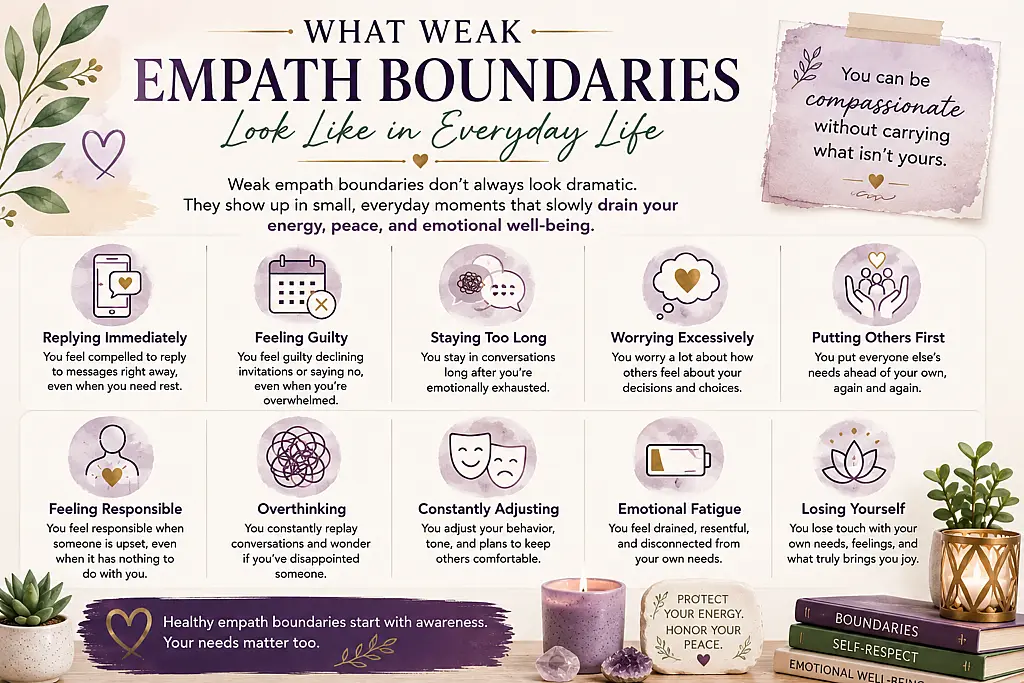
Weak empath boundaries do not always appear as dramatic emotional exhaustion.
More often, they show up in small daily moments that gradually drain your energy without you even realising it.
Because these behaviours often become habits, many empaths assume they are simply part of their personality.
They tell themselves:
“I’m just a caring person.”
“I don’t want to upset anyone.”
“It’s easier if I handle it myself.”
Over time, however, these seemingly small choices can add up to emotional fatigue, resentment, and a growing disconnect from your own needs.
You Reply To Messages Even When You Need Rest
Your phone lights up.
You see a message.
Even though you’re tired, overwhelmed, or trying to relax, you feel compelled to respond immediately.
Many empaths struggle to give themselves permission to wait.
They worry about appearing rude, unavailable, or uncaring.
As a result, other people’s needs constantly interrupt their own moments of rest.
You Feel Guilty Declining Invitations
Even when you know you need time alone, saying no can feel uncomfortable.
You may worry about hurting someone’s feelings or disappointing them.
Instead of asking yourself what you need, you focus on how the other person might react.
This often leads to overcommitting and emotional exhaustion.
You Stay In Conversations Long After You’re Drained
Have you ever found yourself listening to someone’s problems long after you have mentally checked out?
Many empaths continue giving emotional support even when they have nothing left to give.
They feel guilty ending the conversation or redirecting it.
Over time, this habit can leave you feeling depleted and emotionally overwhelmed.
You Worry About How Others Feel About Your Decisions
You make a choice that feels right for you.
Then you spend hours worrying about how someone else might feel about it.
Will they be upset?
Will they understand?
Will they think differently of you?
This constant focus on other people’s reactions often makes it difficult to trust your own decisions.
You Put Everyone Else’s Needs Before Your Own
Many empaths are incredibly skilled at recognising what others need.
The challenge is remembering to ask themselves the same question.
When everyone else’s needs consistently come first, your own well-being often gets pushed aside.
Over time, this can create feelings of frustration, exhaustion, and self-neglect.
You Feel Responsible When Someone Is Upset
Perhaps someone is having a bad day.
Maybe a friend is struggling.
Maybe a family member seems disappointed.
Even when their emotions have nothing to do with you, you feel responsible for making things better.
This is one of the most common signs of weak empath boundaries.
Caring about someone’s feelings is healthy.
Believing you are responsible for fixing them is not.
You Overthink Whether You’ve Disappointed Someone
A simple conversation replays in your mind.
You wonder if you said the wrong thing.
You analyse their tone.
You question whether they are upset with you.
Many empaths spend enormous amounts of energy trying to manage other people’s perceptions.
This constant mental effort can be surprisingly draining.
You Constantly Adjust Your Behaviour To Keep Others Comfortable
You avoid expressing your true feelings.
You stay quiet when something bothers you.
You agree when you would rather disagree.
You become the version of yourself that feels easiest for everyone else to accept.
While this may reduce conflict in the short term, it often comes at the expense of authenticity.
The Common Thread
At the heart of all these behaviours is a simple pattern:
You become so focused on other people’s needs, emotions, and comfort that you stop listening to your own.
This is why healthy empath boundaries matter.
They help you remember that your needs deserve consideration too.
Because the goal is not to stop caring about others.
The goal is to care about yourself with the same compassion you so freely offer everyone else.
Signs Your Empath Boundaries Need Strengthening
Sometimes weak empath boundaries are obvious.
Other times they appear in subtle ways that become so familiar you barely notice them.
Many empaths assume they are simply being caring, supportive, or compassionate when in reality they are regularly abandoning their own needs to take care of everyone else.
If any of the following signs feel familiar, it may be time to strengthen your empath boundaries.
You Feel Guilty Saying No
One of the most common boundary struggles for empaths is guilt.
Even when you’re overwhelmed, exhausted, or already carrying too much, you may agree to requests because you fear disappointing someone.
Rather than asking yourself what you need, you focus on how the other person might feel if you decline.
Over time, this can create a cycle where everyone else’s needs take priority over your own.
You Absorb Other People’s Moods
Have you ever walked into a room feeling perfectly fine, only to leave feeling anxious, frustrated, or emotionally drained?
Many empaths unconsciously absorb the emotional atmosphere around them.
While sensitivity can be a gift, it becomes problematic when another person’s mood dictates your own emotional state.
Healthy empath boundaries help you recognise the difference between understanding someone’s emotions and carrying them.
You Feel Responsible For Fixing Problems
When someone you care about is struggling, your first instinct may be to help.
There is nothing wrong with compassion.
However, weak boundaries can create the belief that every problem requires your involvement.
You may spend hours offering advice, searching for solutions, or worrying about situations that are ultimately outside your control.
Support is healthy.
Taking responsibility for another person’s healing journey is not.
You Overextend Yourself
Many empaths give far beyond what feels sustainable.
You may constantly volunteer your time, emotional energy, or attention while ignoring your own needs.
At first this can feel generous.
Eventually it often leads to exhaustion.
Healthy empath boundaries allow you to give from a place of abundance rather than depletion.
You Feel Resentful
Resentment is often one of the clearest signs that a boundary needs attention.
You continue saying yes.
You continue helping.
You continue showing up.
Yet part of you secretly wishes people would stop asking so much from you.
In many cases, resentment develops when your actions no longer align with your true feelings.
Boundaries help close that gap.
You Rarely Ask For Help
Many empaths are excellent at supporting others but struggle when it comes to receiving support themselves.
You may feel uncomfortable asking for help, expressing your needs, or leaning on others during difficult times.
As a result, relationships can become one-sided.
Healthy empath boundaries are not only about protecting your energy.
They are also about allowing yourself to receive the same care, understanding, and support that you freely give to others.
You Feel Drained After Every Interaction
Not every conversation should leave you feeling exhausted.
If you regularly finish phone calls, social gatherings, or family interactions feeling emotionally depleted, it may be a sign that your boundaries are being crossed or ignored.
Pay attention to the relationships and situations that consistently leave you feeling tired.
They often reveal where stronger boundaries are needed.
The goal of empath boundaries is not to stop caring.
It is to care without losing yourself in the process.
If you often absorb the emotions of people around you, read Physical Empath Traits: 17 Powerful Signs You Absorb Other People’s Energy for additional insight into emotional sensitivity.
The Spiritual Meaning Of Boundaries
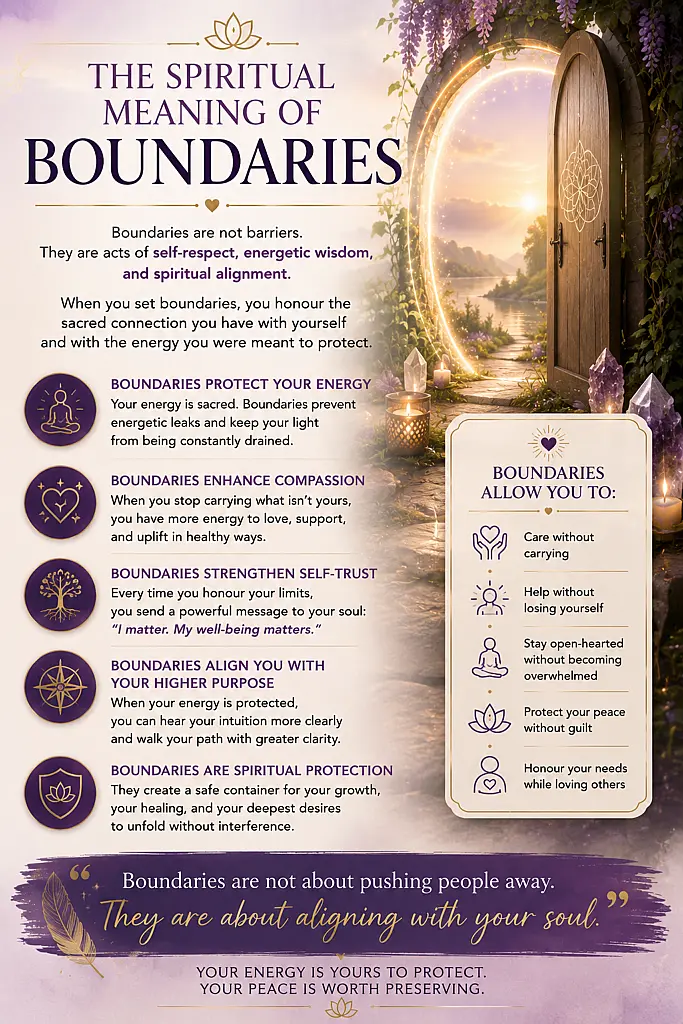
Many spiritual people mistakenly believe boundaries are unkind.
The opposite is often true.
Healthy boundaries create space for authentic relationships, emotional balance, and self-respect.
Without boundaries:
- Resentment grows
- Frustration builds
- Authenticity disappears
- Relationships become imbalanced
- Emotional exhaustion becomes normal
Spiritually speaking, boundaries honour your energy, time, and personal truth.
They communicate:
“I respect myself enough to recognize my limits.”
Compassion does not require self-sacrifice.
You do not need to drain yourself to prove your love.
You do not need to suffer to demonstrate your kindness.
True spiritual growth often involves learning where your responsibility ends.
The Misunderstanding Many Empaths Face
Many empaths unintentionally confuse spirituality with self-sacrifice.
They believe being a loving person means always being available.
Always helping.
Always listening.
Always putting themselves last.
But constantly abandoning your own needs is not a sign of spiritual growth.
It is often a sign that your boundaries need attention.
Being spiritually aware does not mean carrying everyone else’s emotional burdens.
It means learning how to remain compassionate while staying connected to yourself.
Boundaries Allow You To Show Up Authentically
When you repeatedly ignore your own limits, something important happens.
You stop showing up as your true self.
Instead, you begin showing up as the version of yourself that everyone else expects.
You say yes when you want to say no.
You stay silent when you want to speak.
You give when you need rest.
Over time, this creates a disconnect between your inner truth and your outward behaviour.
Healthy boundaries help bring those two things back into alignment.
Boundaries Are An Act Of Self-Respect
Many people view boundaries as something they place on others.
In reality, boundaries are promises you make to yourself.
They reflect what you are willing to accept, tolerate, and give.
Each time you honour a healthy boundary, you reinforce the belief that your needs, feelings, and well-being matter too.
This is not selfish.
It is self-respect.
Spiritual Growth Requires Discernment
One of the most overlooked aspects of spiritual growth is discernment.
Discernment is the ability to recognise what belongs to you and what does not.
What is your responsibility?
What is someone else’s responsibility?
What can you support?
What must you release?
Strong empath boundaries help answer these questions.
Rather than carrying everything, you learn to respond with wisdom.
You learn that love does not require self-abandonment.
You learn that compassion does not require suffering.
You learn that protecting your peace can be one of the most spiritual choices you make.
Because the goal is not to become less caring.
The goal is to care deeply while remaining rooted in your own truth.
The Difference Between Compassion And Responsibility
This is one of the most important lessons an empath can learn.
Many empaths spend years carrying emotional burdens that were never theirs to carry because they confuse compassion with responsibility.
At first glance, the two can look very similar.
Both involve caring.
Both involve concern.
Both involve wanting the best for someone else.
But there is an important difference.
Compassion says:
“I care about your experience.”
Over-responsibility says:
“I must fix your experience.”
One is supportive.
The other is exhausting.
Compassion Walks Beside Someone
Compassion allows you to be present for another person’s struggles without taking ownership of them.
You can listen.
You can offer encouragement.
You can provide support.
You can hold space for someone who is hurting.
But you do not need to carry their pain as your own.
Compassion says:
“I am here for you.”
It does not say:
“I will carry this for you.”
Responsibility Tries To Take Control
When empathy becomes over-responsibility, a subtle shift occurs.
You begin believing that another person’s happiness, healing, success, or emotional state depends on you.
You may find yourself:
- Constantly giving advice
- Trying to solve every problem
- Worrying excessively about other people’s decisions
- Feeling guilty when someone is upset
- Taking blame for situations outside your control
Over time, this creates emotional exhaustion because you are attempting to manage things that were never yours to manage.
Everyone Has Their Own Journey
One of the hardest truths for many empaths to accept is that every person has their own lessons, choices, and experiences to navigate.
Sometimes the most loving thing you can do is step back.
Not because you don’t care.
But because you trust the other person to find their own way.
Growth often happens through experience.
When we constantly rescue others from discomfort, we may unintentionally prevent them from developing their own strength, resilience, and self-awareness.
A Powerful Question To Ask Yourself
The next time you feel emotionally responsible for someone else’s situation, pause and ask:
“Am I being compassionate, or am I trying to take responsibility for something that does not belong to me?”
This simple question can reveal a lot.
It helps you recognise where support ends and over-involvement begins.
Compassion Without Self-Abandonment
Healthy empath boundaries allow you to care deeply without losing yourself in someone else’s experience.
You can offer kindness without becoming consumed.
You can support without rescuing.
You can love without carrying.
In many cases, this creates healthier growth for everyone involved.
Because true compassion is not about taking responsibility for another person’s life.
It is about walking beside them while allowing them to walk their own path.
The Difference Between Being Kind And Being Available
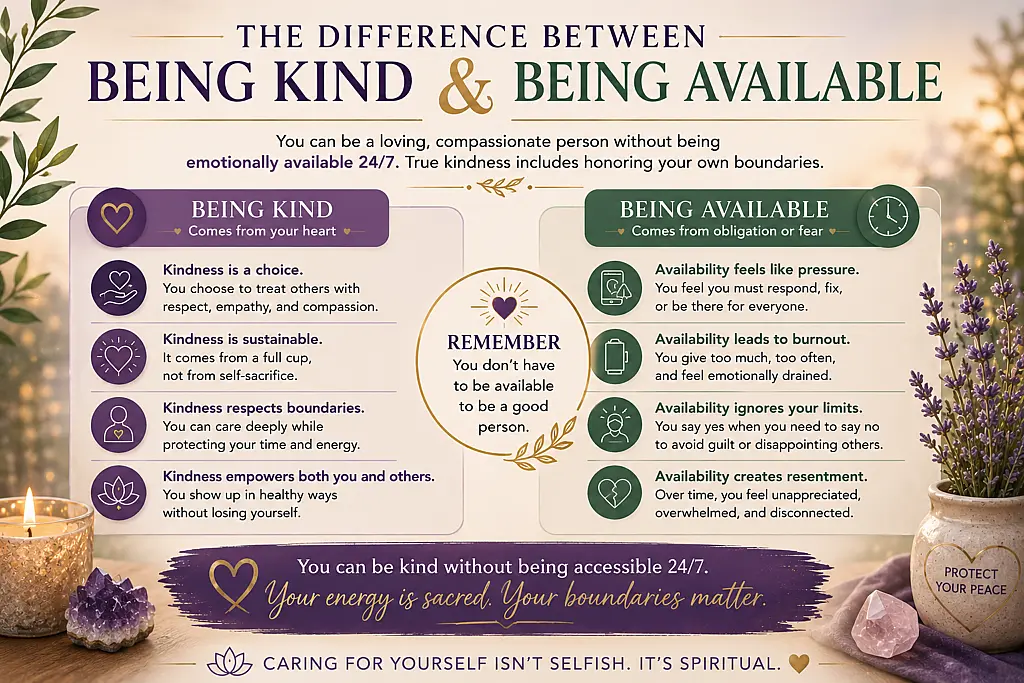
Many empaths believe kindness means always being available.
Always answering.
Always helping.
Always listening.
Always saying yes.
But kindness and availability are not the same thing.
In fact, confusing the two is one of the quickest paths to emotional exhaustion.
You can be a caring person without being constantly accessible.
You can love someone without solving every problem they face.
You can support others while still protecting your own time, energy, and emotional well-being.
One of the healthiest lessons an empath can learn is this:
Not everyone deserves unlimited access to your energy.
Kindness Is Who You Are
Kindness is a quality of your character.
It reflects how you treat people.
It is expressed through compassion, understanding, empathy, and respect.
A kind person does not become unkind simply because they need rest.
A kind person does not become selfish because they say no.
A kind person does not lose their compassion by setting healthy boundaries.
Your kindness is not measured by how much you sacrifice yourself for others.
Availability Is A Choice
Availability is different.
Availability is about access.
How much time, energy, attention, and emotional space you choose to give.
Many empaths unintentionally believe they must always be available to prove they care.
They answer every call.
Respond to every message.
Listen to every problem.
Show up for everyone.
Eventually, they begin feeling emotionally drained because there is little energy left for themselves.
Healthy empath boundaries recognise that your energy is valuable.
You have the right to decide where it goes.
Constant Availability Creates Imbalance
When people know you are always available, some may begin relying on you more than is healthy.
Without meaning to, you can become:
- The unpaid therapist
- The emotional caretaker
- The problem solver
- The person everyone leans on
Meanwhile, your own needs often move to the bottom of the list.
This creates an imbalance where you are constantly giving but rarely receiving.
Over time, that imbalance often turns into frustration, exhaustion, or resentment.
Being Available Less Can Improve Relationships
Many empaths fear that setting limits will damage their relationships.
In reality, healthy boundaries often strengthen them.
When people know your yes is genuine, they value it more.
When you stop overextending yourself, you show up with greater presence and authenticity.
Instead of helping from obligation, you help from a place of choice.
That creates healthier and more sustainable connections.
You Are Allowed To Be Unavailable
You are allowed to rest.
You are allowed to take time for yourself.
You are allowed to ignore a message until you have the energy to respond.
You are allowed to protect your peace without explaining yourself to everyone.
Being unavailable sometimes does not make you less caring.
It makes you human.
A Boundary Many Empaths Need To Hear
You do not have to earn your worth by being endlessly available.
Your value does not come from how much you give.
Your value exists whether you are helping others or taking care of yourself.
The goal of healthy empath boundaries is not to become less kind.
It is to remain kind without becoming depleted.
Because the most sustainable form of compassion is the kind that includes yourself too.
How To Set Healthy Empath Boundaries
Building healthy empath boundaries is a skill.
Like any skill, it becomes easier with awareness, consistency, and practice.
If you’ve spent years putting other people’s needs before your own, boundary setting may feel uncomfortable at first.
That is normal.
Many empaths worry that setting boundaries will make them seem selfish, distant, or uncaring.
In reality, healthy boundaries allow you to show up for others without sacrificing yourself in the process.
The goal is not to become less compassionate.
The goal is to stop abandoning your own needs while caring for everyone else’s.
Pause Before Saying Yes
Many boundary problems begin with automatic yeses.
Someone asks for help.
Someone needs a favour.
Someone wants your time or emotional support.
Before you even think about it, you’ve already agreed.
Instead of immediately saying yes, give yourself permission to pause.
Try saying:
- Let me think about it.
- I’ll check my schedule.
- I’ll get back to you.
- Let me see what I can realistically manage.
This simple pause creates space between the request and your response.
It allows you to make a conscious decision rather than reacting from guilt, habit, or pressure.
Check In With Yourself First
Empaths are often highly aware of what everyone else needs.
The challenge is remembering to check in with themselves.
Before agreeing to something, ask yourself:
- Do I genuinely want to do this?
- Am I acting from guilt or obligation?
- Do I have the time and energy for this right now?
- What would I choose if I wasn’t worried about disappointing someone?
These questions help bring your own needs back into the conversation.
Your feelings matter too.
Stop Explaining Excessively
Many empaths feel the need to justify every boundary.
They provide lengthy explanations in hopes of avoiding conflict or making other people feel better.
But boundaries do not require a detailed defence.
You are allowed to say:
- No, thank you.
- I can’t commit to that right now.
- That doesn’t work for me.
- I need some time for myself.
A respectful no is enough.
The more comfortable you become with simple, clear communication, the easier boundary setting becomes.
Let People Have Their Feelings
This can be one of the hardest lessons for empaths.
Someone may be disappointed.
Someone may disagree.
Someone may not understand your boundary.
That is okay.
Many empaths immediately try to fix, soften, or manage another person’s reaction.
However, their feelings are not proof that your boundary is wrong.
People are allowed to have emotions.
Just as you are allowed to have boundaries.
Healthy relationships can tolerate occasional disappointment.
Practice Emotional Detachment
Emotional detachment does not mean becoming cold, uncaring, or distant.
It means recognising that another person’s emotions belong to them.
You can care deeply about someone without taking responsibility for their emotional state.
You can listen without absorbing.
You can support without rescuing.
You can love without carrying.
This is one of the most important boundary skills an empath can develop.
Start Small
Many people think boundary setting requires dramatic conversations or major life changes.
Often it begins with small choices.
You might:
- Silence notifications for an hour
- Take longer before responding to messages
- Decline one request that feels overwhelming
- Spend time alone without feeling guilty
- Prioritise rest when you need it
Small boundaries create confidence.
Confidence creates stronger boundaries.
And stronger boundaries create greater emotional freedom.
Remember Why You’re Doing It
Every healthy boundary serves a purpose.
It protects your peace.
It preserves your energy.
It supports your emotional well-being.
It allows you to show up more authentically in your relationships.
Most importantly, it helps you remain connected to yourself.
Because healthy empath boundaries are not about shutting people out.
They are about making sure you do not lose yourself while letting others in.
The Hidden Cost Of Weak Boundaries
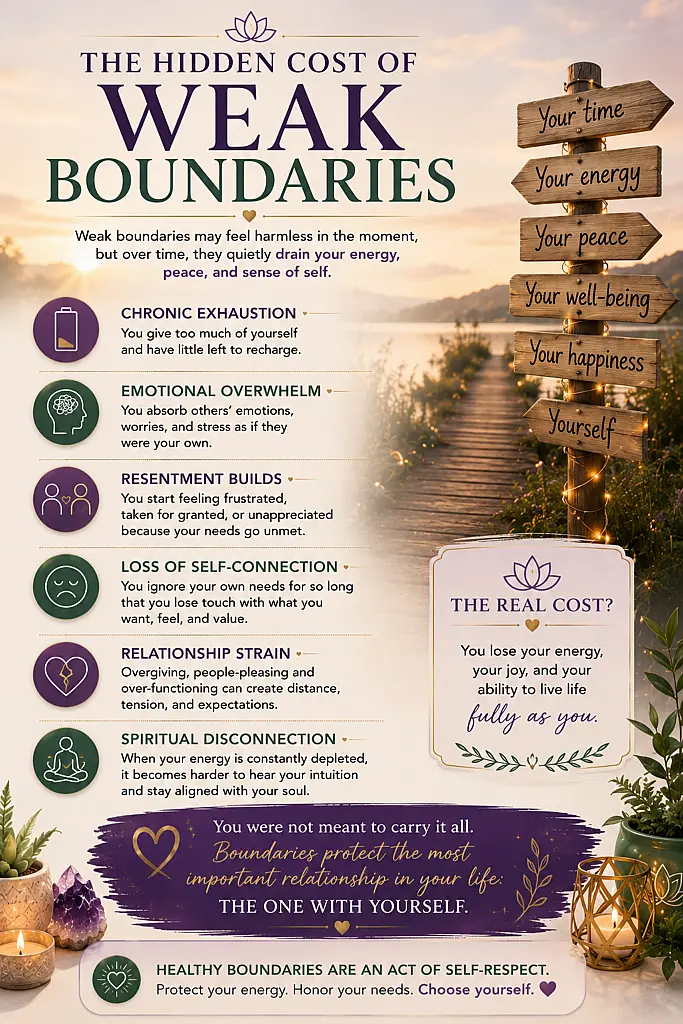
Weak empath boundaries rarely affect only one area of life.
Most people do not wake up one day feeling completely exhausted.
Instead, the effects build gradually over time.
A little extra emotional labour here.
A little people-pleasing there.
Another request you agree to when you really want to say no.
Eventually, the weight of constantly carrying more than you should begins to take its toll.
The hidden cost of weak boundaries is not always obvious at first.
But over time, it can influence your relationships, work, emotional well-being, and even your connection to yourself.
Relationships
When boundaries are weak, you may unintentionally become the emotional caretaker for everyone around you.
Friends come to you with their problems.
Family members rely on you for support.
Partners expect you to manage their emotions.
While helping others can feel meaningful, relationships become unhealthy when the support only flows in one direction.
You may find yourself constantly giving while receiving very little in return.
Over time, this can lead to resentment, emotional exhaustion, and feelings of being taken for granted.
Work
Weak boundaries often follow empaths into the workplace.
You may volunteer for extra tasks.
Stay late to help others.
Take responsibility for problems that are not yours to solve.
Many empaths struggle to separate being helpful from overextending themselves.
As a result, work can become a significant source of stress and overwhelm.
Healthy boundaries help you contribute without carrying responsibilities that belong to other people.
Family
Family relationships can be particularly challenging when boundaries are unclear.
You may become the person everyone turns to during difficult times.
The listener.
The fixer.
The peacemaker.
The reliable one.
While these qualities are admirable, constantly supporting others without receiving support yourself can become emotionally draining.
Many empaths discover that they have spent years carrying family responsibilities that were never theirs to carry.
Your Emotional Well-Being
One of the greatest costs of weak boundaries is the impact on your emotional health.
When you are constantly focused on other people’s needs, emotions, and expectations, your own feelings often get pushed aside.
You may begin to feel:
- Overwhelmed
- Irritable
- Emotionally exhausted
- Disconnected from yourself
- Unsure of what you truly want
This is often a sign that your energy is being directed everywhere except inward.
Spiritual Growth
Many empaths seek deeper spiritual awareness, intuition, and inner peace.
However, constant emotional overload can make it difficult to hear your own inner guidance.
When your attention is always focused on everyone else’s feelings, there is little space left to listen to your own.
Many empaths spend so much time tuning into others that they slowly lose connection with themselves.
They stop trusting their instincts.
They ignore their own needs.
They become disconnected from their own inner wisdom.
Healthy empath boundaries help restore that connection.
They create space for self-reflection, clarity, and a stronger relationship with your intuition.
The Real Cost
The greatest cost of weak boundaries is not simply exhaustion.
It is self-abandonment.
Each time you ignore your own needs to keep someone else comfortable, you move a little further away from yourself.
Healthy boundaries help you return.
They remind you that caring for others and caring for yourself are not opposing choices.
The strongest empath boundaries allow you to do both.
A Simple Boundary Reflection Exercise
Building healthy empath boundaries starts with awareness.
Before you can change a pattern, you first need to recognise it.
Many empaths spend years operating on autopilot.
They automatically help.
Automatically say yes.
Automatically put themselves last.
Over time, these habits become so familiar that they feel normal.
This simple reflection exercise can help you identify where your boundaries may need strengthening.
Find a quiet moment, grab a journal, and answer the following questions honestly.
There are no right or wrong answers.
The goal is simply to become more aware of your patterns.
Who Leaves Me Feeling Drained Most Often?
Think about the people you interact with regularly.
Are there certain relationships that consistently leave you feeling exhausted, overwhelmed, or emotionally depleted?
Notice whether these interactions feel balanced or if you are doing most of the emotional work.
Where Do I Say Yes When I Want To Say No?
This question often reveals some of the most important boundary opportunities.
Consider:
- Requests you agree to out of guilt
- Commitments you secretly resent
- Situations where you prioritise someone else’s comfort over your own needs
Ask yourself:
What am I afraid might happen if I said no?
What Situations Create Guilt For Me?
Many empaths struggle with guilt when they choose themselves.
Notice what triggers that feeling.
Perhaps it is:
- Taking time alone
- Declining invitations
- Asking for help
- Prioritising rest
- Setting limits with family members
Understanding your guilt triggers can reveal where old beliefs may be influencing your choices.
Which Relationships Feel One-Sided?
Healthy relationships involve both giving and receiving.
Reflect on whether there are relationships in your life where you consistently provide support but rarely receive it.
Ask yourself:
- Do I feel heard?
- Do I feel valued?
- Do I feel supported?
If not, stronger empath boundaries may be needed.
What Would Change If I Trusted My Own Needs More?
This question often leads to powerful insights.
Imagine what your life might look like if you trusted yourself enough to honour your needs without guilt.
Would you spend your time differently?
Would you say no more often?
Would you create more space for rest, creativity, or personal growth?
Allow yourself to answer honestly.
What Patterns Am I Beginning To Notice?
After completing the exercise, take a moment to review your answers.
You may notice recurring themes.
Certain people.
Specific situations.
Common fears.
Boundary work often begins with these small moments of awareness.
Because once you can see a pattern clearly, you can begin to change it.
Awareness is often the first step toward stronger empath boundaries.
And sometimes, one honest reflection can reveal exactly where your healing needs to begin.
A Gentle Practice For Building Stronger Boundaries
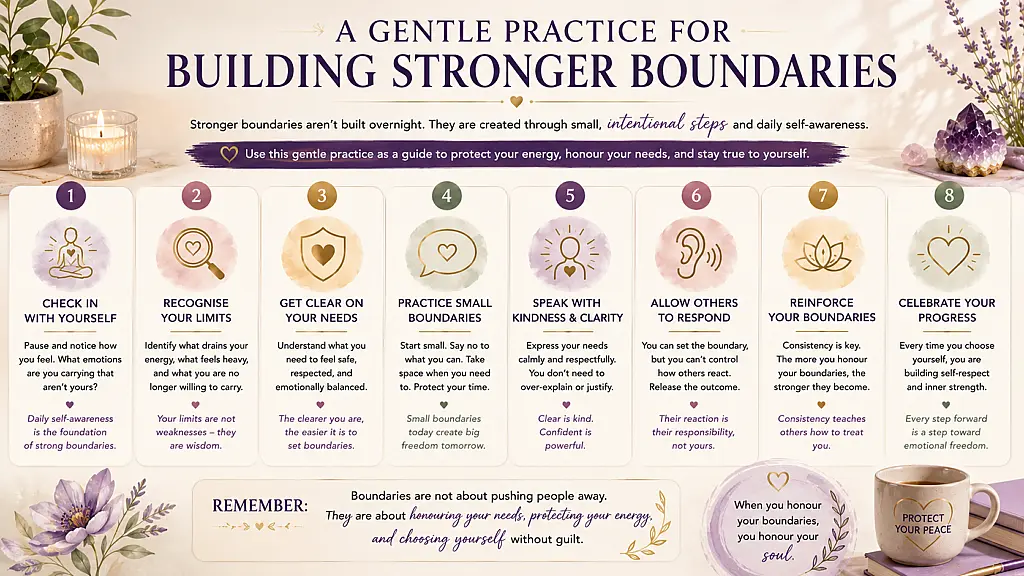
One of the most effective ways to strengthen empath boundaries is to begin paying attention to your emotional patterns.
Many empaths are highly aware of what other people are feeling.
The challenge is that they often spend far less time noticing their own emotional responses.
This simple practice helps shift your attention back to yourself.
Over the next week, take a few moments each day to reflect on your interactions, experiences, and emotional energy.
Notice:
- Who energizes you
- Who drains you
- What situations leave you feeling calm and grounded
- What situations create resentment or frustration
- When you feel most like yourself
- When you feel pressured to ignore your own needs
The goal is not to judge yourself or anyone else.
The goal is simply to observe.
Look For Patterns
As you begin paying closer attention, certain patterns often emerge.
You may notice that some relationships leave you feeling supported and valued.
Others may leave you feeling emotionally exhausted.
You might discover that certain situations repeatedly trigger guilt, people-pleasing, or the urge to rescue others.
These patterns are valuable.
They reveal where your boundaries are naturally strong and where they may need more attention.
Ask Yourself One Simple Question
At the end of each day, ask:
“Did I honour my own needs today?”
Notice what comes up.
There is no need for self-criticism.
This question is simply an invitation to become more aware of how you show up for yourself.
Small Awareness Creates Big Change
Many empaths assume stronger boundaries require dramatic conversations or major life changes.
In reality, boundaries often begin with awareness.
The moment you notice a pattern, you create an opportunity to choose differently.
You may start saying no more often.
You may stop taking responsibility for problems that are not yours.
You may begin prioritising your own well-being without guilt.
These small shifts can create profound changes over time.
Remember This
Healthy empath boundaries are not built in a single day.
They are built through small moments of awareness, honesty, and self-respect.
Every time you notice a pattern, honour a need, or choose yourself without guilt, you strengthen the relationship you have with yourself.
And that relationship forms the foundation of every healthy boundary you create.
The Moon Planner Journal was created to help you reflect on emotional cycles, personal growth, energy shifts, intentions, and recurring patterns throughout each month. Many empaths discover that regularly tracking their emotions helps them identify where stronger boundaries are needed and where their energy is being depleted. It provides a gentle space for self-awareness, reflection, and personal growth.
The goal is not perfection.
The goal is awareness.
You may also enjoy Anxiety Spiritual Meaning, which explores how emotional discomfort sometimes acts as an invitation to examine areas of life that feel out of alignment.
What Happens When Empaths Develop Strong Boundaries?
Many people fear that boundaries will make them less caring.
They worry they will become distant.
Less compassionate.
Less supportive.
Most discover the opposite.
Healthy empath boundaries do not reduce your capacity to care.
They simply help you care in a way that is sustainable.
Instead of constantly feeling overwhelmed by everyone else’s needs, you begin creating space for your own well-being too.
The result is often far more positive than many empaths expect.
More Emotional Stability
When you stop carrying emotions that do not belong to you, your own emotional world becomes easier to understand.
You spend less time reacting to everyone else’s moods and more time connecting with your own feelings.
Life may still have challenges, but you no longer feel pulled in multiple emotional directions at once.
Less Overwhelm
Many empaths become overwhelmed because they are managing far more than they realise.
Not only their own responsibilities, but everyone else’s as well.
Strong boundaries help reduce this emotional clutter.
You learn what belongs to you and what does not.
That distinction alone can feel incredibly freeing.
Greater Confidence
Every time you honour a boundary, you send yourself a powerful message:
“My needs matter.”
Over time, this strengthens self-trust.
You become more confident in your decisions, less dependent on external approval, and more comfortable standing by what feels right for you.
Improved Relationships
One of the biggest surprises for many empaths is that healthy boundaries often improve relationships.
When expectations become clearer, resentment has less room to grow.
Communication becomes more honest.
Connections become more balanced.
Rather than helping from obligation, you begin helping from genuine choice.
Reduced Resentment
Resentment is often a sign that something within you needs attention.
Many empaths experience resentment when they continue giving long after they have reached their limit.
Strong boundaries help prevent this cycle.
You stop overcommitting.
You stop saying yes when you mean no.
You begin respecting your limits before exhaustion sets in.
Better Decision-Making
Without the constant pressure to keep everyone happy, decisions become clearer.
You spend less time worrying about disappointing others and more time considering what genuinely aligns with your values, needs, and well-being.
This creates greater clarity and confidence in everyday life.
More Energy For Meaningful Connections
When your energy is no longer being scattered in every direction, you have more available for the people and experiences that matter most.
You become more present.
More engaged.
More authentic.
Strong empath boundaries do not reduce connection.
They improve its quality.
Increased Self-Respect
One of the most profound changes often happens internally.
You begin treating yourself with the same compassion and care that you so freely offer others.
You honour your limits.
You listen to your needs.
You stop viewing self-care as something you have to earn.
This shift can transform the relationship you have with yourself.
Greater Inner Peace
Perhaps the greatest benefit of all is a deeper sense of peace.
Not because life suddenly becomes perfect.
But because you stop fighting against your own needs.
You stop carrying burdens that were never yours.
You stop trying to manage everyone else’s emotions.
Instead, you learn to remain grounded in yourself.
Sustainable Compassion
Healthy empath boundaries allow you to help others from a place of fullness rather than depletion.
You are no longer running on empty.
You are no longer sacrificing yourself to prove your love.
You are simply showing up as your authentic self.
That is sustainable compassion.
And for many empaths, it is one of the most liberating discoveries they will ever make.
Boundary Affirmations For Empaths
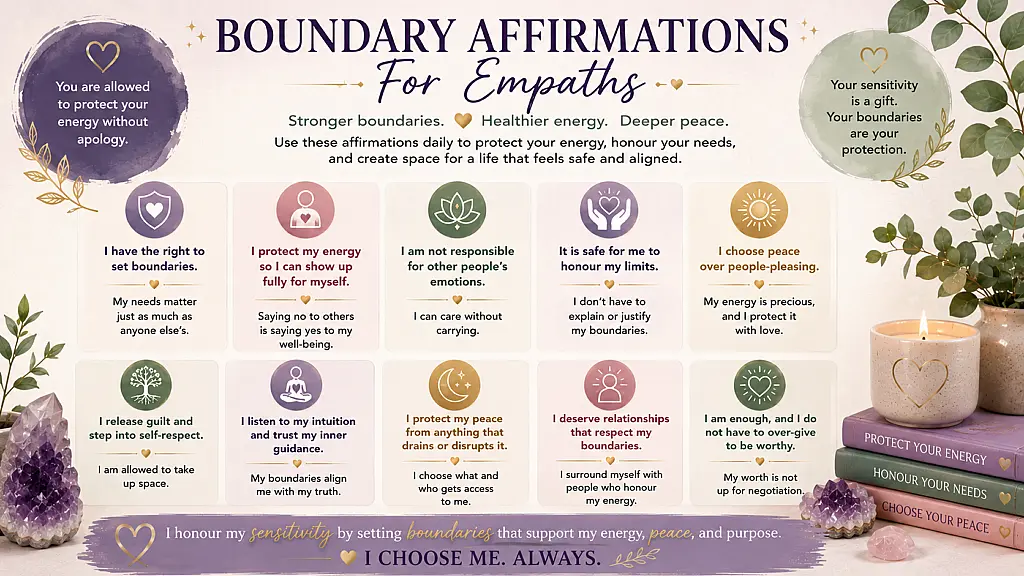
If setting boundaries feels uncomfortable, these affirmations can help reinforce healthier patterns:
- My needs matter too.
- I can care without carrying.
- I am allowed to say no without guilt.
- Other people’s emotions are not my responsibility.
- Protecting my peace is an act of self-respect.
- I deserve relationships that feel balanced and supportive.
- I release the need to fix everything for everyone.
- I honour my energy and use it wisely.
- I trust myself to make decisions that support my well-being.
- Healthy boundaries create healthier relationships.
Repeat the affirmations that resonate most with you and allow them to become reminders that healthy boundaries support both you and the people around you.
Common Boundary Mistakes Empaths Make
Learning to create healthy empath boundaries is a journey.
Like any new skill, there will be moments when you get it right and moments when you fall back into old patterns.
That is completely normal.
Many empaths spend years prioritising other people’s needs before they begin practising healthier boundaries. As a result, certain mistakes tend to appear repeatedly.
Recognising these patterns can help you navigate boundary work with greater awareness and self-compassion.
Waiting Until They’re Exhausted
One of the most common mistakes empaths make is waiting until they are completely overwhelmed before setting a boundary.
They continue saying yes.
They continue helping.
They continue giving.
Eventually, they reach a point where frustration, resentment, or burnout forces them to pull back.
At that stage, boundaries often come from exhaustion rather than intention.
Healthy boundaries work best before overwhelm appears.
They are not emergency measures.
They are ongoing acts of self-care.
Expecting Everyone To Understand
Many empaths hope that if they explain their boundaries clearly enough, everyone will immediately understand and support them.
Unfortunately, that is not always how life works.
Some people may be disappointed.
Some may disagree.
Others may resist because they benefited from your lack of boundaries in the past.
Remember:
Someone else’s reaction does not determine whether your boundary is healthy.
A boundary can still be necessary even if another person doesn’t like it.
Feeling Guilty For Self-Care
Many empaths have been conditioned to believe that caring for themselves is selfish.
As a result, they often experience guilt when they prioritise rest, alone time, or personal needs.
They may think:
- I should be doing more.
- Other people need me.
- I don’t want to let anyone down.
The truth is that self-care is not selfish.
It is maintenance.
Just as you would recharge your phone before the battery reaches zero, you need time to recharge yourself.
Healthy empath boundaries help protect the energy you need to show up fully in your own life.
Trying To Change Other People
Boundaries are often misunderstood as a way to make other people behave differently.
In reality, boundaries are about your choices, not theirs.
You cannot control:
- Other people’s emotions
- Other people’s reactions
- Other people’s behaviour
What you can control is how you respond.
For example:
A boundary is not:
“You must stop complaining to me.”
A boundary is:
“If this conversation becomes overwhelming, I will step away and continue it another time.”
The focus remains on your actions rather than attempting to control someone else’s.
Making Boundaries Too Complicated
Many empaths believe boundaries require lengthy explanations, difficult conversations, or dramatic life changes.
Often, the most effective boundaries are simple.
A clear no.
A delayed response.
An honest conversation.
A decision to leave when you feel uncomfortable.
Boundary work does not have to be complicated to be powerful.
Giving Up Too Soon
Boundary setting can feel uncomfortable, especially in the beginning.
You may feel guilty.
You may second-guess yourself.
You may wonder if you’re being too harsh.
This discomfort does not mean you are doing something wrong.
It often means you are breaking old patterns.
Like any new habit, boundaries become easier with practice.
The more consistently you honour your needs, the more natural it becomes.
Progress Over Perfection
The goal of healthy empath boundaries is not perfection.
There will be times when you overextend yourself.
There will be times when you say yes when you meant no.
There will be times when you realise a boundary should have been set sooner.
That does not mean you have failed.
Every moment of awareness is progress.
Every healthy choice strengthens your ability to honour yourself.
And every boundary you set is a reminder that your well-being matters too.
Frequently Asked Questions
Are empath boundaries selfish?
No.
Healthy empath boundaries are not selfish. They allow you to care for yourself while maintaining healthier relationships with others.
Without boundaries, many empaths become emotionally exhausted because they constantly prioritise everyone else’s needs above their own.
Boundaries help create balance. They allow you to offer support and compassion without sacrificing your well-being in the process.
Why do I feel guilty when setting boundaries?
Many empaths have learned to associate self-sacrifice with kindness.
As a result, saying no or prioritising personal needs can trigger feelings of guilt.
Boundary work often involves unlearning the belief that your worth is tied to how much you do for others.
Over time, many empaths discover that healthy boundaries actually strengthen relationships rather than damage them.
Can boundaries improve relationships?
Yes.
Healthy relationships thrive on honesty, mutual respect, and realistic expectations.
When boundaries are clear, communication improves and resentment has less opportunity to build.
Rather than helping from obligation, you begin helping from genuine choice.
This often creates more authentic and balanced connections.
What is the most important boundary for empaths?
One of the most transformative lessons for empaths is learning that they are not responsible for managing other people’s emotions.
You can care deeply about someone without carrying their emotional burdens.
Understanding this distinction often creates greater emotional freedom, peace, and self-awareness.
How long does it take to build healthy empath boundaries?
Boundary work is an ongoing practice rather than a destination.
Small, consistent changes often create meaningful results over time.
The more frequently you honour your needs and respect your limits, the more natural healthy boundaries become.
Progress matters far more than perfection.
Why do empaths attract people with poor boundaries?
Many empaths are naturally compassionate, patient, and willing to help others.
Unfortunately, people who struggle with their own boundaries may sometimes rely heavily on these qualities.
Without strong empath boundaries, relationships can become one-sided, leaving the empath feeling drained or overwhelmed.
Learning to recognise unhealthy dynamics early can help create more balanced relationships.
Can you be an empath and still say no?
Absolutely.
In fact, learning to say no is often an essential part of developing healthy empath boundaries.
Saying no does not make you less caring.
It simply means you are recognising your own needs, energy, and limitations.
A thoughtful no can be one of the most respectful responses you give—to both yourself and others.
What happens if empaths never set boundaries?
Without healthy boundaries, many empaths experience chronic emotional exhaustion, people-pleasing, resentment, and feelings of overwhelm.
Over time, weak boundaries can affect relationships, confidence, emotional well-being, and even spiritual growth.
Strong empath boundaries help prevent self-abandonment and create a healthier balance between caring for others and caring for yourself.
Final Thoughts On Empath Boundaries
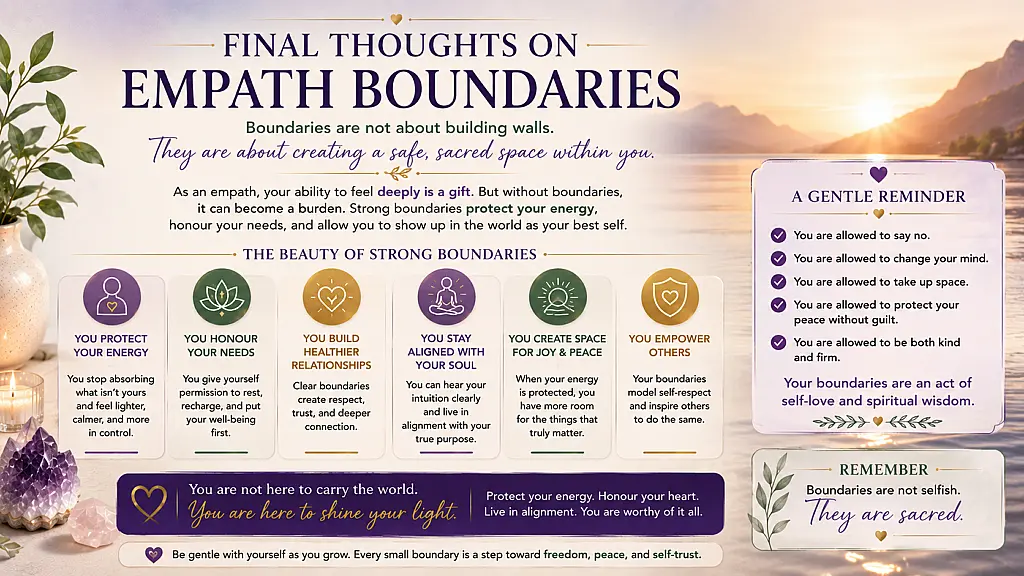
Learning to create healthy empath boundaries is not about becoming distant.
It is about becoming balanced.
For many empaths, boundary work begins with a simple but powerful realisation:
You were never meant to carry everyone’s emotions, solve everyone’s problems, or sacrifice your own well-being to keep the peace.
Yet many sensitive people spend years doing exactly that.
They become the listener.
The helper.
The peacemaker.
The emotional caretaker.
Over time, they give so much of themselves to others that they lose sight of their own needs, feelings, and desires.
Healthy empath boundaries help change that.
They remind you that your energy is valuable.
Your time matters.
Your emotions deserve attention too.
Your sensitivity is a gift.
But like any gift, it requires care, wisdom, and stewardship.
The strongest empaths are not those who give endlessly.
They are those who understand when to give, when to pause, and when to return to themselves.
They know that compassion does not require self-abandonment.
They understand that love does not require suffering.
And they recognise that protecting their peace allows them to show up more fully for the people and experiences that truly matter.
The goal of empath boundaries is not to build walls around your heart.
It is to build a doorway.
A doorway that allows healthy relationships, meaningful connections, and genuine compassion to enter while protecting your peace from being constantly drained.
As you continue this journey, remember that boundaries are not something you create once and never revisit.
They evolve as you grow.
Each time you honor your needs, trust your intuition, or choose yourself without guilt, you strengthen the relationship you have with yourself.
And that relationship is the foundation of every healthy boundary you will ever create.
Because boundaries do not weaken compassion.
They strengthen it.
When you stop carrying what isn’t yours, you finally have the energy to care for what is.
And that may be one of the most empowering lessons an empath can learn.
Continue Your Journey Within
Looking for deeper emotional restoration?
Read The Spiritual Bedtime Routine for Better Sleep to create an evening practice that supports emotional balance, self-reflection, and inner peace.
If you’re ready to develop greater emotional awareness, recognize unhealthy patterns, and reconnect with your own needs, the Moon Planner Journal offers a gentle space for reflection, intention setting, and personal growth through every season of life.

This article offers general wellbeing education and spiritual reflection. It is not medical or mental health advice, and a spiritual interpretation should not replace professional assessment. Seek qualified support for persistent fatigue, pain, sleep disruption, anxiety, low mood or other symptoms that concern you.
Cite or share this page
Want to reference this guide? Please link to the canonical page rather than copying the article.