
Micro breathwork practices are short breathing exercises that can be completed in as little as 30 seconds to five minutes to help reduce stress, improve focus, and promote a greater sense of calm. Unlike longer meditation sessions, these quick techniques are designed to fit into everyday life, making them ideal for busy schedules or moments of overwhelm.
Research suggests that intentional breathing can help regulate the body’s stress response, making micro breathwork a practical tool for supporting mental and emotional wellbeing.
You don’t need an hour of uninterrupted silence to experience the benefits of mindful breathing. Whether you’re preparing for an important meeting, feeling anxious before a difficult conversation, or simply need a mental reset during the day, a few intentional breaths can make a noticeable difference.
In this guide, you’ll discover simple micro breathwork practices that are easy to learn, require no special equipment, and can be used almost anywhere.
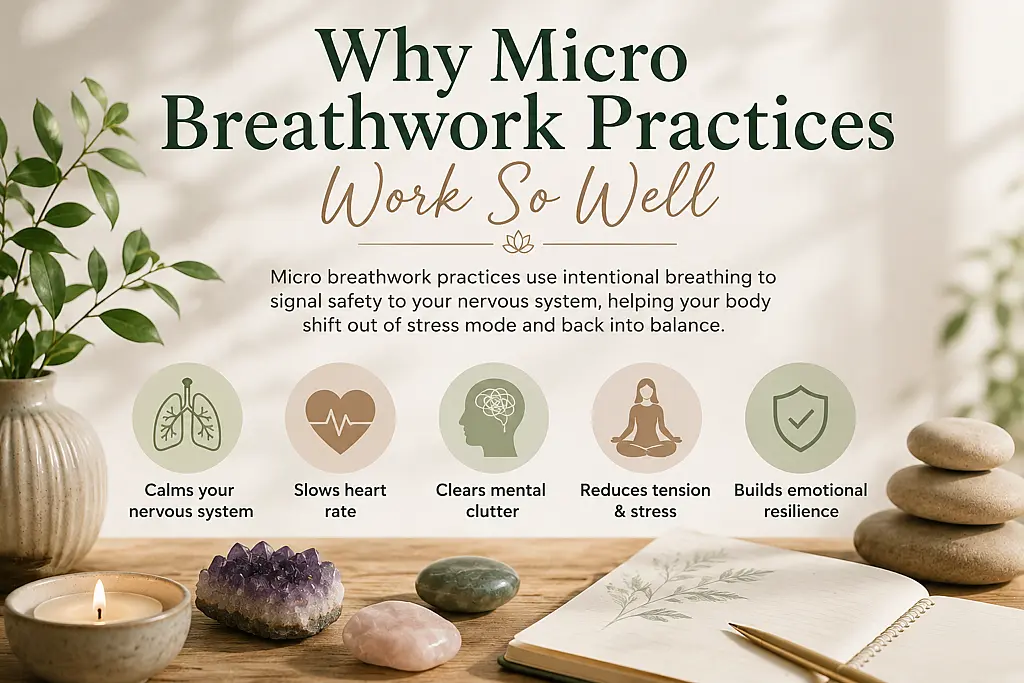
Why Micro Breathwork Practices Work So Well
Many people think anxiety begins in the mind.
In reality, it affects your entire body.
When your brain perceives a threat—whether it’s physical danger or simply a stressful thought—it activates your sympathetic nervous system, often called the fight-or-flight response.
Within seconds, your body begins preparing for action.
Your breathing becomes faster.
Your heart rate increases.
Stress hormones such as cortisol and adrenaline begin circulating through your body.
Muscles tighten.
Your thoughts become more alert, but often less rational.
This response is incredibly useful if you’re escaping genuine danger.
The problem is that modern anxiety is rarely caused by wild animals or immediate physical threats.
Instead, it often comes from:
- Overthinking
- Work pressure
- Financial stress
- Difficult conversations
- Health worries
- Relationship challenges
- Constant digital stimulation
Your body reacts the same way regardless.
Fortunately, your breath offers something remarkable.
It acts as a bridge between your conscious mind and your automatic nervous system.
Unlike your heartbeat or digestion, breathing is one of the few bodily functions you can consciously influence.
When you intentionally slow your breathing, especially your exhale, your body receives a powerful message:
“I’m safe.”
As that message repeats, your nervous system gradually begins shifting away from survival mode.
You may notice:
- Your heart rate slows.
- Your shoulders begin to relax.
- Your thoughts feel less overwhelming.
- Muscle tension decreases.
- Your breathing becomes more natural.
- You feel more present and emotionally balanced.
This doesn’t mean anxiety disappears instantly.
Rather, your body begins moving from a state of protection toward a state of regulation.
That’s why micro breathwork practices feel so different from simply telling yourself to “calm down.”
Instead of fighting your thoughts, you’re supporting your body’s natural ability to return to balance.
The Benefits of Micro Breathwork Practices
Many people begin using micro breathwork practices because they want immediate relief from anxiety.
While they can certainly help during stressful moments, their greatest benefits often appear over time.
As breathing becomes a regular habit rather than an emergency response, you may begin noticing subtle but meaningful changes throughout your day.
These practices may help support:
- Reduced feelings of anxiety and overwhelm
- Greater emotional regulation
- Improved focus and concentration
- Better sleep quality
- Less muscle tension
- Increased mindfulness
- More patience during stressful situations
- Improved resilience to everyday challenges
- A stronger connection between your mind and body
- Greater awareness of your emotional triggers
Perhaps the greatest benefit isn’t simply breathing more slowly.
It’s discovering that you always have a calming tool available to you.
No batteries.
No subscriptions.
No expensive equipment.
Just your next breath.
That awareness alone can become incredibly empowering.
When to Use These Micro Breathwork Practices
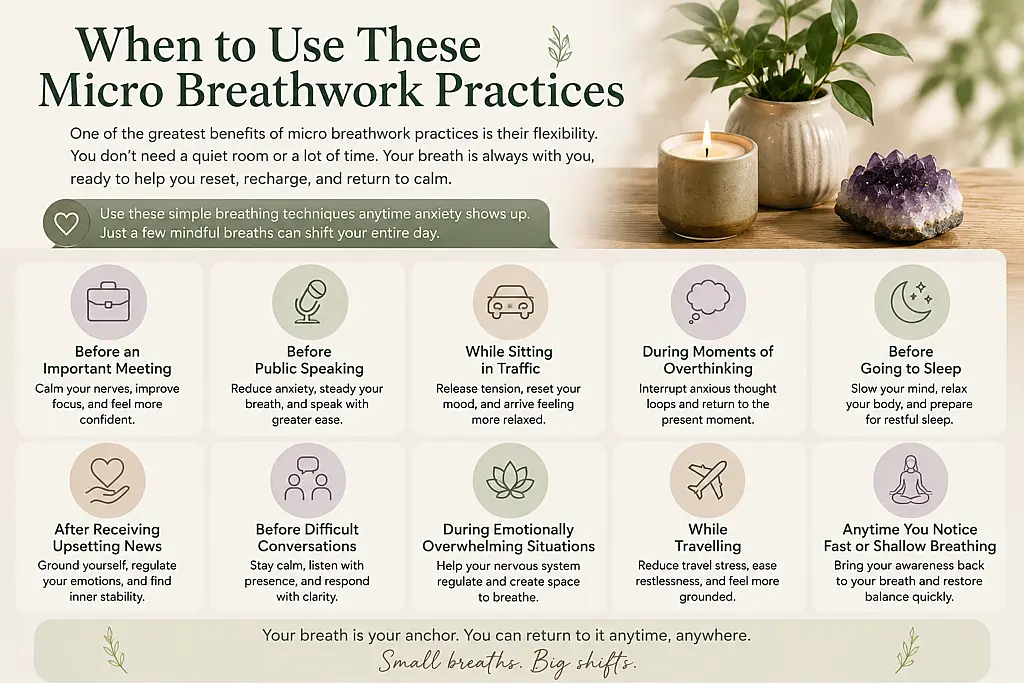
One of the biggest advantages of micro breathwork practices is their flexibility.
You don’t need to set aside an hour every day.
Most exercises take between one and five minutes, making them easy to incorporate into everyday life.
Try using them:
- Before an important meeting
- Before public speaking
- While sitting in traffic
- During moments of overthinking
- Before going to sleep
- After receiving upsetting news
- Before difficult conversations
- During emotionally overwhelming situations
- While travelling
- Whenever you notice your breathing becoming fast or shallow
Many people only remember breathing exercises once anxiety has already taken over.
While they can still help, you’ll often notice even greater benefits when you practise them before stress reaches its peak.
Think of breathwork as daily maintenance for your nervous system rather than emergency first aid.
Just as we don’t wait until we’re dehydrated to drink water, we don’t need to wait until we’re overwhelmed to care for our emotional wellbeing.
A few mindful breaths throughout the day can gently reduce the build-up of stress before it becomes difficult to manage.
Breathwork vs Meditation: What’s the Difference?
People often use the terms breathwork and meditation interchangeably, but they’re not exactly the same.
Both support emotional wellbeing.
Both encourage mindfulness.
Both can help reduce stress.
However, they approach calm from different directions.
Breathwork focuses on consciously changing your breathing pattern to influence your nervous system.
Meditation focuses on observing your thoughts, emotions, or present-moment experience without judgment.
You could think of breathwork as preparing your body.
Meditation then prepares your mind.
Many people who struggle with meditation discover that beginning with two or three minutes of breathwork makes sitting quietly feel much easier.
Instead of trying to calm a busy mind through willpower alone, your breathing helps settle your body first.
The two practices complement each other beautifully.
If you’ve ever felt that meditation “doesn’t work” because your thoughts race constantly, try starting with one of the breathing techniques in this guide before meditating.
You may find your experience becomes noticeably calmer.
Breathwork Is About Progress, Not Perfection
One of the biggest misconceptions about breathwork is that there’s a perfect way to do it.
There isn’t.
Some days your breathing will feel slow and effortless.
Other days your mind will wander after only a few breaths.
Both experiences are completely normal.
Breathwork isn’t a performance.
There are no scores.
No competitions.
No perfect rhythm to achieve.
Every intentional breath matters.
Even one minute of conscious breathing is more beneficial than waiting for the “perfect” time that never arrives.
Rather than asking yourself:
“Am I doing this correctly?”
Try asking:
“How do I feel after slowing down for one minute?”
That small change shifts your attention away from performance and toward self-awareness.
Healing rarely happens because we do something perfectly.
It happens because we return to the practice consistently.
Your breath has been with you since the day you were born.
It may also become one of the gentlest ways to return to yourself whenever life feels overwhelming.
Before we explore the individual breathing techniques, remember one simple principle.
Breathing should always feel comfortable.
Never force your inhale.
Never strain your exhale.
Gentle, relaxed breathing is almost always more effective than trying to take the biggest breath possible.
Small adjustments.
Consistent practice.
Patient curiosity.
That’s where meaningful change begins.
7 Simple Micro Breathwork Practices to Calm Anxiety
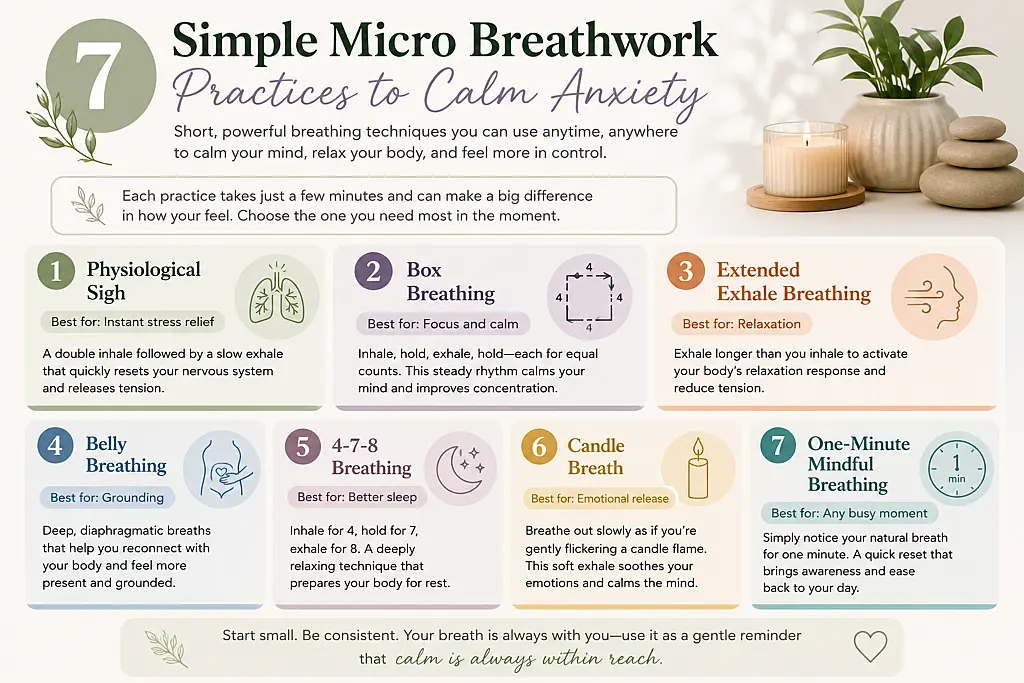
Now that you understand how micro breathwork practices support your nervous system, it’s time to explore the techniques themselves.
Don’t feel pressured to try all seven at once.
Start with the one that feels most approachable.
Practice it for a few days.
Notice how your body responds.
Then, if you’d like, explore another technique.
Remember, there’s no “best” breathing exercise for everyone.
Some people find structured breathing patterns like Box Breathing incredibly calming.
Others feel more relaxed with the gentle rhythm of Extended Exhale Breathing or the simplicity of One-Minute Mindful Breathing.
Your experience is unique.
Allow yourself to approach these practices with curiosity rather than expectation.
If one technique doesn’t resonate with you today, that’s perfectly okay.
Another may feel exactly right next week or next month.
The goal isn’t to master every breathing exercise.
The goal is to discover the practices that help you feel calmer, more grounded, and better equipped to navigate life’s inevitable moments of stress.
As you work through each exercise, pay attention to how your breathing changes, how your body feels, and whether your thoughts begin to soften.
Those small shifts are often the first signs that your nervous system is learning a new, healthier rhythm.
Let’s begin with one of the quickest and most effective techniques for calming anxiety in the moment.
1. Physiological Sigh
Best for: Immediate stress relief and calming sudden anxiety.
If you’ve ever taken one long inhale followed by a deep sigh after a stressful moment, you’ve already experienced the body’s natural reset button.
Known as the physiological sigh, this simple breathing technique has gained attention because of its ability to help regulate the nervous system quickly.
Rather than forcing yourself to “relax,” it works with a breathing pattern your body already understands.
It’s one of the easiest micro breathwork practices to learn because it only takes a few breaths to complete.
Whether you’ve just received difficult news, feel panic beginning to rise, or notice your thoughts spiraling, this exercise can help interrupt that cycle before it gathers momentum.
How to Practice It
- Take a slow, comfortable breath in through your nose.
- Before exhaling, take one smaller second inhale.
- Slowly exhale through your mouth until your lungs feel comfortably empty.
- Repeat three to five times.
Allow each breath to feel relaxed rather than forced.
Why It Works
During periods of stress, we often breathe rapidly without fully emptying our lungs.
The physiological sigh helps restore a healthier breathing rhythm while encouraging your body to release tension naturally.
Many people notice their shoulders soften and their heartbeat begin slowing after only a few rounds.
Best Time to Use It
This practice works particularly well:
- Before an important meeting
- After receiving upsetting news
- During moments of sudden anxiety
- Before difficult conversations
- When your thoughts begin racing
- Any time you notice yourself holding your breath
Common Mistakes
Avoid trying to take the biggest breath possible.
Comfort always matters more than volume.
Gentle breathing is far more calming than forceful breathing.
Continue Your Wellness Journey
If anxiety often keeps you awake at night, our guide to Which Chakra Is Related to Sleep? explores the emotional and energetic connection between restful sleep and overall wellbeing.
2. Box Breathing
Best for: Slowing racing thoughts and improving mental focus.
Box breathing is one of the most well-known micro breathwork practices, and for good reason.
Its simple rhythm gives your mind something steady to focus on while encouraging slower, more balanced breathing.
Many professionals, athletes, emergency responders, and meditation teachers use this technique because it’s easy to remember even during stressful situations.
Instead of becoming caught in anxious thinking, your attention gently shifts toward counting each breath.
That small change can create a surprising sense of calm.
How to Practice It
- Breathe in through your nose for four seconds.
- Hold your breath for four seconds.
- Exhale slowly through your mouth for four seconds.
- Pause for four seconds before inhaling again.
Repeat for one to three minutes.
If four seconds feels uncomfortable, simply reduce the count.
The rhythm matters more than the numbers.
Why It Works
Equal breathing patterns encourage consistency.
That steady rhythm helps interrupt anxious thought patterns while allowing your nervous system to settle.
Many people describe it as giving their mind “something else to do” besides worrying.
Best Time to Use It
Try box breathing:
- Before presentations
- During busy workdays
- Before studying
- Before driving
- During stressful appointments
- Whenever your thoughts feel scattered
Common Mistakes
Don’t become overly focused on counting perfectly.
If your breathing naturally changes pace, simply continue comfortably.
Breathwork should reduce pressure—not create more of it.
Continue Your Wellness Journey
If overthinking leaves you emotionally exhausted, you may also enjoy Anxiety Spiritual Meaning, where we explore how emotional discomfort can become an opportunity for greater self-awareness and healing.
3. Extended Exhale Breathing
Best for: Relaxing the body and calming anxious evenings.
Sometimes the smallest adjustment creates the biggest change.
Extended exhale breathing focuses on just one thing.
Allowing your exhale to become slightly longer than your inhale.
That gentle shift encourages your nervous system to move away from stress and toward relaxation.
Unlike more structured breathing exercises, this practice feels wonderfully natural.
You don’t need to remember complicated patterns.
You simply breathe out a little more slowly than you breathe in.
This makes it one of the most accessible micro breathwork practices for beginners.
How to Practice It
- Inhale gently through your nose for four seconds.
- Exhale slowly through your mouth for six seconds.
- Continue for two to five minutes.
If counting becomes distracting, simply allow your exhale to feel comfortably longer than your inhale.
Your body will naturally find its own rhythm.
Why It Works
Longer exhalations encourage your heart rate to slow while helping release physical tension stored throughout the body.
Many people notice their shoulders relax and their breathing become deeper within only a few minutes.
This technique is especially comforting after emotionally demanding days.
Best Time to Use It
Practice extended exhale breathing:
- Before bed
- During anxious evenings
- After emotional conversations
- Following stressful workdays
- Before meditation
- Whenever your body feels tense
Common Mistakes
Avoid emptying your lungs completely with every breath.
Gentle breathing feels far more soothing than pushing yourself to breathe harder.
Relaxation comes from ease.
Not effort.
Can Breathwork Help During a Panic Attack?
One of the most common questions people ask is whether breathwork can stop a panic attack.
The honest answer is that it isn’t a guaranteed cure.
Panic attacks are complex experiences, and what works for one person may not work for another.
However, gentle micro breathwork practices can often help reduce some of the physical sensations that accompany panic.
By focusing on slow, comfortable breathing, you may begin calming your nervous system and creating a greater sense of stability.
If you’re in the middle of intense panic, avoid forcing deep breaths.
Instead, simply focus on making your exhale a little slower than your inhale.
Even one or two calmer breaths can help you reconnect with the present moment.
If panic attacks occur regularly or feel severe, it’s important to speak with a qualified healthcare professional who can provide personalised advice and support.
Breathwork works best as one helpful tool within a broader approach to emotional wellbeing.
Remember, you don’t have to navigate anxiety alone.
4. Belly Breathing
Best for: Grounding yourself when anxiety feels physical.
Anxiety doesn’t only affect your thoughts.
It often shows up in your body first.
A tight chest.
A knot in your stomach.
Shallow breathing.
Restless energy.
Belly breathing, also known as diaphragmatic breathing, gently interrupts that pattern by encouraging slower, deeper breaths that engage your diaphragm rather than your chest.
It’s one of the most calming micro breathwork practices because it reconnects you with your body instead of leaving you trapped inside anxious thinking.
Many people discover that simply placing a hand on their abdomen while breathing creates an immediate sense of reassurance.
How to Practice It
- Sit or lie somewhere comfortable.
- Place one hand on your chest and the other on your abdomen.
- Breathe in slowly through your nose.
- Allow your belly to rise naturally.
- Exhale gently and feel your abdomen soften.
- Continue for two to five minutes.
Why It Works
When we become anxious, our breathing often moves higher into the chest.
Belly breathing encourages your diaphragm to do more of the work, creating slower, more efficient breaths that support relaxation.
It also increases awareness of physical tension you may not have realised you were carrying.
Best Time to Use It
This technique is particularly helpful:
- Before going to sleep
- After emotionally difficult conversations
- During stressful workdays
- When your chest feels tight
- During mindfulness practice
- Whenever you feel disconnected from your body
Common Mistakes
Don’t force your abdomen outward.
Allow each breath to happen naturally.
Gentle movement is far more effective than exaggerated breathing.
Continue Your Wellness Journey
If you often If you often find yourself highly responsive to others' tone, tension, or visible emotions, our guide to and emotions, our guide to Empath Boundaries explores practical ways to protect your energy while remaining compassionate.
5. 4-7-8 Breathing
Best for: Quieting a busy mind before sleep.
If anxious thoughts tend to appear the moment your head touches the pillow, this may become one of your favorite micro breathwork practices.
The 4-7-8 breathing method creates a gentle rhythm that encourages your body to slow down before sleep.
Rather than trying to force yourself to stop thinking, you give your attention to something simple and calming.
Your breath.
Many people find this technique particularly useful after stressful days when their body feels tired but their mind refuses to switch off.
How to Practice It
- Breathe in gently through your nose for four seconds.
- Hold your breath comfortably for seven seconds.
- Slowly exhale through your mouth for eight seconds.
- Repeat up to four rounds.
If these numbers feel too long, shorten them.
A relaxed rhythm is more important than following exact timings.
Why It Works
The extended exhale encourages your body to move toward a calmer physiological state while the counting gently redirects your attention away from anxious thoughts.
It’s simple enough to practise in bed without needing to sit up or prepare anything beforehand.
Best Time to Use It
Try this technique:
- Before sleep
- After emotionally demanding days
- Before meditation
- During periods of overthinking
- Whenever your mind feels restless
Common Mistakes
Avoid straining during the breath hold.
If holding your breath feels uncomfortable, simply remove that step and continue with slow, relaxed breathing.
Continue Your Wellness Journey
Combine this breathing exercise with our Spiritual Bedtime Routine to create a peaceful evening ritual that supports deeper rest and emotional balance.
6. Candle Breath
Best for: Emotional release and gentle relaxation.
Sometimes visualisation makes breathing even more effective.
Imagine a candle burning quietly in front of you.
Your goal isn’t to blow it out.
Your goal is simply to make the flame dance.
That gentle image naturally encourages slower, softer exhalations without forcing the breath.
Candle Breath is one of the most beginner-friendly micro breathwork practices because it replaces complicated instructions with a calming mental picture.
It often feels especially comforting during emotionally overwhelming moments.
How to Practice It
- Inhale gently through your nose.
- Imagine a candle flame in front of you.
- Slowly breathe out through your mouth as though you’re making the flame flicker.
- Repeat for one to three minutes.
Why It Works
Visualisation gives your mind something peaceful to focus on.
At the same time, the slow exhale encourages your nervous system to settle naturally.
Together, these two elements create a surprisingly calming experience.
Best Time to Use It
Use Candle Breath:
- After arguments
- During emotional overwhelm
- Before journaling
- During evening wind-down routines
- After stressful workdays
Common Mistakes
Don’t blow forcefully.
Imagine the smallest possible movement of the flame.
Soft breathing creates the greatest sense of calm.
Continue Your Wellness Journey
Many people pair breathwork with intention setting. Our guide to New Moon Ritual for Beginners offers a simple spiritual practice that complements mindful breathing beautifully.
7. One-Minute Mindful Breathing
Best for: Busy days when you only have sixty seconds.
Many people believe they need long breathing sessions before they’ll notice any benefits.
That’s simply not true.
One mindful minute can completely change the direction of your day.
This final practice strips everything back to its simplest form.
No counting.
No breath holds.
No complicated techniques.
Just noticing your breath exactly as it is.
For many people, this becomes the breathing exercise they return to most often because it fits into almost every situation.
How to Practice It
- Set a timer for one minute.
- Sit or stand comfortably.
- Notice your natural breathing.
- Feel each inhale.
- Feel each exhale.
- Whenever your mind wanders, gently bring your attention back to your breath.
That’s all.
Why It Works
Mindful breathing interrupts autopilot.
Instead of becoming swept away by anxious thoughts, you create a brief pause.
That pause often becomes the beginning of emotional regulation.
Even sixty seconds can reduce mental overwhelm and increase your awareness of the present moment.
Best Time to Use It
Practice this whenever you need a reset:
- Between meetings
- Before checking social media
- Before meals
- During work breaks
- Before responding to stressful emails
- Anytime anxiety begins to build
Common Mistakes
Don’t expect your mind to become completely quiet.
Thoughts will come and go.
The practice isn’t about stopping them.
It’s about gently returning to your breath each time you notice you’ve become distracted.
Continue Your Wellness Journey
If you’re looking to deepen your mindfulness practice beyond breathing exercises, our guide to Spiritual Awakening Books shares thoughtful reads that encourage greater self-awareness, presence, and emotional resilience.
A Simple 5-Minute Anxiety Reset Routine
If you’re unsure which technique to begin with, combine several of these micro breathwork practices into one calming daily routine.
You can use it first thing in the morning, during a stressful afternoon, or before bed.
Minute One — Arrive
Sit comfortably.
Relax your shoulders.
Notice your breathing without trying to change it.
Simply become aware.
Minute Two — Box Breathing
Use a steady rhythm to gently settle your thoughts.
Allow the counting to become your only focus.
Minute Three — Extended Exhale
Lengthen your exhale slightly.
Feel tension beginning to leave your body.
Minute Four — Belly Breathing
Place one hand on your abdomen.
Reconnect with slow, natural breathing.
Allow your body to soften.
Minute Five — Quiet Stillness
Return to your normal breathing.
Sit quietly for one minute.
Notice how your body feels now compared with when you started.
You may not feel completely free from anxiety.
That’s okay.
The goal isn’t perfection.
It’s creating a small space where calm has an opportunity to return.
Sometimes five mindful minutes are enough to completely change the rhythm of your day.
What Happens Inside Your Body During Calm Breathing?
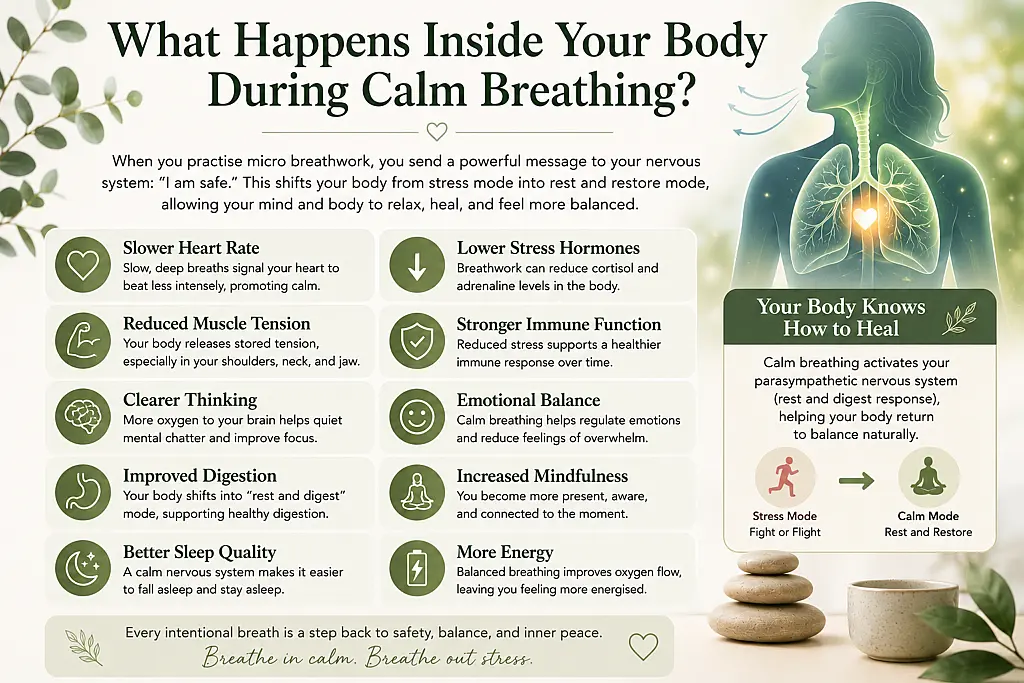
One of the most remarkable things about micro breathwork practices is that they influence far more than your breathing.
Every slow, intentional breath creates a ripple effect throughout your body.
When anxiety takes over, your nervous system prepares you for action.
Your breathing becomes quicker.
Your muscles tighten.
Your heart beats faster.
Your body becomes focused on survival.
Calm breathing gently encourages the opposite response.
As your breathing slows, your body begins receiving signals that the immediate danger has passed.
Over time, you may notice:
- A slower heart rate
- Reduced muscle tension
- Less jaw clenching
- Softer shoulders
- Improved digestion
- Clearer thinking
- Better emotional regulation
- A greater sense of physical calm
Many researchers also believe slow, controlled breathing supports stimulation of the vagus nerve, an important part of the parasympathetic nervous system.
Often called the body’s “rest and digest” response, this system helps your body recover after stress.
Rather than remaining trapped in fight-or-flight mode, your nervous system gradually learns how to return to balance more efficiently.
This is one of the reasons regular breathwork often feels easier over time.
You’re not simply practising breathing.
You’re training your nervous system to recover more quickly from everyday stress.
Why Consistency Matters More Than Duration
Many people assume they need thirty-minute breathing sessions before they’ll notice any benefits.
In reality, consistency almost always matters more than duration.
Five mindful minutes every day is often far more effective than one long session once a week.
Think about brushing your teeth.
You wouldn’t brush for two hours once a month and expect healthy teeth.
Breathwork works in a similar way.
Small daily habits gradually strengthen your ability to respond calmly during stressful situations.
Your nervous system learns through repetition.
Every time you practice one of these micro breathwork practices, you’re reinforcing a healthier breathing pattern.
Over weeks and months, those patterns become easier to access naturally.
That’s why many experienced practitioners don’t necessarily breathe differently during calm moments.
They recover more quickly after stressful ones.
Healing isn’t built through intensity.
It’s built through consistency.
Create Your Own Calm Routine
One of the most empowering aspects of breathwork is discovering which techniques work best for you.
Everyone experiences anxiety differently.
Some people benefit from structured breathing patterns.
Others find visualisation more calming.
Some prefer quiet mindfulness.
Others enjoy combining breathing with journaling or meditation.
Instead of searching endlessly for the “perfect” breathing exercise, begin noticing your own patterns.
Ask yourself:
- Which breathing technique feels most calming?
- What situations usually trigger my anxiety?
- What time of day do I feel most overwhelmed?
- Which practice helps me recover the fastest?
- How does my body feel after five minutes of breathing?
Recording these observations helps transform breathwork from an occasional exercise into a personalised wellbeing practice.
Our Moon Planner Journal was designed to support this journey.
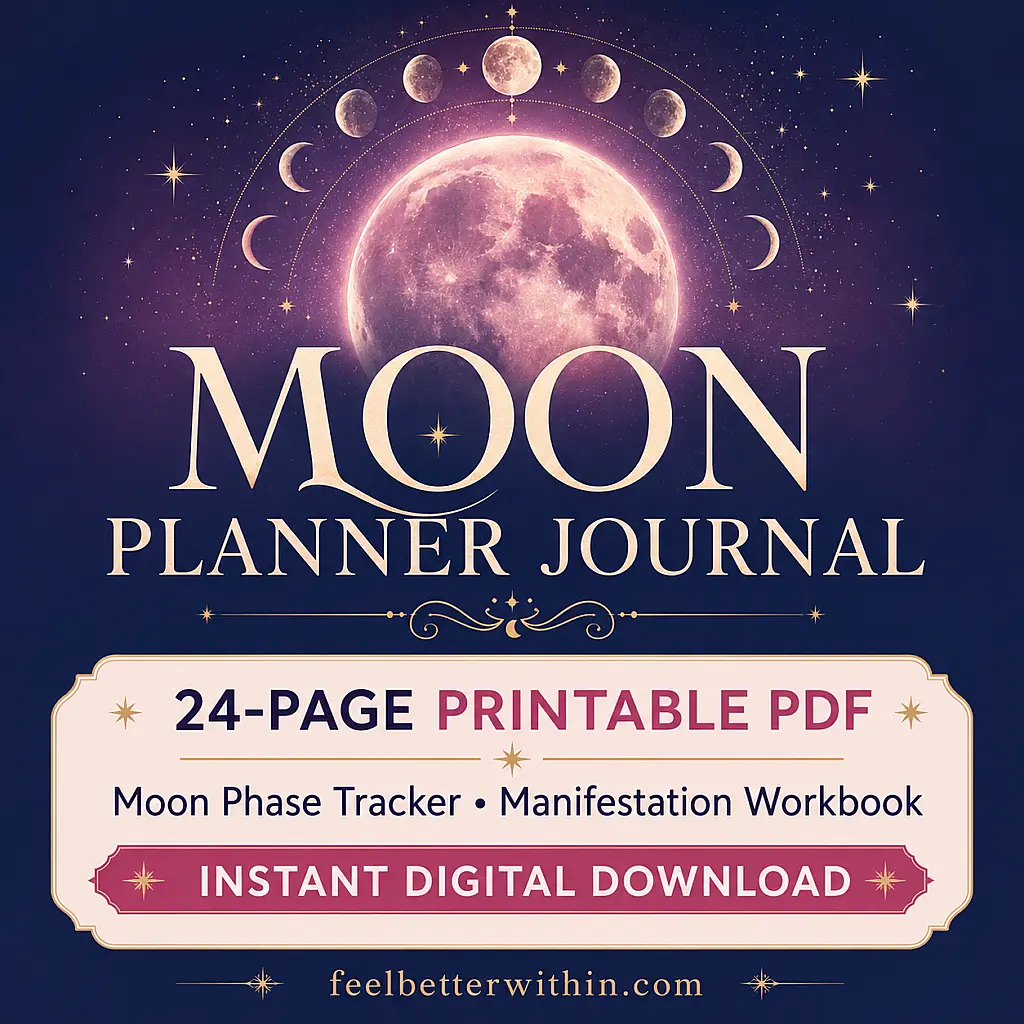
It’s a peaceful place to record daily reflections, gratitude, emotional patterns, breathing practices, intentions, and personal growth.
Looking back over your journal after several weeks often reveals progress you may not have noticed from one day to the next.
Small changes become visible.
Confidence grows.
Your relationship with anxiety begins to change.
Common Mistakes People Make With Breathwork
Breathwork is wonderfully simple.
Sometimes we accidentally make it more complicated than it needs to be.
Here are a few common mistakes worth avoiding.
Waiting Until Anxiety Feels Overwhelming
Many people only remember breathwork once they’re already feeling highly anxious.
While breathing exercises can certainly help during those moments, they become even more effective when practised regularly throughout the day.
Think of breathwork as prevention as much as relief.
Trying Too Hard
More effort doesn’t always create better results.
Forcing deep breaths can actually create additional tension.
Relaxed breathing almost always feels more calming than exaggerated breathing.
Expecting Instant Transformation
Some sessions will feel incredibly calming.
Others may feel ordinary.
That’s completely normal.
Breathwork isn’t about chasing one perfect experience.
It’s about gradually strengthening your nervous system over time.
Comparing Yourself to Others
Your breathing is unique.
Your nervous system is unique.
The goal isn’t to breathe like someone else.
The goal is discovering what helps you feel safe, grounded, and calm.
Forgetting to Be Kind to Yourself
Perhaps the most important reminder of all.
Healing isn’t linear.
Some days anxiety will feel easier to manage.
Other days it may feel louder.
Both experiences are part of being human.
Every mindful breath is still moving you forward.
Frequently Asked Questions
How often should I practice micro breathwork?
Even one to five minutes each day can make a meaningful difference over time.
Consistency is far more important than long sessions.
Can micro breathwork stop anxiety immediately?
Breathwork doesn’t guarantee anxiety will disappear instantly.
However, it can help calm your body’s stress response, reduce physical tension, and make anxious moments feel more manageable.
Is breathwork better than meditation?
They work differently.
Breathwork helps regulate your nervous system through conscious breathing.
Meditation develops awareness and observation.
Many people find they complement each other beautifully.
Can I practice breathwork every day?
Yes.
Gentle breathing exercises are generally suitable as part of a daily wellbeing routine.
If you have a respiratory or medical condition, speak with your healthcare professional before beginning any new breathing practice.
Why do I sometimes feel emotional during breathwork?
Slowing down often creates space for emotions that have been pushed aside during busy daily life.
This is a normal experience for many people.
Allow emotions to arise gently without judging yourself.
Which breathing exercise is best before bed?
Many people find Extended Exhale Breathing or 4-7-8 Breathing particularly calming during the evening because both encourage relaxation before sleep.
Final Thoughts
Anxiety often convinces us that everything needs to be solved immediately.
Your breath offers a different message.
Slow down.
Pause.
Begin with this moment.
The beauty of micro breathwork practices isn’t that they remove every challenge from your life.
It’s that they gently remind your body how to return to safety, one breath at a time.
Some days you’ll notice a dramatic shift.
Other days the change will feel almost invisible.
Both experiences matter.
Healing is rarely built through one perfect breathing session.
It’s built through hundreds of small moments of awareness repeated with patience and self-compassion.
Your breath has been with you since your very first day.
It asks for nothing.
It is always available.
And no matter how busy, uncertain, or overwhelming life becomes, your next calm breath is never further away than the present moment.

Cite or share this page
Want to reference this guide? Please link to the canonical page rather than copying the article.