

If you are asking, “How do I protect my peace without cutting everyone off?” the answer is usually not to disappear from people completely. It is to replace constant access with clear, proportionate limits.
Decide what you can realistically offer, communicate it calmly and give safe people a chance to adjust. Take space when you need it, address recurring problems directly and reserve greater distance for situations where your boundaries are repeatedly ignored or you do not feel safe.
Protecting your peace should make your relationships more sustainable—not leave you feeling as though isolation is your only option.
How Much Distance Do I Actually Need?

Protecting your peace means managing access, demands and recovery time so that connection remains sustainable.
It does not require you to avoid every difficult feeling, disagreement or awkward conversation. Some discomfort is part of honest relationships, particularly when you begin changing a pattern of always being available, saying yes automatically or putting other people’s needs ahead of your own.
A useful principle is:
Choose the smallest boundary that adequately protects your peace.
A draining afternoon might mean you need a quiet evening.
Repeated late-night calls might require a communication limit.
A relative who constantly raises a subject you do not want to discuss might need a clear topic boundary.
Repeated harassment, intimidation or controlling behaviour may require much greater distance.
The aim is not to find the harshest response available. It is to find the response that actually fits the situation.
This leaves room for relationships to adjust and repair without treating unlimited access to you as the price of caring.
There is an important exception. If someone is threatening, abusive, controlling or making you feel unsafe, you do not owe them repeated explanations or additional opportunities to cross your limits.
Know What a Boundary Is—and What It Is Not
A healthy boundary focuses primarily on what you will accept and what you will do.
It cannot guarantee that another adult will agree with you, understand you or change their behaviour.
For example:
- A boundary: “If the conversation becomes insulting, I’ll end the call and we can try again another day.”
- A temporary pause: “I’m too upset to talk about this properly right now. I’ll contact you tomorrow.”
- Avoidance: repeatedly withdrawing from a generally respectful person because the conversation feels uncomfortable, without explaining the problem or returning to it.
- Punishment or control: using silence, access or threats mainly to frighten someone, force compliance or make them suffer.
There is also an important difference between making a request and setting a boundary.
“Please stop calling after 9 pm” is a reasonable request.
A boundary adds the action that remains within your control:
“I put my phone on silent after 9 pm and will reply the following day.”
You are not trying to control whether the person calls. You are deciding when you will be available.
Clear limits can still disappoint people.
Their disappointment does not automatically mean you were rude or unfair. In the same way, feeling uncomfortable after speaking honestly does not automatically mean you did something wrong.
Look at what you actually said, whether your response fits the situation and what has been happening over time.
When Protecting Your Peace Becomes Avoidance
Taking space can be healthy.
Disappearing every time something becomes uncomfortable is different.
Ask yourself:
Am I taking space so I can return more steadily, or am I hoping the issue will disappear without communication?
If the relationship is generally safe and respectful, consider whether a smaller boundary could solve the problem.
Instead of disappearing, you might:
- delay a difficult conversation until you feel calmer;
- shorten a visit rather than avoiding it completely;
- choose texting instead of a long phone conversation;
- ask for notice before someone visits;
- stop discussing one particular topic;
- explain that you need more time before replying.
Sometimes the problem is not the whole relationship. It is the amount of access, the timing, the topic or a repeated behaviour.
That distinction matters.
This does not apply when someone is threatening, controlling, abusive or repeatedly ignoring clear limits. Greater distance can be appropriate when ordinary boundaries are not enough.
Choose the Smallest Boundary That Meets the Need
When you are overwhelmed, every problem can start to feel enormous.
That is where a Peace Protection Ladder can help.
Instead of immediately deciding between “put up with it” and “cut them off,” consider how much distance the situation actually requires.
1. Reset
Let the initial emotional intensity settle before making a lasting decision when it is safe to do so.
Step outside.
Put the phone down.
Have some quiet time.
Write down what actually happened.
A difficult hour does not always require a permanent relationship decision.
2. Adjust Access
Sometimes the simplest solution is changing how much access someone has to your time and attention.
You might mute non-urgent notifications, shorten visits, choose text instead of calls or schedule recovery time after demanding events.
If phone conversations are particularly draining, it may help to understand why phone calls can feel more draining than texting.
3. Make a Clear Request
Name the behaviour rather than attacking the person.
For example:
“Could you message before visiting rather than arriving unannounced?”
Clear requests give reasonable people an opportunity to adjust.
4. Set and Enforce a Limit
If the problem continues, decide what you will do.
For example:
“If you arrive without checking first, I may not be able to let you in.”
A boundary becomes meaningful when your actions match what you have said.
5. Increase Distance
If lower-level boundaries repeatedly fail—or the situation makes them inappropriate—reduce the amount or type of contact.
That might mean fewer visits, shorter conversations, using only one communication method, blocking particular channels or, in some circumstances, ending contact.
Before deciding, ask:
Is this a one-off or a pattern?
Is this person willing to listen or repair things?
Do I feel temporarily uncomfortable, repeatedly depleted or genuinely unsafe?
The ladder is a decision aid, not a rulebook.
You do not have to work through every step before protecting yourself from threats, stalking, abuse or controlling behaviour.
How to Set a Boundary Without Pushing Someone Away

Once you know what level of boundary you need, the next question is how to communicate it.
Use this five-step approach.
1. Pause Before Deciding
Unless immediate action is needed for safety, give yourself enough time to separate the situation from the first wave of emotion.
You do not have to solve every relationship problem while you are angry, exhausted or overwhelmed.
2. Identify the Precise Drain
Replace a broad thought such as:
“This person ruins my peace.”
with something observable.
Maybe they:
- call late at night;
- expect immediate replies;
- criticise your appearance;
- bring up the same conflict-heavy subject;
- arrive without warning;
- keep extending visits;
- expect you to listen to problems for hours.
Precision makes boundaries easier.
You can respond to a behaviour far more effectively than to the vague feeling that someone is “too much.”
3. Choose a Boundary You Can Actually Enforce
Try not to build a boundary that depends entirely on the other person cooperating.
You can silence your phone.
You can leave a conversation.
You can refuse to discuss a particular subject.
You can shorten a visit.
You cannot guarantee that another person will understand, agree or approve.
4. Communicate Briefly
Explain the behaviour, what you need and what you will do.
You usually do not need a ten-paragraph defence of your decision.
For example:
“I’m not available for long calls in the evening anymore. If I miss you, I’ll get back to you the next day.”
Avoid cataloguing every mistake someone has ever made or trying to diagnose why they behave the way they do.
More explanation does not always produce more understanding.
5. Watch What Happens Next
Do not judge the whole relationship by the person’s first facial expression.
People sometimes need time to adjust when an old pattern changes.
Instead, watch what happens over time.
Do they make an effort?
Do they negotiate reasonably?
Do they continually ignore what you have asked?
Do they punish you whenever you say no?
The pattern tells you more than one uncomfortable conversation.
If guilt or overthinking makes you question what happened afterwards, write down:
- what boundary you set;
- why you needed it;
- what you actually said;
- how the person responded.
This can help you return to the facts instead of mentally rewriting the conversation twenty different ways.
Calm Boundary Scripts for Common Situations
Sometimes you know that you need a boundary but freeze when it is time to say it.
Keep it simple.
When Someone Wants a Long Conversation
“I can listen for about 15 minutes, but I don’t have the capacity for a long call tonight.”
When People Expect Immediate Replies
“I’m not always able to reply straight away. I’ll get back to you when I have the headspace.”
When a Conversation Becomes Disrespectful
“I want to talk about this, but I’m going to pause the conversation if we start insulting each other.”
When Someone Keeps Raising a Personal Topic
“I’m not discussing my body or relationship choices. Let’s talk about something else.”
When You Need to Leave Earlier
“I’m going home after lunch rather than staying all day.”
If family events tend to leave you emotionally exhausted, it may help to plan how you will protect your energy before a family gathering.
When You Need Less Digital Access
“I keep my phone on Do Not Disturb after 8 pm. I’ll reply when I’m available.”
When Someone Regularly Uses You as Their Emotional Outlet
“I care about you, but I’m not able to process all of this with you tonight.”
Learning how to stop feeling responsible for everyone’s emotions can make this boundary much easier to understand.
Remember that a script only works when it is backed by an action.
If you say you will end a conversation when insults begin, calmly end it when that line is crossed.
Worked Example: From Disappearing to a Clear Limit
Imagine a friend repeatedly sends you intense late-night messages.
You care about them, but you are exhausted.
Soon, you begin dreading every notification.
Two extremes might be:
Extreme one: keep answering every night while becoming increasingly resentful.
Extreme two: suddenly disappear without explanation when there is no safety reason preventing you from communicating.
There is a middle option.
You could say:
“I care about you and want to be honest that I can’t provide support late at night. I keep my phone muted from 9 pm and will respond when I can the next day. If you need immediate support, please reach out to someone or a service that is available at that time.”
Then follow through.
Mute the notifications.
Reply when you genuinely have the capacity.
You have not stopped caring.
You have changed the conditions under which you are available.
That distinction is at the heart of protecting your peace without cutting everyone off.
Care and constant availability are not the same thing.
How to Handle Guilt After Setting a Limit
Guilt is an emotion, not a verdict.
Feeling guilty after setting a boundary does not automatically mean the boundary was wrong.
Sometimes guilt appears because you genuinely handled something badly.
But sometimes it appears simply because you behaved differently.
If people are accustomed to you always saying yes, always replying or always being available, changing that pattern can feel uncomfortable for everyone involved.
Ask yourself three questions:
Was I clear rather than cruel?
Was the limit proportionate to what was happening?
Is there something specific I genuinely need to apologise for or clarify?
If your delivery was unnecessarily harsh, you can repair the delivery without abandoning the boundary.
For example:
“I’m sorry I raised my voice. I still need us to stop discussing that topic.”
That is very different from:
“I feel guilty, so forget everything I said.”
Someone being unhappy with your boundary does not necessarily make the boundary unfair.
People who benefited from your previous availability may notice the change before they understand it.
Give yourself time to distinguish between:
I feel guilty because I behaved badly
and
I feel guilty because I behaved differently.
Readers who strongly identify with other people’s feelings may also find setting empath boundaries without guilt helpful.
Try not to turn guilt into a reassurance-seeking loop.
You do not need to rewrite the same message twelve times, ask five people whether you were wrong and then send another enormous explanation because the first one felt uncomfortable.
Return to the facts.
If something genuinely needs repairing, repair it.
If it does not, allow the discomfort of doing something differently to settle.
When Greater Distance or No Contact May Be Appropriate
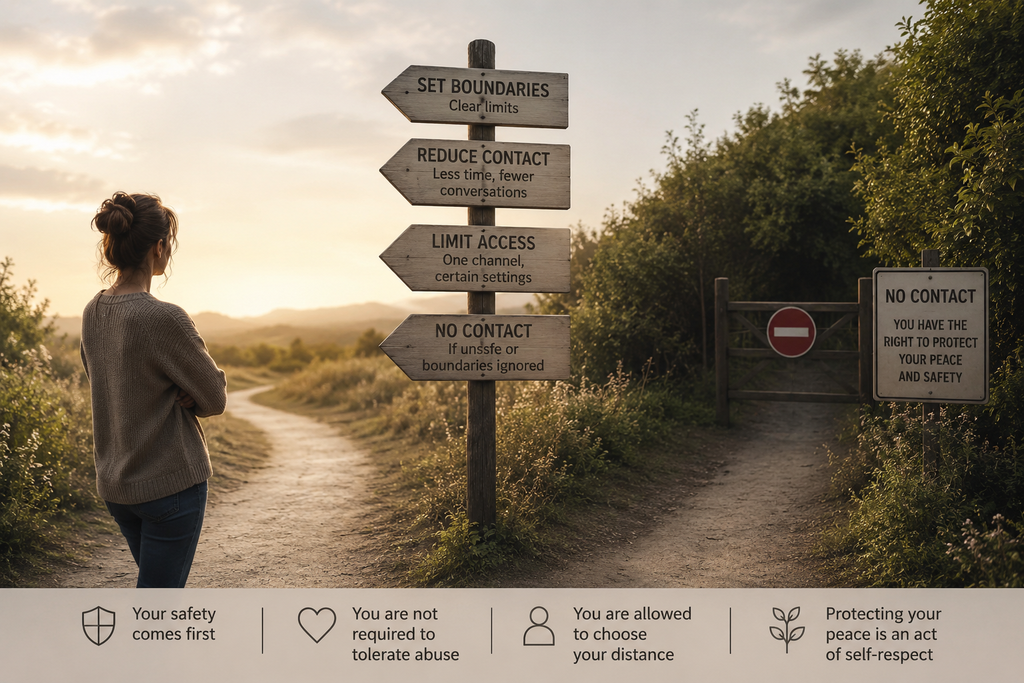
Protecting your peace does not mean every relationship must be preserved.
Greater distance may be reasonable when there is a persistent pattern of boundary violations, harassment, threats, stalking, controlling behaviour, manipulation or abuse.
Depending on the circumstances, greater distance might involve:
- reducing how often you communicate;
- meeting only in certain settings;
- using one communication channel;
- blocking contact;
- involving other people for support;
- ending the relationship entirely.
No contact is a serious, context-dependent decision.
It should not be used as a fashionable label for every disagreement or as a punishment designed to make another person suffer.
But preserving contact is not always appropriate either.
You are not required to repeatedly explain yourself, negotiate with someone who is frightening you or gradually work through smaller boundaries when doing so could increase the risk to you.
If family or domestic violence is involved, specialist support can help you consider your options safely.
In Australia, 1800RESPECT provides support relating to domestic, family and sexual violence on 1800 737 732.
If there is immediate danger, call Triple Zero (000).
The information in this article is general wellbeing information and is not an individual safety plan or legal advice.
Protect Your Peace While Leaving Room for Connection
Protecting your peace does not have to mean building a wall around your life.
Often, it means creating a door and deciding when it opens.
Choose one recurring drain this week.
Maybe it is:
- a phone call that always runs too long;
- messages you feel pressured to answer immediately;
- a family topic you are tired of defending;
- a visit that needs an end time;
- someone else’s problem that you keep treating as your responsibility.
Then test one modest boundary.
Shorten the call.
Delay the reply.
Change the subject.
Leave earlier.
Put the phone on silent.
Healthy connection can include limits, disagreement, repair and periods of rest.
The practical answer to “How do I protect my peace without cutting everyone off?” is not to preserve every relationship at any cost.
It is to offer connection in forms you can genuinely sustain while paying attention when someone repeatedly refuses to respect reasonable limits.
If emotional overload makes it difficult to work out what you actually need, use the to note what drained you, what helped you recover and one boundary you want to practise next.
Cite or share this page
Want to reference this guide? Please link to the canonical page rather than copying the article.