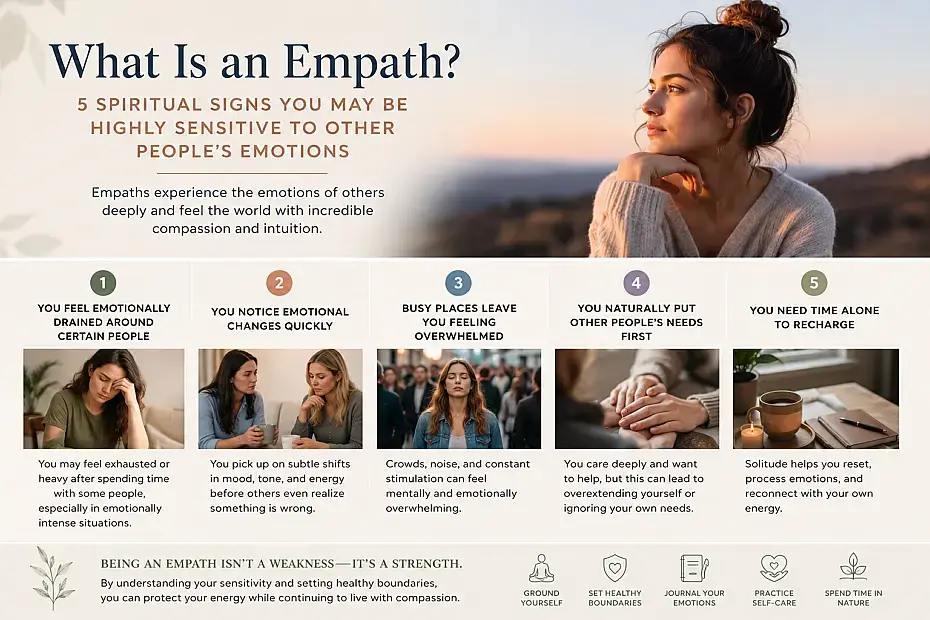
An empath is someone who believes they experience other people’s emotions more deeply than most. While “empath” is not a recognized medical or psychological diagnosis, many people use the term to describe an unusually high level of emotional sensitivity, intuition, and awareness of the feelings of those around them.
Whether you see empathy through a spiritual or psychological lens, learning to recognise your own emotional patterns can help you build healthier boundaries and protect your wellbeing.
If you’ve ever walked away from a conversation feeling emotionally exhausted, become overwhelmed in busy environments, or struggled to separate your own feelings from those of others, you may have wondered whether you’re an empath.
Some people understand this experience as a spiritual gift, while others relate it to traits such as high sensitivity, emotional awareness, or sensory processing sensitivity.
There is no universal definition, but most descriptions share one common theme: a tendency to experience emotions deeply and respond compassionately to others.
Empath vs Highly Sensitive Person
Although the terms empath and Highly Sensitive Person (HSP) are often used interchangeably, they describe slightly different experiences.
A Highly Sensitive Person (HSP) is someone with the personality trait known as sensory processing sensitivity (SPS). First identified by psychologist Dr. Elaine Aron, this trait suggests that some people naturally process emotional, social, and sensory information more deeply than others.
Highly sensitive people may notice subtle details, become overwhelmed by loud or busy environments, and need regular quiet time to recharge. Sensory processing sensitivity is a recognized area of psychological research, although not a medical diagnosis.
An empath, on the other hand, is a term more commonly used in spiritual and self-development communities. People who identify as empaths often describe feeling deeply connected to the emotions of others or sensing another person’s emotional state very strongly.
Some believe they absorb the feelings or energy of those around them, while others simply experience an unusually high level of empathy and emotional awareness.
The two experiences can overlap. Many people who identify as empaths also recognise themselves in the characteristics of a Highly Sensitive Person. Both may feel emotionally overwhelmed in stressful environments, value time alone to recover, and have a strong sense of compassion for others.
The key difference is that high sensitivity is a researched personality trait, while being an empath is a personal or spiritual identity that does not have a universally accepted scientific definition. Neither label is better than the other, and you don’t need to fit perfectly into either category to benefit from understanding your emotional patterns and taking care of your wellbeing.
If you find yourself relating to both descriptions, the most important question isn’t which label fits best—it’s learning what helps you stay emotionally balanced, set healthy boundaries, and care for yourself while continuing to care for others.
5 Signs You May Be an Empath

Rather than focusing on dramatic spiritual experiences, these signs reflect patterns many self-identified empaths commonly describe.
1. You Feel Emotionally Drained Around Certain People
One of the most commonly reported empath traits is feeling emotionally exhausted after spending time with certain people. You might leave a difficult conversation feeling mentally drained, emotionally heavy, or as though you need time alone to recover—even if nothing physically demanding happened.
This doesn’t necessarily mean you’re literally absorbing someone else’s emotions. In many cases, emotional exhaustion can result from listening deeply, supporting others through stressful situations, or constantly paying attention to subtle emotional cues. If you’re naturally compassionate, it’s easy to invest a great deal of emotional energy without realising it.
Over time, this can leave you feeling depleted, especially if you rarely make space to recharge. Learning to recognise your own emotional limits and creating healthy boundaries allows you to continue caring for others without neglecting your own wellbeing.
2. You Notice Emotional Changes Quickly
Have you ever sensed that something was wrong before anyone said a word?
Many people who identify as empaths say they quickly notice subtle changes in another person’s mood or behaviour. It might be a slight shift in someone’s tone of voice, a change in facial expression, quieter body language, or simply the feeling that something is different.
This heightened awareness doesn’t necessarily mean you have a supernatural ability. It may reflect strong emotional intelligence, careful observation, or years of paying close attention to the people around you. Some people naturally pick up on emotional signals that others overlook.
While this sensitivity can help you become a supportive friend, partner, or parent, it can also become overwhelming if you constantly feel responsible for everyone else’s emotions. Recognising emotional changes is valuable, but remembering that you don’t have to fix every problem is equally important.
If you often carry other people’s feelings long after a conversation ends, learn how to create healthier emotional boundaries in How To Stop Feeling Responsible For Everyone’s Emotions
3. Busy Places Leave You Feeling Overwhelmed
If crowded places leave you feeling mentally exhausted, you’re not alone.
Shopping centres, airports, concerts, sporting events, or busy family gatherings can bombard your senses with constant noise, movement, conversations, and activity. For people who are naturally sensitive, processing all of this information at once can become tiring surprisingly quickly.
Many self-identified empaths describe feeling emotionally overwhelmed in these environments, while Highly Sensitive People often experience sensory overload alongside emotional fatigue. After a busy day, you may find yourself craving silence, fresh air, or a quiet space simply to reset.
Taking short breaks, stepping outside for a few minutes, or scheduling downtime after busy events can make a noticeable difference. Looking after your own nervous system isn’t selfish—it’s an important part of maintaining emotional balance.
4. You Naturally Put Other People’s Needs First
Caring about others is one of the qualities many empaths value most about themselves.
You may be the person friends call when they’re struggling, the family member who always checks in, or the colleague who offers support without being asked. Compassion is a wonderful strength, but it can become exhausting when everyone else’s needs consistently take priority over your own.
Over time, constantly saying “yes,” avoiding conflict, or feeling responsible for other people’s happiness can contribute to emotional exhaustion and even burnout. Healthy relationships involve compassion, but they also require boundaries.
Looking after yourself doesn’t make you selfish. In fact, protecting your own emotional wellbeing often allows you to show up more patiently, calmly, and authentically for the people you care about.
5. You Need Time Alone to Recharge
If you regularly need quiet time after socialising, it doesn’t mean you’re antisocial or unfriendly.
Many people who identify as empaths simply find that solitude helps them process emotions, clear mental clutter, and reconnect with themselves after a busy or emotionally demanding day. While some people feel energised by constant social interaction, others recover best through peaceful, uninterrupted moments alone.
Your idea of recharging might be taking a walk in nature, journaling, reading, practising meditation, or simply enjoying a cup of tea without distractions. The activity itself matters less than giving yourself permission to slow down.
Rather than seeing solitude as something to feel guilty about, consider it an important form of self-care. Regular moments of rest can help you return to your relationships feeling calmer, more present, and emotionally resilient.
Need a quick way to recharge? Try our 10-Minute Spiritual Awakening Grounding Reset to help calm your mind and restore emotional balance.
Is Being an Empath a Spiritual Gift?
Whether being an empath is a spiritual gift depends largely on your personal beliefs and experiences.
In many spiritual traditions, empaths are thought to have a heightened awareness of the emotions, energy, or emotional state of the people around them. Some believe this sensitivity allows them to offer compassion, guidance, or support in ways that feel deeply intuitive.
Practices such as meditation, prayer, grounding, and mindfulness are often used to help protect emotional wellbeing while developing this sense of awareness.
Others view empathy through a psychological perspective rather than a spiritual one. Researchers recognize that people naturally vary in empathy, emotional intelligence, and sensitivity to their surroundings.
Personality, upbringing, life experiences, and the way we process emotions can all influence how deeply we respond to other people’s feelings. From this perspective, feeling emotionally affected by those around you doesn’t necessarily require a spiritual explanation.
For many people, these two perspectives can exist comfortably alongside one another. Someone may find meaning in spiritual practices while also understanding the importance of healthy boundaries, emotional regulation, and self-care.
Rather than focusing on whether empathy is a gift, a personality trait, or something in between, it can be more helpful to ask how your sensitivity influences your daily life.
If your empathy helps you build meaningful relationships, support others, and live with compassion, it can be a wonderful strength. However, if it regularly leaves you emotionally overwhelmed, anxious, or exhausted, it may be a sign that you need stronger boundaries and more intentional self-care.
Ultimately, the label matters far less than learning to understand your own emotional needs. Whether you identify as an empath, a Highly Sensitive Person, or simply someone who feels deeply, developing habits that protect your wellbeing allows your compassion to remain a strength rather than becoming a source of emotional exhaustion.
How to Protect Your Emotional Wellbeing

Whether you identify as an empath, a Highly Sensitive Person, or simply someone who feels emotions deeply, protecting your emotional wellbeing is essential. Compassion is a valuable strength, but without healthy habits, it can become emotionally exhausting.
Taking care of yourself isn’t about becoming less caring—it’s about making sure you have the emotional energy to continue supporting the people who matter most.
Small, consistent habits often have the greatest impact. Instead of waiting until you feel completely overwhelmed, try building simple practices into your daily routine that help you reset and recharge before stress begins to build.
Some of the most effective ways to support your emotional wellbeing include:
- Schedule regular quiet time to process your thoughts and recharge after busy or emotionally demanding days.
- Practice grounding techniques or mindful breathing to help calm your nervous system when you feel overwhelmed.
- Create healthy emotional boundaries by recognising what you can support and what isn’t yours to carry.
- Limit unnecessary exposure to emotionally draining situations whenever possible, especially if you know you need time to recover afterwards.
- Write in a journal to organise your thoughts, recognise emotional patterns, and let go of worries instead of carrying them throughout the day.
- Prioritise quality sleep, gentle movement, nourishing food, and regular self-care, as your physical wellbeing has a direct impact on your emotional resilience.
Remember, you don’t have to solve every problem or carry every emotion to be a kind and compassionate person. Looking after your own wellbeing allows you to show up for others with greater patience, clarity, and emotional balance, rather than running on empty.
Looking for practical ways to recharge? Explore our guides to Grounding Techniques for Overthinkers, Healing Through Breath for simple strategies that can help you feel calmer, more centered, and emotionally resilient.
Is being an empath scientifically proven?
No. The term empath is widely used in spiritual, wellness, and personal development communities, but it is not a recognised medical or psychological diagnosis. However, scientific research does recognize that people vary in empathy, emotional intelligence, and sensory processing sensitivity.
Some individuals naturally process emotions and social information more deeply than others. Many people use the term empath to describe these experiences, while others prefer terms such as Highly Sensitive Person (HSP) or simply high emotional sensitivity.
Can you be both an empath and a Highly Sensitive Person?
Yes. Many people identify with both descriptions because they share similar characteristics, such as emotional awareness, compassion, and a need for regular downtime after stimulating situations. However, they are not exactly the same.
Highly Sensitive Person (HSP) describes a researched personality trait known as sensory processing sensitivity, while empath is generally a personal or spiritual identity. You don’t need to choose one label over the other if both reflect your experience.
Can empaths become emotionally exhausted?
Yes. Many self-identified empaths say they feel mentally or emotionally drained after supporting others, navigating conflict, or spending time in busy environments. This emotional exhaustion may be related to factors such as stress, compassion fatigue, emotional labor, or sensory overload rather than empathy alone.
Building healthy boundaries, prioritizing rest, and practicing grounding techniques can help reduce emotional overwhelm and support long-term emotional wellbeing.
How do I know if I’m an empath or just very sensitive?
There isn’t a medical test that can determine whether you’re an empath. Instead, consider how your experiences affect your daily life. If you consistently feel emotionally affected by other people’s moods, need regular time alone to recharge, and become overwhelmed in emotionally intense situations, you may relate to the empath description.
Learning about Highly Sensitive Person (HSP) traits can also help you understand whether high sensitivity better reflects your experiences.
Can you stop being an empath?
Most people who identify as empaths don’t want to stop being compassionate—they simply want to feel less overwhelmed. Rather than trying to become less empathetic, it’s often more helpful to strengthen your emotional boundaries, practice self-care, and learn when to step back from emotionally draining situations.
With the right habits, many people find they can remain caring and supportive without constantly feeling exhausted.
Final Thoughts
Being an empath isn’t about fitting neatly into a label—it’s about understanding how you experience the world and learning what helps you thrive. Whether you see your sensitivity as a spiritual gift, a natural personality trait, or a combination of both, greater self-awareness can help you turn emotional sensitivity into one of your greatest strengths rather than a constant source of overwhelm.
The more you understand your emotional patterns, the easier it becomes to recognise when you need rest, stronger boundaries, or time to reconnect with yourself. Small, consistent habits—such as grounding, mindful breathing, journaling, and prioritising self-care—can help you stay compassionate without carrying the weight of every emotion around you.
Remember, you don’t have to absorb everything to care deeply. Protecting your own wellbeing allows you to be more present, resilient, and emotionally available for the people and experiences that truly matter.
References
The following sources informed the factual and psychological information presented in this article:
- Aron, E. N. (1996). The Highly Sensitive Person. Broadway Books.
- Aron, E. N., & Aron, A. (1997). Sensory-processing sensitivity and its relation to introversion and emotionality. Journal of Personality and Social Psychology, 73(2), 345–368.
- American Psychological Association (APA). Resources on empathy, emotional intelligence, stress, and wellbeing.
- Cleveland Clinic. What Is an Empath? (Explains the term “empath,” emotional sensitivity, and current psychological understanding.)
- National Institute of Mental Health (NIMH). Resources on stress, emotional wellbeing, and mental health.
- Harvard Health Publishing. Articles on mindfulness, stress management, emotional regulation, and resilience.

This article offers general wellbeing education and spiritual reflection. It is not medical or mental health advice, and a spiritual interpretation should not replace professional assessment. Seek qualified support for persistent fatigue, pain, sleep disruption, anxiety, low mood or other symptoms that concern you.
Cite or share this page
Want to reference this guide? Please link to the canonical page rather than copying the article.