

Spiritual awakening symptoms are personal changes that some people interpret as a shift in meaning, identity or spiritual awareness. Seven often-described signs are stronger emotions, disrupted sleep, a desire for solitude, changing interests, heightened attention to patterns, unfamiliar physical sensations and a sense that change is approaching.
A spiritual awakening is not a medical or psychological diagnosis, and none of these experiences proves that one is happening. Poor sleep, mood changes, anxiety, exhaustion, detachment and physical sensations can also relate to stress, grief, trauma, medication, sleep loss, mental health concerns or physical health conditions.
You do not have to choose between spiritual reflection and practical care. You can explore what an experience means to you while also considering ordinary explanations, daily functioning and appropriate support.
Important health note: This article is for spiritual reflection and general wellbeing education. It is not medical or mental health advice. Seek qualified support if your experiences are severe, frightening, persistent, affecting everyday life or making you feel unsafe.
What a Spiritual Awakening Can Mean

In spiritual terms, an awakening is often described as a period when familiar assumptions stop feeling adequate. You may question what you value, why you follow certain routines and whether your choices reflect your present beliefs.
A spiritual awakening can therefore be understood as a framework for interpreting personal change rather than a single event with a fixed set of symptoms. It may feel dramatic, but it can also begin quietly through dissatisfaction, curiosity or a growing wish to live more honestly. For reading ideas, see our spiritual awakening books guide.
If your old life no longer feels right, look at what has actually changed. Perhaps a career conflicts with your values, a friendship depends on habits you have outgrown or a previously important goal now feels imposed rather than chosen.
Restlessness alone cannot tell you what the change means. Ask which parts of life feel misaligned, which still matter and what small, reversible step would help you learn more before making a major decision.
This guide to spiritual protection offers another way to think about boundaries and spiritual practice while staying attentive to everyday needs.
7 Experiences Often Associated With Spiritual Awakening

How can you make sense of these changes without rushing to label them? No item on this list can settle whether you are experiencing an awakening, burnout, grief, overstimulation or dissatisfaction. Context, duration and the effect on your daily life matter. If the question follows an interaction, you can also explore how you react to other people’s emotions.
The following seven experiences are sometimes described as spiritual awakening symptoms. Treat them as prompts for reflection, not confirmation of a spiritual status. If low mood is part of your experience, see Spiritual Awakening Symptoms That Feel Like Depression.
1. Your emotions feel unusually intense or changeable
A minor disagreement might bring up disproportionate anger, an old memory may prompt grief or a moment of beauty may move you more than expected. The emotion can be real even when its immediate trigger does not explain all of its intensity.
Questioning your identity, relationships or direction may bring unresolved concerns back to your attention. Stress, hormonal changes, exhaustion and difficult circumstances can also affect emotional intensity.
Pause and write three lines: what am I feeling, what happened just before it and what do I need now? That need might be rest, information, reassurance, space or professional support. You do not have to treat every powerful feeling as a spiritual message.
2. Your sleep pattern changes
You might wake during the night, struggle to settle, sleep longer than usual or feel tired despite spending enough time in bed. These changes are sometimes folded into awakening stories, but they also occur during stress, grief, schedule disruption and physical or mental health difficulties.
Keep the response practical: use a consistent wind-down routine where possible, step away from stimulating content before bed and note whether the pattern follows particular events or habits. Seek professional advice if sleep disruption persists, becomes severe or affects your ability to function safely.
Here’s a simple grounding technique for moments when emotions or racing thoughts feel intense.
3. You want more time alone
Solitude can create room to think without performing familiar roles. It can also reflect social exhaustion, conflict, low mood or simple overstimulation, so notice its effect rather than assuming a spiritual cause.
Restorative solitude may leave you more able to reconnect, while isolation can make contact feel increasingly difficult. Set a clear period for quiet time while keeping at least one supportive point of contact.
If someone may mistake your need for space as rejection, you could say: “I’m taking a quieter weekend to think and rest. I care about you, and I’ll check in on Sunday.”
4. Your interests and priorities begin to change
Goals, routines or social activities that once mattered may lose their appeal. This can happen as values change, but it does not automatically mean every part of your previous life must be abandoned.
Before resigning from a job, ending a relationship or making another irreversible choice, test the change on a smaller scale. Try a class, reduce one commitment, volunteer in an area that matters to you or write down which values the new interest expresses. Review what you learn after the initial intensity settles.
5. You notice signs, patterns or coincidences
You may think of someone shortly before they contact you, repeatedly notice a number or encounter a symbol that feels relevant to a question. Within a spiritual framework, you might call these experiences synchronicities.
The meaning can be personally useful without proving that an external force sent a message. Coincidences happen, and themes that already matter to you may be easier to notice.
If you keep a signs journal, record the event, your first interpretation, at least one ordinary explanation and any action you are considering. Do not use a coincidence alone to make major health, financial or relationship decisions. Seek support if perceived signs become frightening, commanding or disruptive.
For an optional symbolic practice, this post on moon-phase rituals may help you create a reflective pause without treating the moon as the cause of an experience.
6. You notice unfamiliar physical sensations
During emotionally demanding periods, you may become more aware of muscle tension, chills, fatigue, headaches, tingling, sleep changes or pressure around the face and forehead.
Some spiritual traditions interpret these sensations through ideas such as energy movement or chakra awareness. That interpretation may be meaningful to you, but it is not a medical explanation and does not establish that awakening caused the symptom.
Physical sensations can have many causes, including stress, posture, migraine, illness, medication, circulation, dehydration, anxiety or lack of sleep. Note when a sensation occurs and what else was happening, including sleep, meals, posture, stress and medication changes.
Rest, water, gentle stretching or a quiet sensory pause may provide comfort, but new, persistent, painful, worsening or concerning symptoms warrant advice from a health professional.
7. You sense that change is approaching
You may feel unusually expectant even when nothing obvious has happened. During an uncertain transition, anticipation can arrive before you have words for what feels unsettled.
Treat this feeling as an invitation to investigate, not a prediction. Ask, “Which part of my life seems ready for review?” Then choose one concrete, reversible action, such as researching a course, restarting a creative project or arranging a conversation you have been avoiding.
These experiences can appear separately or in waves. Their practical impact and your response to them matter more than finding a definitive label.
Responding to the Emotional Side of Change

Seeing spiritual awakening symptoms listed is easier than handling them in the moment. The following distinctions can help you respond without turning every emotion into evidence that a transformation is under way. For a reflective practice, see Daily Spiritual Meditation Practices for Inner Peace.
Separate the feeling from the conclusion
A feeling, the story attached to it and the action you take are not the same thing. Naming each one can reduce the pressure to respond immediately.
For a hypothetical example, imagine that a friend cancels plans. The observation is that the plan was cancelled; the feeling may be disappointment; the conclusion might be “we have outgrown each other”. A measured action would be to ask about rescheduling before treating one cancellation as proof about the relationship or your spiritual path.
Make room for solitude without ranking other people
Belief changes can make familiar conversations feel less satisfying, but that does not mean the people around you are less aware, less evolved or wrong for you. They may simply use different language or have different priorities.
Try explaining your needs without demanding agreement: “I’m reconsidering a few things and may be quieter than usual. You don’t need to see it the same way, but I’d appreciate being able to talk without being dismissed.”
Treat returning memories as information, not instructions
A smell, place, conversation or social media post may bring an old memory back unexpectedly. Its return does not by itself reveal why it appeared or prove that you must relive, release or reinterpret it in a particular way.
Write down the cue, the emotion and what would help you feel safe in the present. Do not force additional recall. If memories are traumatic, persistent or difficult to manage, consider discussing them with a suitably qualified professional.
Reduce overload and check what needs attention
Intense reflection can coincide with too many commitments, too little rest and constant input. Before assigning spiritual meaning to feeling overloaded, check what can be simplified today.
- Postpone one non-essential demand.
- Attend to food, water, rest and a manageable daily task.
- Orient yourself by naming what you can see, hear and physically feel around you.
- Tell a trusted person if you are struggling rather than withdrawing without explanation.
Do not write off sudden or severe physical symptoms as awakening. Seek prompt professional help when symptoms are painful, alarming or interfere with normal functioning.
These crystal meditation steps can serve as an optional meditation prompt if crystal practice is meaningful to you. Crystal practice is not a medical explanation or substitute for care.
The Dark Night of the Soul

Some spiritual writing uses “Dark Night of the Soul” for a period of doubt, emptiness or loss of meaning. You might feel detached from goals, uncertain about your identity or unable to take pleasure in activities that previously mattered.
This can resemble depression, and a blog cannot determine the difference. Do not assume that severe distress is required for spiritual growth or wait for suffering to become meaningful. Seek qualified support if low mood persists, feels severe or affects daily life.
Practical support during a dark period
- Keep a basic structure: attend to meals, water, rest and one manageable task at a time.
- Tell someone plainly: “I’ve been feeling empty and disconnected, and it is affecting my day. Can we talk or find some support?”
- Write questions rather than fixed conclusions: note what feels empty, what still matters and which expectations you may want to reconsider.
- Ask for professional help: especially when you feel unsafe, cannot function or are losing touch with reality.
What reflection may reveal
If the distress eases, a period of questioning may help clarify which expectations were inherited and which choices still feel worthwhile. This is a possible outcome, not a guaranteed spiritual reward.
Divide a page into two columns: “expectations I have been following” and “choices I want to examine”. Select one reversible action from the second column rather than trying to rebuild your whole life at once.
Practical indications that things are becoming more manageable
Do not use these as a test of spiritual progress. They are everyday signs that you may be regaining stability:
- Daily tasks require less effort.
- Interest in people or activities begins to return.
- Uncertainty feels tolerable without an urgent need to find signs.
- You can consider both spiritual and ordinary explanations.
- Asking for help no longer feels like a failure.
These signs of spiritual protection can be used as prompts for boundaries and reflection if spiritual protection is part of your practice. They do not prove that an invisible protective force is present.
The Rebuild: Turning Insight Into Daily Choices

Rebuilding is less about becoming a completely new person and more about integrating what you have learnt. Insight becomes useful when it leads to repeatable choices that support your values and responsibilities.
Start with one value, one routine and one boundary:
- Value: identify a quality you want to express, such as honesty, care or creativity.
- Routine: choose a small action that supports it consistently.
- Boundary: use clear language such as, “I can’t take that on this week.”
This stage may still include uncertainty or difficult days. A calmer period is welcome, but it is not proof that you have reached a higher spiritual level.
Signs that your changes are becoming sustainable
- Ordinary routines feel more manageable.
- You can enjoy small moments without needing them to carry a hidden message.
- Your decisions draw on values, evidence and consequences rather than urgency alone.
- You can say no clearly while remaining open to respectful repair.
- You can seek help without viewing it as a spiritual failure.
Explore how the full moon can support your integration. Treat any moon-based practice as an optional calendar prompt for reflection rather than evidence that the lunar cycle caused a change.
When It May Be More Than a Spiritual Awakening
Spiritual growth can feel emotionally intense, but not every difficult experience should be treated as an awakening symptom.
Please seek professional support if you:
- feel unable to function normally
- go for long periods with very little sleep
- experience ongoing depression, panic or severe anxiety
- feel disconnected from reality
- hear or see things that frighten you
- behave in ways that feel unusually impulsive or unsafe
- have thoughts of harming yourself or someone else
Receiving medical or psychological support does not invalidate your spirituality. Appropriate support may help you feel safer and clearer without requiring you to be ashamed of your beliefs.
If you are in immediate danger in Australia, call 000. For crisis support, call Lifeline on 13 11 14.
Hold Spiritual Meaning and Practical Care Together

Feeling emotionally overwhelmed during a spiritual awakening can include periods of clarity followed by renewed doubt. Strong emotion may accompany personal change, but it does not confirm that spiritual advancement is taking place.
When an experience feels significant, ask three questions:
- What has actually changed in my life or behaviour?
- What practical factors might also explain what I am noticing?
- What is the safest, most useful next step?
If symbolic home rituals help you pause, you can explore 5 Easy Home Remedies for Energy Clearing as a set of optional ideas. Use them for reflection rather than as substitutes for medical, psychological or practical support.
Your interpretation may remain spiritual while your response stays attentive to evidence, safety and everyday responsibilities.
Optional Tools for Structured Reflection
Journals can help organise observations, but the patterns you record should not be treated as proof of spiritual or lunar causation.
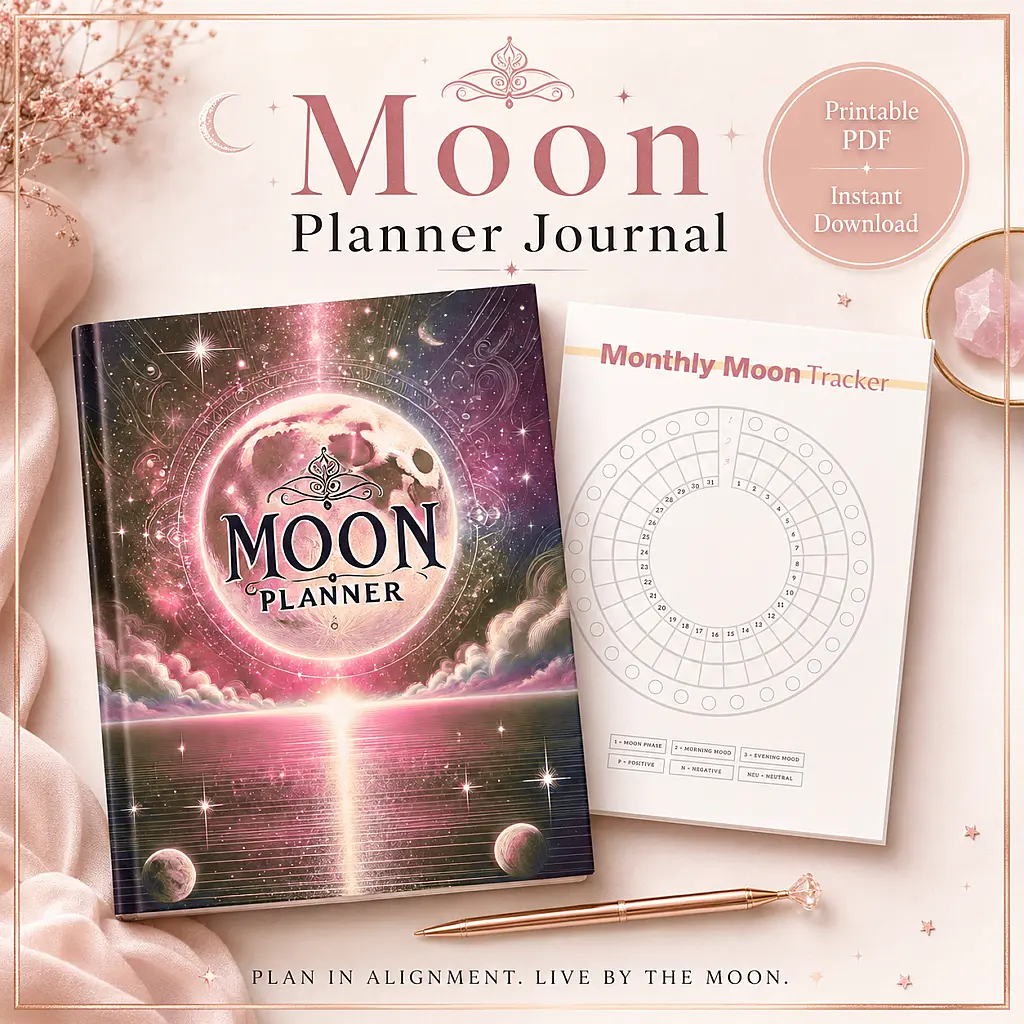
Moon Planner Journal
The Moon Planner Journal can be used to note dates, moods, sleep, routines and personal reflections alongside lunar phases.
A record may help you review your own habits and interpretations over time. It does not establish that a moon phase caused an emotional or physical change.

Crystal Journal PDF, Chakra Guide and Collection Tracker
For empaths: use the journal as a record of personal practice, not as evidence of spiritual or medical causation.
Readers who use crystals or chakras as symbolic practices can use a journal to organise personal reflections.
The Crystal Journal can be used to catalogue crystals and record personal observations about meditation, mindfulness or chakra-based rituals. These notes are personal reflections rather than medical evidence.
Start With Spiritual Wellbeing for a broader collection of articles about spiritual reflection and everyday wellbeing.

About This Guide
Written and edited by Donna and Iain at Feel Better Within. We create practical content about personal change and spiritual reflection for empaths, highly sensitive people and anyone learning to protect their peace in everyday life.
This article is for spiritual reflection, self-care and general wellbeing education only. It is not medical, psychological, legal or professional advice. Persistent, severe or concerning symptoms deserve support from a qualified professional.
Cite or share this page
Want to reference this guide? Please link to the canonical page rather than copying the article.